Random musings on sports, geopolitics, current events, pin-ups and the railroad industry from a rank amateur blogger.
Thursday, February 13, 2014
Today's Train of Thought- Whoa Whoa Whoa Waterloo, Feb 13th, 2014
Today's train of thought takes us to Waterloo, IA where a flood-damaged bridge nearly proved to be a successful shortline's Waterloo- for lack of a better term.
Started up in the 1980s from an abandoned and largely unwanted portion of the bankrupt Rock Island, the Iowa Northern operates more than 160 miles in northern and central Iowa between Cedar Rapids and Manly, IA. Although it's fortunes improved considerably with the advent of the ethanol boom in the mid-2000s, it all came to a grinding halt in June 2008 after an important bridge used by the line collapsed into the Cedar River, cutting off the Iowa Northern from their southern interchange with the Union Pacific, Cedar Rapids & Iowa City, Canadian National and Iowa Interstate. This necessitated lengthy detours across the DM&E and Canadian Pacific of up to 300 miles that increased fuel and labor costs for the line. To make matters even worse, the IANR didn't even own the damaged bridge- it was part of a lightly used former Chicago Great Western branchline now owned by the Union Pacific. The IANR simply exercised trackage rights over the bridge and the UP was in no hurry to repair it.
After much political wrangling, an estimated $5.9 million was secured- including more than $3 million in state and federal funding- for repairs to the collapsed bridge, which reopened in time for the 2009 harvest.
Here, railpictures.net contributor Scott Marsh caught Iowa Northern GP38-2 #3802 trundling across the Cedar River into Waterloo, IA with a southbound freight destined for the IANR's Bryant Yard in the middle of a snowstorm on December 20, 2012. Trailing the #3803 are a pair of rebuilt former Amtrak F40PHs that have seen service on both the Iowa Northern and Montreal, Maine & Atlantic predecessor Canadian Atlantic.
According to the photographer, the storm was in the middle of dumping some 10-12 inches on that part of the Hawkeye State.
Friday, October 25, 2013
Today's Train of Thought- The Rockford Files, October 25, 2013
Today's Train of Thought takes us to the Hawkeye State right around harvest time, not to mention Hawkeyes football season.
While not an Iowa alumni himself, Iowa Northern President Dan Sabin has been operating the Hawkeye Express shuttle, taking fans from a station in Coralville, IA to Kinnick Stadium in Iowa City for Iowa Football home games since 2006.
Besides the seasonal Hawkeye Express shuttle, the 163-mile Iowa Northern earns its keep hauling ethanol, corn, RV parts, grain, fertilizer, windmill components and farming machinery. The ethanol boom of the last decade has been particularly good to the Iowa Northern, although management and most industry observers typically caution against a carrier being overly-dependent on a single commodity. Still, inbound trainloads of grain and outbound unit trains of ethanol keep the Cedar Rapids, IA-based line busy.
Here, railpictures.net contributor James House caught a freshly re-crewed Iowa Northern train powered by GP38-2s #3801 and #3805 accelerating as they leave the town of Rockford, IA on a gorgeous, sunny afternoon on October 5th, 2011.
Even in the heart of corn country, there's still some fall foliage to be seen.
Thursday, September 12, 2013
Today's Train of Thought- Junk Along the Trunk, Sept 12th 2013.
Today's train of thought takes us along the western end of the Vermont Railway system and the tiny burgh of Danby, VT.
There's that old saying 'One Man's Trash is Another Man's Treasure' which seemed to have gained new life after the 2010 debut of American Pickers on the History Channel [the premise, for those of you who have never seen it, is two guys from the Midwest in a van travel cross-country in search or rare an valuable antiques that they hope to sell at a profit at their own shop- NANESB!].
Of course, growing up in New England, I remember that in many cases the only thing that separated hoarders from antique 'dealers' was usually a sign that said "ANTIQUES" out front. The antiques shop shown above in western Vermont might've been one such instance- although the relatively new car out front seems to imply the antique shop was actually open for business and not just a motley collection of rusted junk with a sign in front of it.
The dealer has set up shop in the former Rutland Railroad Danby, VT depot located along what is now the Vermont Railway's B&R line (Bennington to Rutland). This stretch of the Rutland line used to go as far south as Chatham, NY until the 1960s when it was abandoned.
Here, NERail Photo Archives contributor John Bazan braved free range chickens and tall grass to catch Vermont Railway GP38-2 #201 heading south towards North Bennington and the Pan-Am interchange at Hoosack Falls, NY with a mix of grain and limestone slurry in May 2008.
While it seems as though the guys from American Pickers would've had a field day at the old Rutland depot turned antiques shop, the building is no longer standing. It was already in poor shape when Bazan snapped this photo, plus there apparently was drainage issues as well before the depot was finally torn down in 2011.
Thursday, July 4, 2013
Happy Independence Day From Not Another New England Sports Blog!
Although not exclusive to the 4th of July, bikinis and summer seem to go hand in hand.
Mmm....nope. Still haven't wrecked myself.So it was only natural that Kirkland, WA- based online swimwear retailer Bikini Beach became a semi-regular fixture in the town's 4th of July parade [many thanks to Turners and Models for keeping a detailed photographic record of those occasions- NANESB!].
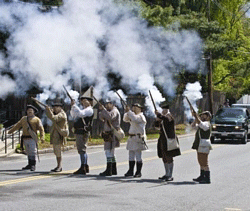
Wait- did the Patriots just score a touchdown?Then there's the parades- growing up in New England, the rich history of the area meant that parades would often feature re-enactors dressed up as minutemen from the colonial era occasionally firing off a volley from their muskets [the AR-15s of their day!- NANESB!]. In parts of the south and Mid Atlantic, re-enacting battles from the Civil War has been popular.
Restored fire truck in Cobleskill, NY's 4th of July Parade. Photo by inkfeather via Flickr.
Of course, throughout the country it seems as though no Independence Day Parade is complete without the appearance of a fire truck. It can be a newer truck with one of the local departments, but often it's a painstakingly restored vintage pumper or ladder truck undertaken as a labor of love and shown off for exactly this occasion.
Having long finished up it's day's work, LLPX former Belt Railway of Chicago GP38-2 #2228 basks in the glow of a fireworks display in Poplar Bluff, MO on July 4th, 2007. Zach Pumphrey photo
And let's not forget the fireworks- no fourth of July seems to be complete without them. People will stake out a spot a few hours in advance and have a picnic or a cookout while waiting for it to get dark enough for the fireworks to begin. People will come from as far as hundreds of miles away to stepping out on their own apartment balconies to take it all in. And when it does, it is usually a sight to behold (usually) and ends with not just a bang, but a series of teeth jarring concussive, car-alarm triggering blasts depending on how close you are.
As a matter of fact, I'm on my way to such a display right now. But I'll leave you with this:
Above all, have a safe and happy 4th of July!
Saturday, June 29, 2013
Today's Train of Thought- The Lake Show, June 29th, 2013
Today's train of thought takes us to Michigan's lower peninsula and gives us a glimpse of one of the few remaining independent regionals in the state.
Operating some 400 miles of track entirely within the state of Michigan, the Great Lakes Central is a fairly recent addition to the shortlines that operate within the wolverine state. In 2006, the Tuscola and Saginaw Bay railway- which was a cluster of former Ann Arbor, New York Central, Grand Trunk Western and Chesapeake & Ohio lines from Ann Arbor, MI to Petoskey, MI- was purchased by Federated Railways, Inc and renamed the Great Lakes Central. While the line has ambitions to operate a commuter rail service in the Ann Arbor area, like most regionals and shortlines, the focus remains on freight.
Traffic for the Great Lakes Central includes plastics, chemicals, coke, lumber, sand, fertilizer, cement and grain and the line interchanges with the Canadian National, Norfolk Southern, CSX, Mid Michigan Rail, Genesee and Wyoming's Huron and Eastern and WATCO's Ann Arbor. Motive power for the Great Lakes Central includes a half dozen former Conrail GP38-2s as well as ten former Tuscola and Saginaw Bay (nee Ann Arbor) GP35s- some of them with ALCo trucks.
Here, railpictures.net contributor Kyle Korionek caught GP38-2s #396 and #397 racing past a venerable grain elevator in downtown Cohoctah, MI on a sunny August 2012 afternoon with an Ann Arbor-bound mixed freight. The train has just finished up doing some interchange work with the Huron & Eastern at Owosso and Canadian National at Durand.
Thursday, February 28, 2013
Today's Train of Thought- Stockholm Syndrome, February 28, 2013
So with that in ming, Today's Train of Thought takes us to the northern plains in the dead of winter- namely Stockholm. Here, railpictures.net contributor Mike Vandenberg caught a trio of BNSF Geeps making their way west over the former Great Northern line through the rolling hills of northeastern South Dakota. GP38-2 #2264 is seen leading local freight L-TWI6711 towards Watertown, SD over the rollercoaster terrain in Stockholm, SD on the last day of 2012.
Wednesday, December 19, 2012
Today's Train of Thought- Donner's Passing Grade, December 19, 2012
Donner Pass has become synonymous with California's rugged Sierra Nevada range, America's westward expansion and cannibalism. It was also one of the operational hurdles the Union Pacific ended up with after their 1996 acquisition of the Southern Pacific.
Some 30 years ago, Union Pacific's only gateway to California was the Los Angeles-Salt Lake City line through Cajon Pass and Las Vegas. That began to change with the 1983 acquisition of the Western Pacific, whose line from Sacramento and the Bay Area cut through the mountains along the turbulent and flood prone Feather River before reaching Nevada and continuing east to Salt Lake City.
By 1996, the Union Pacific had acquired the Missouri Pacific, Missouri-Kansas-Texas, Chicago & Northwestern and Southern Pacific lines. And with the Southern Pacific acquisition came one of the UP's biggest operational headaches west of the Pecos- the Donner Pass line.
That particular stretch of the Sierras was made infamous by the ill-fated Donner Party of 1846 who had to resort to cannibalism after becoming trapped when they were attempting to traverse the Sierras in the winter months. 106 years later, the outcome of the ill-fated Donner Expedition was likely on the minds of some 200 passengers and crew of Southern Pacific's City of San Francisco as it became trapped under some 12 feet of snow and buffeted by wind gusts of nearly 100 MPH- all 196 passengers and 20 crew members were eventually evacuated by highway [an interesting footnote was that an escaped German POW from WWII took part in the rescue despite being on the FBI's most wanted list at the time- NANESB!].
The frequent accumulation of snow along this stretch meant that the SP had to be vigilant about not only clearing the line with plows, but also specially made flanges used to break up snowbanks and snowdrifts before they can become big enough to bring an entire train to a halt- as was the case in 1952 with the City of San Francisco.
Here, railpictures.net contributor Mike Haire caught Union Pacific GP38-2 #572 through a telephoto as it leans into a curve in Cisco, CA on the day after Christmas 2009 with five more EMDs and a flanger in tow- all on their way to Truckee, CA. The units assigned to snow clearing in the Sierras are of Southern Pacific ancestry and some of them were still in scarlet and grey until about five years ago.
Wednesday, October 31, 2012
Today's Train of Thought- Pumpkin Patchwork, October 31, 2012
Take seasonal crops like squash and pumpkins, for instance. Despite the recent disaster that has affected the region, this was a pretty good year for the pumpkin harvest in New Jersey. Growing conditions are usually favorable enough that pumpkins can be grown in every county in New Jersey, from Montague to Cape May. Some of these are grown on family operated farms that offer hayrides or for a fee let you venture out into the field to pick your own pumpkins.
Here, Conrail Shared Assets train WPSA-31 is seen trundling past a pumpkin patch in the bourough of Freehold, NJ. Still in Conrail blue, Norfolk Southern GP38-2 #5286 heads past the field towing some mixed freight the day prior to Haloween in 2008. According to photographer and railpictures.net contributor Andrew Blaszczyk, all the good pumpkins in the field in the foreground had already been picked, leaving just misshapen ones and 'runts'.
Sunday, April 15, 2012
Today's Train of Thought- Apple of My Eye, April 15, 2012

Today's train of thought takes us to the Garden State, whose monicker isn't being used in an ironic or facetous sense this time around.
Although split up by competitors Norfolk Southern and CSX Transportation in 1999, Conrail is technically still around in the form of Conrail Shared Assets operations. Unlike the mainlines belonging to Conrail and their predecessors, Conrail Shared Assets Operations performs switching and the running of local freights on behalf of CSX and Norfolk Southern to prevent either railroad from gaining a monopoly in some of the markets Conrail had prevously operated in. This includes ports and branchlines along the northeast corridor in the Philadelphia and Jersey City area as well as Detroit- although CSX or Norfolk Southern equipment is routinely used.
Here, railpictures.net contributor Gerald Oliveto caught CSX GP38-2 #2577 trundling past some crabapple trees in bloom with a Conrail Shared Assets local freight in the quiet north Jersey burgh of Helmetta, NJ on April 24, 2008. The train originated in Browns Yard in Sayreville, NJ (and still operated by Conrail Shared Assets) and is travelling along the former Pennsylvania Railroad Amboy Secondary, which was once electrified. Although the wires came down sometime in the 1990s, the catenary poles are still standing along the route.
Sunday, March 11, 2012
Today's Train of Thought- Horse Play, March 11, 2012

As predicted back in December by yours truly, snow has arrived in the Jefferson County/Thousand Islands region of Upstate New York. Mind you, this is hardly a bold act of prognostication for a part of the Empire State that annually sees more than 110 inches of the white stuff [imagine how much worse it would be if it weren't for global warming- NANESB!]. There's a reason the US Army's 10th Mountain Division is stationed nearby.
Here, railpictures.net contributor Joe Hance catches CSX GP38-2s #2799 and #2721 trundling north with a short cut of cars at Antwerp, NY with local freight B 778-03 enroute to Gouverneur, NY on a snowy December 3rd, 2008.
The lead CSX geep is showing the the CSX paint scheme known as 'Bright Future' while the trailing unit shows off more utilitarian colors known as 'Dark Future'. As the photographer pointed out- the horse in the foreground simply doesn't care and does its best to go about grazing undisturbed.
Monday, October 24, 2011
Todays Train of Though- Change of Seasons in the Hoosier State, October 24, 2011

Granted New England seems to be more renowned for its fall foliage, but with just the right composition, the Midwest autumn can be just as colorful.
Take for instance this local freight on the Indiana & Ohio's Brookville line in Southern Indiana. Here, railpictures.net contributor Michael Beihn caught GP38-2 #3889 from sister Rail America road Chicago, Ft Wayne & Eastern trundling long hood forward past some late fall foliage in Cedar Grove, IN in November 2009. In most of New England, most of the foliage is typically already on the ground by this point.
The freight shown here is traversing the I&O's Brookville branch which connects the southern Indiana town with the Cincinnati, OH area.
Wednesday, October 12, 2011
Iron Horse Roundup- Yet Another Tropical Storm Irene Cleanup Edition

New England Central detour freight MFMO (Millers Falls, MA- MOhawk Yard, Schenectady NY) preparing to head west at Pan Am's former Boston & Maine yard in East Deerfield, MA on September 8, 2011. Only a stone's throw away from the NECR interchange at Millers Falls, the train will then continue north to Whitehall, NY where it will traverse over the Vermont Railway system via Rutland and north to 'home' rails at Burlington, VT- Photo, Matt BajAs cleanup from Irene continued throughout the Green Mountain state and elsewhere, Class 1 and regional rail carriers were scrambling to accommodate an array of detour traffic over the regions intact lines throughout the month of September.
Canadian Pacific ES44AC GEVO #8780 and a pair of former BNSF SD40-2s blast out of the East Portal of the Hoosac Tunnel in Florida, MA with loaded unit ethanol train MOPW (MOhawk Yard to Providence & Worcester interchange at Gardner, MA)on September 10, 2011. The first car is actually a spacer, while the ethanol tak cars are obscured by the shadows. Photo, Matt RooksThe flurry of activity breathed new life into obscure and long-forgotten junctions and spawned an alphabet soup of new and improvised train symbols on one railway.
Rail America's New England Central got the ball rolling on September 9th with a southbound detour train from Essex Jct, VT that consisted primarily of empty welded rail cars from the track improvement project on NECR's Roxbury and Palmer subdivisions and backlogged freight cars. The detour train (NECR gave it the symbol 323X) would traverse the western end of the Green Mountain state between Burlington and Rutland before heading west to the Canadian Pacific interchange at Whitehall, NY on the Vermont Railway's former Delaware & Hudson's Rutland branch.
Once on CP rails, the detour freight would be handed off to the Pan Am railway at Mohawk Yard just outside of Schenectady, NY. From there, the NECR detour would continue east over the former Boston & Maine Fitchburg Main to the NECR interchange at Millers Falls, MA.
At least one unit ethanol train was rerouted off VRS's Green Mountain Gateway in the wake of Irene. On September 10, Canadian Pacific handed off a 50 car loaded ethanol train to Pan Am at Mohawk Yard. From there, the train would travel as far east as Gardner, MA on the former Boston & Maine line where it was handed off to the Providence & Worcester.

Vermont Railway GP38-2 #303 leads a solid set of red EMDs north out of Crescent, NY after having just swapped cars with Pan Am freight EDSR (East Deerfield, MA to Canadian Pacific's yard at SaRatoga, NY) on September 11, 2011. The Pan Am freight picked up carloads of limestone slurry and handed over ballast cars and empties. Normally, the interchange would take place in Hoosac Falls, NY. Photo, Gary R. Schermerhorn
The B&R line between Rutland and North Bennington, VT was also damaged in the aftermath of Irene. In addition to local lumber and grain traffic, this portion of the Vermont Railway System also hosts a weekly unit limestone slurry train that is handed off to Pan Am in Hoosac Jct, NY and on to Maine from there. Interestingly, the original routing for the slurry train when it first started was over the Green Mountain gateway where it was interchanged with the Pan Am at Bellows Falls before continuing to Maine. The south end of the B&R branch was reopened in recent years to accommodate the slurry train and give the VRS and Pan Am a second interchange point.
Like the NECR detours, the VRS slurry train reached the Pan Am via Canadian Pacific at the Whitehall, NY interchange and used Vermont Railway motive power- although instead of travelling to Mohawk Yard, they apparently met with a Pan Am freight just outside of Saratoga, NY on Canadian Pacific's former D&H Bridge Line.

New England Central GP38-2 #3857 leads a mixed bag of power from other Rail America roads and leasers across the Hudson River on the former Boston & Maine west end in Mechanicsville, NY at dusk on September 16th, 2011 with symbol freight MFMO. This would be the last NECR detour train using the Pan Am routing as the Green Mountain Railway line would reopen to through traffic less than 24 hours later. Photo, John BazanOn September 16, the Vermont Railway's Green Mountain Line re-opened to through traffic between Rutland and Bellows Falls, VT. Not only did this mean that through trains could resume on the former Green Mountain Railway, but that the NECR could utilize a less circuitous detour than the Pan Am and Canadian Pacific lines through Western Massachusetts and Upstate New York while work was continuing on reopening their Roxbury Subdivision north of White River Jct, VT. Instead, NECR trains could travel from New London, CT or Palmer, MA as far north as Bellows Falls, VT before detouring over the Vermont Railway System.
Former Goderich & Exeter GP38 #3843 leads a NECR GP38-2 and Connectictut Southern B39-8 as they lean into the curve at Royalton, VT with New England Central train 323-21 on September 21, 2011. This is the first northbound through train on the former Central Vermont Roxbury Subdivision since Tropical Storm Irene struck. Photo, Kevin BurkholderAfter weeks of clearing fallen trees and moving in train loads of ballast, rip rap and gravel, the NECR line north of White River Jct and south of Essex Jct, VT had been reopened to through traffic on September 21st.
Crews had been working around the clock to reopen both the VRS and NECR lines since late August. The final NECR work train reportedly ran north out of White River Jct. on September 25 with a Florida East Coast GP40-2 (ironically, with the 'Hurricane' logo on the hood) and a NECR GP38-2 followed by 9 cars of rip rap to shore up repairs made along the line.
While most of VRS's Washington County Railway line between Newport, VT and White River Jct survived Irene, the trestle across the White River itself was undercut when floodwaters twisted one of the stone piers supporting it, causing the deck to drop almost 6 feet our of alignment. Crews have erected a temporary support system and will replace the damaged piers with a concrete pillar. The bridge might be carrying trains as early as this week. Since the warped trestle isolated the WACR's Connecticut River Division from the rest of the Vermont Railway system, the WACR has been borrowing a Montreal, Maine & Atlantic B39-8 to service the line south of the MM&A interchange in Newport.
Sunday, September 25, 2011
Today's Train of Thought- Encounter At Eagle Bridge, September 25, 2011

Today's serendipitous Train of Thought takes us to a rural corner of Upstate New York that seems frozen in time on this particular date.
Sharing a name with the nearby Batten Kill creek, the quixotic Batten Kill Railroad was formed in the early 1980s to take over operations from the shuttered Greenwich & Johnsonville and the Southernmost 20 miles of the former Delaware & Hudson 'Slatepicker' line between Eagle Bridge, NY north to Castleton, VT. Besides operating some seasonal excursion trains, the Batten Kill might be best known for being the first railroad owned and operated by an African-American.
The rural line trundles its way through Washington County, NY, paralleling the Vermont state line for much of the way. From day one, motive power for the Batten Kill was a pair of Schenectady-built ALCo RS3s, the newest of which was built in 1952. For the last 30 years, traffic has mainly consisted of feed and grain to an elevator at Greenwich Jct. NY, although in recent years, the BKRR has also made some money storing idle flatcars around Salem, Greenwich Jct and the company headquarters in Greenwich.
The Batten Kill's link to the rest of the North American rail network is at the village of Eagle Bridge. Although the D&H had abandoned the Slatepicker line north of Salem in the 1970s and sold off the southern portion to the Batten Kill, they retained trackage rights over Boston & Maine (now Pan-Am's) Fitchburg Division between Mechanicville, NY and Eagle Bridge to interchange with the Batten Kill. Although both the B&M and D&H were supposedly indistinguishable under the Guilford umbrella, that changed in the late 1980s when the financially struggling Guilford divested themselves of the D&H. After a few years in which the New York, Susquehanna & Western was named the designated operator of the D&H, the Canadian Pacific purchased the D&H in 1991, and this whole time the D&H still retained their trackage rights over the Guilford/Pan-Am line to reach the diminutive Batten Kill.
And with that in mind, we get a glimpse of the Batten Kill's RS3 #4116 (ex D&H, same number) Still in G&J paint as it trundles by parked Delaware & Hudson GP38-2 #7312 with a cut of 5 cars at the Eagle Bridge, NY interchange. From all appearances, Railpictures.net user Gary R. Schermerhorn could've captured this scene shortly after Ron Crowd purchased the ex-D&H line in 1982. However, this fortuitous find actually took place in May 2009, some 27 years after the founding. It's not commom practice for Canadian Pacific the leave their power overnight on another line, but according to the photographer, a fallen tree blocked the #7312 from reaching the Pan-Am line and returning back to Saratoga Springs, NY. With the tree removed, the EMD sporting the blue and grey lightning stripe scheme is awaiting a new crew for its nocturnal return to Saratoga Springs NY with local freight D44. Meanwhile, the #4116 will trundle north to the grain elevator at Greenwich Jct.
The Boston & Maine/Guilford/Pan-Am line is out of view and to the left of the trees on the left hand side of the photo.
Wednesday, August 10, 2011
Today's Train of Though: Distant Signals- Aug 10, 2011
Today's train of thought takes us to the Green Mountain State and what amounts to a newly reconstituted Rutland. After years of operating losses and labor disputes since the end of World War II, the Rutland Railway shut down operations in May 1963. With the Rutland's abandonment and shutdown leaving much of the state of Vermont without Rail service, the state of Vermont stepped in and in 1964 awarded the Burlington to North Bennington, VT section of track to the Vermont Railway and the Rutland to Walpole, NH to the Green Mountain Railroad. The lines south to Chatham, NY and west to Malone, NY were ultimately abandoned- although the trackage from Ogdensburg, NY east to the New York Central interchange at Norwood, NY remained intact.
Both the Green Mountain and Vermont Railway managed to exist separately, with the Green Mountain trying to get by on seasonal excursions and bridge line traffic between the Boston & Maine and Central Vermont on one end and the Vermont Railway and Delaware & Hudson on the other.
Meanwhile, the Vermont Railway was gradually expanding while hauling feed, lumber, marble, grain, wood chips, limestone and oil. In 1972, the VTRR took over control of the little marble-hauling shortline Clarendon & Pittsford. A little over a decade later, the VTRR would go on to purchase the former Delaware & Hudson Whitehall, NY branch between Rutland, VT and Whitehall, NY. This line would be operated under the Clarendon & Pittsford name, although thanks to a prolonged strike on the Guilford/Delaware & Hudson lines in 1986, traffic on both railways would take a hit.
Fortunes for both railroads seemed to improve heading into the 1990s. To the west, Canadian Pacific managed to acquire the Delaware & Hudson after Guilford transportaiton divested themselves of the line. To the east, Canadian National sold off their Central Vermont subsidiary to RailTex to form the New England Central. For the Green Mountain, additional online traffic in the form of limestone and fly ash began to materielize as well as more favorable interchange partners on each end.
By 1997, the Vermont Railway had paid back the State of Vermont for the former Rutland lines and began consolidating operations with the Green Mountain. Two years later, they took over operations of the struggling Washington County Railroad which operated between Barre Jct, Vt and the state capital of Montpelier. That year, the state also acquired the lightly-used Boston & Maine line north of White River Jct. to Newport, VT and eventually leased the line to VTRR (operating as the Washington County RR) after the previous operator, Iron Road Railways, went bankrupt.
But to this day, the Green Mountain line between Rutland and White River Jct. remains the linchpin of the Vermont Railway system, with the shift in operators still providing ample bridgeline traffic, with the Providence & Worcester (by way of the New England Central) being the latest to move cars in and out of New England through the Green Mountain gateway. Some of the more recent commodities to appear on the VTRR/GMRC rails include coal, limestone slurry and ethanol- the latter two moving in dedicated unit trains.
Railpictures.net contributor Tim Stockwell catches Clarendon & Pittsford GP38-2 #204 is seen trundling past the abandoned Ludlow, VT station on the Green Mountain line, heading back to Rutland with train #264 with a mixed bag of freight on a sunny May 2010 afternoon. Although inactive, the station still sports the intact blades from a semaphore signal.
Friday, July 15, 2011
Today's Train of Thought- A (Gypsy) Rose by Any Other Name; July 15 2011
With a name like Lancaster & Chester, you would expect today's Train of Thought to highlight a bucolic shortline running through Pennsylvania Dutch Country. While the countryside the L&C runs through can be described as bucolic the railway actually runs through the northern reaches of the Palmetto State.The L&C, also known as the Springmaid Line, started up from an 1877 charter to build a 29-mile rail line connecting Chesterfield and Chester counties. Given the inevitable changes that the larger carriers the L&C interchanged with over the last century, operations along the Springmaid Line itself was relatively unchanged until the last decade or so.
However, under the tenure of Elliot White Springs in the 1950s, the shortline embarked on a series of flamboyant and tongue-in-cheek promotions including appointing 29 different Vice Presidents- one for each mile of track.

Perhaps the most memorable was when striptease artist and burlesque entertainer Gypsy Rose Lee (above) was named Lancaster & Chester's 'Vice President of Unveiling'. The railroad also offered a fictitious menu for a number of entrees served on their nonexistent passenger trains, including items like 'Split Dixiecrats with Frozen Assets' or 'Back Bay Trollops with Harvard Accent'- despite the fact that the L&C didn't even own a dining car.
Over the years, traffic has consisted of coal, textile products, aggregates, fertilizer, wood products, sand and fiberglass, with a stable of powder-blue EMD end cab switchers doing most of the heavy lifting throughout much of the L&C's diesel era.
In the late 1990s, JP Henderson Inc set up shop on L&C property and began extensively refurbishing and restoring passenger cars. In 2001, the L&C entered into a lease agreement with the Norfolk Southern to begin operating additional trackage in Lancaster County between Catawba Jct and Kershaw. The expansion meant additional motive power for the L&C- first a pair of SW1200s followed by a pair of SW1500s.
However, in addition to borrowing some LLPX loaners the L&C made their first ever purchase of EMD roadswitchers with the purchase of a couple of ex Norfolk Southern (nee Conrail) GP38-2s that were eventually painted in Lancaster & Chester's powder blue scheme and lettered for the Springmaid Line.
In late 2010, the it was announced that Tenessee-based Gulf & Ohio railways would acquire the L&C. The Gulf & Ohio operates the Yadkin Valley and Laurinburg Southern just up the road in North Carolina. In June of this year, the G&O began sending motive power to the L&C starting with a former Kansas City Southern GP38-3. Apparently the plan is to replace the LLPX locomotives with power from other G&O operations as their leases expire.
Bringing us to the very top of the page, railpictures.net contributor Joe Hinson caught a trio of L&C GP38s working the Norfolk Southern interchange at Chester, SC in May 2011. The third unit in the consist is apparently one of the LLPX loaners still on property, although it's difficult to say if it was obscured by design on the photographer's part.
Thursday, May 5, 2011
A Cinco De Mayo Train of Though- Beauties and (High Horsepower) Beasts South of The Border, May 5 2011
It's that time of year again- the 5th of May is an opportunity for As romanticized as the tale of an underdog, poorly trained peasant army beating back a numerically superior foreign military making incursions into their country can be, there are a few common misconceptions about Cinco de Mayo and the Battle of Puebla here in the USA.
First and foremost, this is not Mexico's independence day. I'm pretty sure this topic has come up before on this blog, but I thought it would be worth revisiting. Mexico fought a decade-long war against Spain between 1810 and 1821, while the Battle of Puebla would take place some 40 years later against Napoleonic French troops. Mexico's independence day is actually observed on September 16 each year and is in fact a bigger occasion than Cinco de Mayo, which is mostly celebrated in the state of Puebla.
Second is that while the Battle of Puebla was a remarkable setback for Napoleon III's Army, French forces were able to overwhelm Mexico later on that year and install Austrian archduke Ferdinand Maximilian as Emperor Maximilian I of Mexico beginning in 1864. However, that wouldn't last very long as he was deposed by an army led by Benito Juarez in 1867 and was executed by firing squad. Puebla, the capital of Puebla state southeast of Mexico City also became home to the Mexican National Railway Museum.
Construction on Mexico's railways began shortly before the French Intervention and Battle of Puebla, with an emphasis on completing a line between Mexico City and the Gulf of Mexico port of Veracruz. Other lines radiated north out of the nation's capital, bankrolled by US, Mexican and European interests and linking the resource-rich nation with the US Border and ports along the Pacific Ocean and Gulf of Mexico. However, the network would deteriorate considerably during the Mexican revolution and be incrementally nationalized between 1929 and 1937.
It would take some 60 years for the Mexican government to follow through on privatization. In 1997, the government run Ferrocarriles Nacionales de Mexico (FNM) ceased passenger operations and was divided up. Much of the track to the north and west of Mexico City (as well as the Ferrocarril Sonora-Baja California and Chihuahua al Pacifico lines) went to Grupo Mexico's [BMV: GMEXICOB] FerroMex while the mainline between Mexico City and Nuevo Laredo to the north, Lazaro Cardeans to the South and (eventually) Veracruz to the east went to Transportes Ferroviaria Mexico, a joint venture between Mexico's Grupo TMM [NYSE: TMM] and Kansas City Southern [NYSE: KSU], although Kansas City Southern gained a majority stake in 2005 through it's KCS de Mexico subsidiary.
FerroSur, owned jointly by billionaire Carlos Slim's Grupo Carso [BMV: GCARSOA1] and Financiero Inbursa SAB [BMV: GFINBURO] would gain most of the trackage south of Mexico city, but in 2005 it would be acquired by a GrupoMexico subsidiary with the intention of merging it into FerroMex. Since this would give FerroMex a near monopoly, KCS de Mexico understandably objected and the matter was tied up in litigation until earlier this year when a tribunal from Mexico's Federal Competition Commission ruled in favor of GrupoMexico (but allowed KCS de Mexico to operate into Guadlajara via trackage rights on FerroMex).
While privatization has no doubt improved motive power, rolling stock, physical plant and right-of-way south of the border, like many other seemingly everyday activities in contemporary Mexico, railroading carries an element of risk to it.
With Mexican law enforcement tied up attacking drug cartels, free-lance crime gangs have become more daring and sophisticated, hijacking trucks and trains and stealing massive loads of steel, coffee and beans.Illegal immigrants from Central America also attempt to hop rides on freight trains on their way to try and cross the into USA. Besides the risk of injury or death from falling off the train, there's also the hazard posed by railroad and federal police demanding bribes and Mexican gangs who have demonstrated a willingness to rob, rape and murder the migrants transiting through territory they control.
These gangsters are armed not only with guns but heavy machinery to unload industrial materials and bulk agricultural goods, deftly passing them off to the black market.
Mexico's third largest steel producer, Altos Hornos de Mexico, or AHMSA, has been victim of nearly 40 robberies since January 2008,
"This wasn't happening before," AHMSA spokesman Francisco Orduna said.
"To unload a 30-tonne roll of steel is complicated," he said. "Not just anyone can do that and to find someone who will buy that amount is not that easy either. You have to be really well organized."
Mexico's steel chamber said robberies skyrocketed by 250 percent last year, as 12,500 tons were carted off by thieves, sometimes truck and all. Losses totaled 150 million pesos ($11 million) in 2008 and have continued as a fast clip this year.
The robberies are raising the cost of doing business in Mexico as companies hire guards, expensive security consultants and specialized satellite positioning devices to track cargo.
Using intelligence gathered from employees either intimidated or paid off to leak transport routes, the well-connected groups can hijack a truck making a pit stop, empty out the cargo and dump the driver on an abandoned road.
Gerardo Bortoni, who heads an association of truck drivers in Monclova, said the thieves hand products over to corrupt businessman while authorities turn the other way.
"They are stealing everything, coffee, cacao, pistachios. Before it was just sporadic now its very common. We're afraid to haul a lot of products," he said.
Due to the murky nature of the crimes, it is unclear who the customers are for the stolen goods but Bortoni said in the case of steel, buyers would need the capacity to process raw materials. Wholesalers say stolen food products will show up at the same markets they were taken from, just at a lower price.
Grupo Mexico, which operates Ferromex, one of Mexico's main railroads, set up a system to pay government security forces to guard their trains after a spike in thefts.
In a series of hijackings late last year, bands of dozens of people, armed sometimes with machetes and rocks, sacked entire trainloads of corn and beans.

Southbound trains, however, are less likely to suffer from that problem. Here, railpictures.net contributor Alfonso Chumacero caught FerroMex C30-S7 #3745 on the point of a southbound freight chugging southbound out of the town of Acaponeta in Nayarit state on April 4, 2007 with train FXE 3745. The big 3000 HP GE on the point, a former Ferrocarriles Nacionales Mexico unit, is still wearing the faded two-tone blue of the final few years of FNM's existence.
As a bonus- and to demonstrate that it's still possible to travel by train in Mexico without a peril fraught journey, there's Chihuahua al Pacifico's Copper Canyon excursions between Los Mochis, Sonora and Chihuahua. From the state capital in Chihuahua, the line actually continues north-east to the border crossing at Ojinaga/Presidio, TX and on to Alpine, TX and points north-east via FerroMex subsidiary Texas Pacifico (although the bridge across the Rio Grande was damaged by fire and knocked out of service in late 2008). The Copper Canyon segment wasn't completed until 1961 owing to the on-again off again political instability in Mexico as well as the extremely remote and difficult terrain.Here, enigmatic Railpictures.net contributor E Hames ModelFan has caught in his lens the angular and sturdy lines of FerroMex GP38-2 #2017 in the siding with a Copper Canyon excursion train at Divisadero, Chihuahua in October 2005complimented by some enticing curves closer at hand. The two lovely women in the foreground are identified as models from Playboy Latinoamerica, reportedly preparing to film a travelogue about the Copper Canyon.
Even without the alluring latina models (who, admittedly make a good thing even better) the Chihuahua Pacifico Copper Canyon passenger train is considered one of the world's premiere railroad excursions.
Monday, April 11, 2011
Today's Train of Thought- Tilting at Texas-Sized Windmills, April 11, 2011
The railroad- owned by Mexican copper mining corporation Grupo Mexico [BMV: GMEXICOB] runs some 375 miles from an interchange with the Ft. Worth and Western and BNSF in San Angelo Jct, TX past an interchange with the Union Pacific at Alpine, TX and on through to the Mexican border at Presidio, TX. Texas Pacifico is supposed to interchange with the privatized Mexican carrier (and parent company) FerroMex at the Presidio/Ojinga broder crossing, but the bridge across the Rio Grande was heavily damaged by fire on the Texas side in 2008.
The line originally started out as the Kansas City, Mexico & Orient and work on the line between Wichita, KS and Alpine, TX got underway in 1900. After multiple bankruptcies, the KCM&O was acquired by the Santa Fe in 1928, who in turn completed the line between Alpine and Presidio a few years later. On the Mexican side, difficult terrain and nationalization saw to it that the line from the Mexican border town of Ojinga on through Chihuahua and the port of Los Mochis wasn't completed until 1961.
On the American side, Santa Fe sold the line to a group of Dallas-based investors and the Texas Department of Transportation in 1992, leading to the creation of the South Orient Railroad. In 2005, TXDOT reached a lease and operating agreement with Grupo Mexico and Texas Pacifico to operate the line. So even though the Texas Pacifico is operated by Mexican concerns, it remains cut off from Mexico itself for the time being.
Instead, Texas Pacifico has been pivotal in delivering tower assemblies for a windmill farm outside of Ft. Stockton, TX that opened up in late 2008. Here, Whiskey caught one such high and wide move making its way west from San Angelo Jct in December 2007 with former UP/Chicago & Northwestern (now CIT Financial) GP38-2 #403 in charge of the 5 unit 7,000 foot train. The train is seen above crossing the Concho River trestle in San Angelo, TX, moving at a maximum of 10 MPH according to Whiskey.
Here, the unit train is seen leaning into a curve near Harriett, TX that same day. The train would tie down outside of Barnhart for the night. The locomotives are GP38-2s loaned from either CIT Financial or FerroMex- with all the CIT ones still sporting Chicago & Northwestern's yellow with green trim paint scheme.
Friday, December 24, 2010
Today's Train of Thought- Frosty the Flagman; Dec 24, 2010
What is it about the unassuming western Michigan shortline Marquette Rail that seems to draw photographers to it? Especially in the wintertime.....For the last few years, Marquette rail has operated an annual Santa Train over its line making stops in Manistee, Sparta, Comstock Park and Baldwin among other towns. The train will stop with Santa on board to help distribute candy and even Christmas trees to children and a few families along the line.
Here, railpictures.net contributor John Ryan caught the Santa Train- powered by GP38-2 #2635- approaching a snowman in the tiny village of Fountain, MI on the night of Dec. 11th 2010 after the sunset hours.
If Frosty the Flagman could talk, I'm sure he'd be saying 'Merry Christmas!'
Sunday, December 19, 2010
Today's Train of Thought- What Global Warming? Febuary 2nd, 2010
Railpictures.net contributor raylewis braved the elements for this shot of Union Pacific GP38-2 #600 traversing the former Southen Pacific main line through the Sierra Nevadas on a snowy April 2006 day. Here, the 600 and another GP38-2 have a flanger with them to clear up any snowdrifts that have accumulated along the line. The two locomotives and snow-clearing equipment are seen passing through Soda Spring, CA.Clearing snow from the Donner Pass line can be a full-time undertaking. More than a half-century earlier, this section of the Southern Pacific line played host to a snowbound City of San Francisco streamliner with 226 passengers and crew in January 1952.
Thursday, December 9, 2010
Today's Train of Thought- Swan Lake Creek, December 9, 2010

With the calendar turning to December (already? where did 2010 go?) today's train of through brings us back to a wintry scene on Michigan's lower peninsula.
Here, Railpictures.net contributor Jim Thias caught GMTX Leasing GP38-2 #2652 leading what's pretty much the entire Marquette Rail fleet northbound on Grand Rapids to Baldwin, MI train Z151 as it's getting ready to duck under Route 82 outside of Newaygo, MI on February 27, 2010.
With a fresh snowfall on the ground (as well as the trees and rails) and 100+ freight cars, the train needs all the traction it can get out of the mixed bag of leased GP38-2s and SD40-2s. The leading unit is still painted in Conrail blue with 'Conrail Quality' lettering still visible on the hood, while the trailing unit is identified as Marquette Rail SD40-2 #3001- the only unit to be painted in the railway's colors so far (some of the leased GP38-2s have a Marquette Rail logo applied to their front hood, but nothing as distinct as the 3001's paint scheme).
The swan in the creek to the right seems oblivious to the locomotives roaring past as it continues paddling away.