Showing posts with label GE. Show all posts

Sunday, January 25, 2015

Today's Train of Thought- Happy Australia Day! Jan 25th, 2015


Today's Train of Thought takes us (where else?) Down Under to Australia.

While railways elsewhere in Australia were something of an amalgamation of different gauges and engineering techniques [that apparently weren't brought to a single national standard until the 1980s- NANESB!] the iron-ore railroads of Western Australia's Pilbarra region operate some of the biggest trains in the world in some of the most inhospitable terrain on earth.

One of the first iron-ore lines in northwestern Australia was the Hammersley Iron line between the port of Dampier and the then newly-opened Tom Price mine more than 300km inland back in 1966. Japanese manufacturers sought massive quantities of iron-ore from the Pilbarra region and in no time, 230+ car trains of iron ore began winding their way from mines in the unforgiving interior to waiting vessels in Dampier. To the east, a competing iron-ore railway called the Mount Newman Railway was under construction and by August 1969 saw the first iron-ore trains on its rails.

Much more recently, Fortescue Metals Group sought rail service their Cloud Break mine and Port Hedland some 250 miles away. Before spending more than A$2 billion on a mew line, Fortescue sought access to Cloud Break by way of obtaining trackage rights on BHP Billiton's Mt Newman line. However, that faced legal challenges and Fortescue ended up building their own iron-ore line to Port Hedland, with work completed by 2008.

Meanwhile, like railroads in the US, the other western Australia iron-ore rail lines were subject to mergers and consolidations [although unlike the boom and bust cycles in the USA, the Aussie lines have seen steady growth since opening up- NANESB!] and the original Hammersely iron line came under the control of multinational Rio Tino.

Here, railpictures.net contributor Sean McGarraghy caught Rio Tinto ES44AC #8185 on the point of a northbound ore train as it makes its way through Millstream-Chichester National Park on its way to Dampier on May 14th, 2014. These massive trains routinely exceed 230 cars and often require additional power in the middle of the train.


While on the subject of Australia, the Miss Universe pageant was on Sunday. While Miss Australia, Tegan Martin, made the final cut of 10, the grand prize was awarded to Miss Colombia.

Friday, October 31, 2014

Today's Train of Thought- Throroughbreds and Pumpkins, Oct 31st, 2014


Today's Train of Thought takes us to a pumpkin patch rural central Pennsylvania that just happens to abut the former Pennsy mainline between Pittsburgh and Harrisburg, PA. Here, rrpicturearchives.net contributor Rick Erben caught Norfolk Southern C40-9W #9978 leading a motley lashup- including an SD60I, an SD40-2, a GP38-2 still in Conrail blue and a C39-8- as it leads an eastbound manifest through the quiet Juniata County village of Mexico on Oct 21st, 2010. The pumpkins in the foreground still have a few days to be scooped and made into jack-o-lanterns or pies in time for Halloween that year.

Sunday, August 24, 2014

Today's Train of Thought- Limited Commercial Interruption, August 24th, 2014


Today's Train of Thought takes us to the Land of 10,000 Lakes- specifically, the gritty commercial, industrial, agricultural and transportation hub that is the Twin Cities.

In this era where seemingly every shortline, regional or industrial switching outfit is affiliated with conglomerates such as Genesee & Wyoming, WATCO or Omnitrax, a shortline operator that doesn't fall under that umbrella is something of a rare find. This is especially true of big-city terminal, transfer or switching roads such as the Minnesota Commercial. Back before there were more than six Class One rail carriers in the United States, the burdensome task of dragging cars from one classification yard to another or switching local industries along the way often fell to entities that jointly owned by the rail carriers serving a given area.

A few such examples exist today- Chicago has the Belt Railway of Chicago, St Louis has the Terminal Railroad Association of St Louis and since 1987, the Twin Cities has had the 150-mile Minnesota Commercial. Going by the MNNR abbreviation, the Minnesota Commercial was the successor to the Minnesota Transfer Railway which was at one time jointly owned by robber barons and fallen flags alike- the Northern Pacific; Chicago, Burlington & Quincy; Milwaukee Road; Chicago & North Western; Rock Island; Soo Line; Chicago & Great Western; Minneapolis & St Louis and Great Northern. By 1970, more than half of these railways would find themselves part of the Chicago & North Western or the newly-formed Burlington Northern. Most of the MNNR's trackage is within Hennepin county and includes numerous spurs, branches and yard tracks. By 1987, when the Minnesota Transfer was reorganized as the Minnesota Commercial Railway, the Rock Island had dissolved and the greatly-truncated Milwaukee Road had been taken over by the Soo Line.

Since the late 1990s, ownership of the MNNR has been more or less divided up between the four remaining Class 1 rail carriers that serve the Twin Cities- BNSF, Canadian National, Canadian Pacific and Union Pacific. The MNNR interchanges with all four of those plus regional Twin Cities and Western in St Paul. The Minnesota Commercial also has something of a following among rail enthusiasts for its tendency to utilize oddball power, such as ALCos, MLWs or rebuilt GEs or EMDs. To this day, a pair of locals serving an industrial park on the north end of the MNNR reportedly utilize a pair of former Green Bay & Western ALCo RS27s.

More recently, the MNNR has moved towards adding older four and six-axle GE roadswitchers onto their roster- including the Santa Fe-rebuilt U36C, reclassified as the SF30C [other examples can be found in Brazil and Mexico- NANESB!]. And like nearby shortlines such as the Wisconsin Northern or St Croix Valley, traffic has heated up in recent years thanks to the oil and gas industry's appetite for frac sand from the upper Mississippi River valley.

Here, Minnesota Commercial SF30C #50 is seen with an MNNR MLW M630 and another 6-axle GE as it charges through the Westminster area of St Paul, MN with more than 100 gondolas of wet sand in tow on the BNSF Midway Sub on May 9th, 2012. According to photographer Brian Kays, the unit sand train also required two B23-7s as mid-train helpers as the Texas bound sand train scaled the line out of the Mississippi River Valley.

Sunday, July 20, 2014

Today's Train of Thought- MRS Dash, July 20, 2014


Today's Train of Thought takes us to Brazil one more time [at least until the 2016 Summer Olympics- NANESB!] and features a scene that's reminiscent of a gritty, larger-than-life Lionel trainset- only instead of running under a Christmas tree, this scene takes place in one of Brazil's highest cities.

One of the other major private companies to form after Brazil privatized their rail network is the 1000 mile MRS Logistica [in which VALE mining owns 40%- NANESB!]. While not as big as the other privatized systems in Brazil, MRS links the key population centers, ports and transportations hubs such as Rio de Janerio, Belo Horizonte and Sao Paulo.

Shortly after its 1997 formation, MRS inherited a number of diesels from the state run RFFSA including SD18s and SD38Ms, some of which were built under license by Spain's MACOSA in the late 1960s. A number of these units still soldier on in yard or Maintenance of way service for MRS.

Here, railpictures.net contributor Michael R Silva caught the engineer for light power led by MRS Logistica C36-7M #3860-4 leaning over the talk with a crew member on board SD38M #5111-2 on the point of a passing freight train through Barbacena, Minas Gerias.

Besides being situated on the Rio to Brasilia BR-040 highway, Barbacena was once the junction of the narrow gauge Estrada de Ferro Oeste de Minas line and standard gauge lines. The burly six-axle GE began life in 1979 as Santa Fe #8078 while the 5111 was constructed in 1967.

Wednesday, July 2, 2014

Today's Train of Thought- Canadian Club, July 2, 2014


In [slightly belated] honor of Canada Day today's Train of Thought takes us north of the border to Ontario for something of a throwback that is distinctly Canadian.

The GMD 1 was manufactured by Canada's GM subsidiary starting in the late 1950s and initially found only two buyers- the Canadian National and the Northern Alberta Railways [which was absorbed into the CN system in 1981- NANESB!]. Unlike the ALCo, MLW or EMD end-cab switchers of the time, the GMD1's slightly off-center cab and overall body style was more reminiscent of the ALCo RS1 than any EMD product. The uniquely Canadian units spent much of their service life toiling away on isolated prairie branchlines in Manitoba and Saskatchewan, hauling grain over rail too light for most other locomotive types on the CN roster at the time.

Beginning in the late 1990s, the Canadian National underwent privatization and began divesting themselves of some of the marginal prairie branchlines while acquiring American Class 1 or regional lines such as the Illinois Central or Wisconsin Central. While Canadian National began retiring and selling off a number of the 1200 HP GMD 1's as switchers for quarries, grain elevators and even Cuba's national railways.

Still, a number of the distinctive GMD roadswitchers not only remained on the CN roster, but were put into service systemwide as yard switchers or powering local freights after the prairie lines had been largely abandoned or sold off.

Here, railpictures.net contributor Ryan Gaynor- aka LocalRailfan- caught Canadian National GMD 1 #1444 out on the mainline in Dundas, Ontario on July 6th, 2012. Here, the #1444 and CN GP38-2W #4776 are seen pushing hard on the rear of Toledo, OH to Toronto mainifest freight, Train 385.


The head end power [a CN C44-9W, C40-8 and GP9R] was having a difficult time ascending the Niagara Escarpment on the line between Niagara Falls and Toronto and the #1444 and wide-cab GP38 were summoned from nearby Aldershot Yard to assist the heavy manifest freight up the grade. Fortunately, LocalRailfan has video evidence of this CN freight's epic struggle against gravity on his YouTube channel.

Not only is the power [both head-end and tail-end- NANESB!] increasingly rare and unique, so are manned helpers on Class 1 lines such as the CN. Lately, railroads prefer to tackle difficult terrain using strategically distributed power (DPUs) that can be controlled from the lead units

Saturday, June 14, 2014

Today's Train of Thought- We're Not in Kansas Anymore, June 14, 2014


In honor of the 2014 World Cup, today's Train of Thought takes us not just South of the Border, but south of a couple of borders all the way down to Brazil.

Between 1957 and 1999, most of the rail network in Brazil was operated under the authority of the state controlled RFFSA. The size and scope of railroading in Brazil range from antique streetcars in Rio to some of the world's heaviest trains operating in the northeastern part of the country. Starting in the late 1990s, various lines were privatized and sold off to outfits such as MRS Logistica, Ferronorte, Ferrovia Centro Atlantica, ALL Logistica and VALE SA mining [the lions share of the lines in northern Brazil have been incorporated as part of VALE's considerable mining operations- NANESB!].

Brazil's economic growth in recent years has been so rapid that the various private operators- who have a taste of GE and EMD power- couldn't wait for new power to be built and purchased hundreds of secondhand EMD and GE locomotives from US Class 1's such as CSX, BNSF, Conrail, Norfolk Southern and Union Pacific. Many of these locomotives were pressed into service so rapidly that a number of them were still painted in the colors of their former owners, despite being a hemisphere away.

Some of the power now in Brazil included models and rebuilds that were unique to their previous owner- such as the SFC30, which were Santa Fe U36Cs rebuilt using components from C30-7s and C39-8s in the 1980s. The SF30Cs soldiered on with the Atchison, Topeka and Santa Fe through the time of the merger with BNSF where they were traded into GE for newer Dash Nines or returned to lessor. Sensing the trade-ins still had some mileage on them, the leasing companies began shopping the SF30C and other GE trade-ins to shortline and regional lines- the Minnesota Commercial purchased a few, but the majority ended up in South America on any number of the privatized lines.

Here, railpictures.net contributor Lucas MR caught FCA [Ferrovia Centro Atlantica- NANESB!] SF30C #4718 smoking it up along with other heavy-duty, 6-axle GEs as it leads FCA train U57 out of the yard at Canguera, Sao Paolo state on January 19, 2013. The tracks in and out of Canguera are dual gauge, meaning that both standard gauge and narrow gauge trains can operate into the yard.

Saturday, November 2, 2013

Today's Train of Thought- Attention All Shoppers, November, 2013


Today's Train of Thought takes us to Little Rhody and features one of the few freight carriers for America's smallest state- although in this instance, it isn't hauling freight.

In addition to coal, aggregates, ethanol or construction debris [not to mention ingredients for that yummy Polar Birch Beer- NANESB!], the Providence & Worcester also frequently hauls excursions on its mainline between its two namesake cities. These include the Christmas-themed 'Polar Express' excursions as well as trips to the Roger Williams Park and Zoo in Providence and fall foliage runs.

Here, rrpicturearchives.net contributor Alan Jenks caught P&W B39-8 #3908 heading southbound with a fall Shopper's Special returning from Putnam, CT on October 20, 2012. The train is on the last leg of its return journey to Cumberland, RI as the leaves on the trees trackside showcase an almost prototypical New England fall afternoon.

Sunday, October 6, 2013

Today's Train of Thought- Goodbye Mr. Chips, Ocotber 6th, 2013


Today's Train of Thought takes us to the southwest corner of Old Dominion and gives us a pretty good glimpse of the supply chain for some of those yummy snacks we seem to enjoy.

Here, railpictures.net contributor Mike Pierry Jr caught Norfolk Southern B32-8 #3550 in charge of NS local V19 on July 23, 2013. The burly GE has a cut of tank cars loaded with vegetable oil for the Shearer's Foods potato chip facility in Bristol, VA.

While Virginia is no Idaho or Maine, it does grow its own potato crop, some of which was just brought in by the Freightliner seen in the foreground. According to the photographer, once the truck pulls out, a batch of hydraulic rams will lift the trailer and discharge to potatoes. Once inside, they will be cleaned, skinned, sliced and united with the contents of the tanks cars on the Norfolk Southern train.

Saturday, August 24, 2013

Today's Train of Thought- Way to Go Ohio, Aug 24th 2013

Today's Train of Thought takes us to the verdant fields in the eastern corner of the Buckeye State.

Referred to in tourism literature as the 'Little Switzerland of Ohio', Sugarcreek, OH is known for its gently rolling hills, Amish and Swiss background and until a few years ago, the home of Ohio Central's steam program. The public excursions stopped with the Genesee & Wyoming acquisition of the Ohio Central. However the OHCR's previous owner, Jerry Jacobson, retained his considerable collection of former Ohio Central steam locomotives as part of the deal.

Not only did Jacobson retain his steam fleet, he also had a roundhouse constructed from scratch to house everything. Although he made it clear from the outset that he wouldn't be operating excursions out of Sugarcreek like before, the steam locomotives housed in what would be called the Age of Steam roundhouse would be made available to other scenic and tourist railroads in the region, including the Cuyahoga Valley Scenic outside of Cleveland.

Of course, as the Age of Steam roundhouse is being constructed, there's still a railroad for Genesee & Wyoming to run. The OHCR line through Sugarcreek runs north-south through the gently rolling hills (hence the 'Little Switzerland' moniker) between their Coshocton hub and the Wheeling & Lake Erie interchange in Brewster, OH. Commodities hauled include coal, steel, grain and aggregates- and with ongoing drilling and exploration of the Utica Shale, there's potential for additional traffic including pipe and fracking sand.

Here, railpictures.net contributor Richard Thompson caught Ohio Central B23S-7 #4093 and a trailing Super 7 trundling past a cornfield with a southbound mixed freight outside of Sugarcreek, OH on July 30th 2012. The two-unit lashup represents a sort of 'before and after' of the Ohio Central with the trailing unit in GWRR orange and black.

Thursday, July 4, 2013

Today's Train of Thought: Pitt-riotic Display, July 4th, 2013

Image and video hosting by TinyPic
Today's Train of thought takes us to one of the busiest portions of rail line in the Keystone state- and the Norfolk Southern system for that matter.

I make sure there's zero ambiguity regarding my love for the main streets of small towns (and/or curvaceous bikini clad women) decked out in bunting for 4th of July Parades, but from rickety branchlines that see maybe one train a month to well polished mainlines that get 70 trains a day, nothing says "America- fuck yeah!" to me more than the rail network. Do you want to know why we don't have high speed intercity passenger trains outside of the northeast? It's not because of an ignorant and intransigent public like some HSR advocates claim- it's because of the sheer volume of goods and commodities that move to market by rail. High Speed Rail would either take one of these vital arteries offline by using it for dedicated passenger service or future HSR lines would have to be built from scratch- both of which are cost prohibitive. Freight- for lack of a better term- pays the freight.

During the 1999 breakup of Conrail, Norfolk Southern obtained the former Pennsy Pittsburgh line between the Enola and Conway yards [just outside of Harrisburg and Pittsburg, respectively- NANESB!]. Dubbed the Pitt Line, this 248 mile mainline traverses some of the most difficult terrain east of the Mississippi. Between Harrisburg and Altoona, the line avoids the difficult terrain by hugging the western bank of the Susquehanna River before turning west and paralleling the Juniata River for much of the way into Altoona. West of Altoona, the Pitt Line's assault on the Alleghenies begins in earnest, climbing grades as steep as 1.86% before traversing the famed Horseshoe Curve and cresting the Alleghenies at the town of Gallitzin- a mountain town named after an 18th century Russian aristocrat who became one of the first ordained Catholic priests in the newly-formed USA. Along the route, the Pitt line cuts through an interesting and often overlooked cross section of American history that dates from before the French established Fort Duquesne to the current natural gas drilling boom along the Marcellus Shale.

Heading west, the line coasts downgrade about 25 miles towards Johnstown, PA. From Johnstown, the Pitt Line follows the Conemaugh and Kiskiminetas Rivers into Pittsburgh and onto the massive yard at Conway, PA from there.

The line provides a sampler of early US History along its route- Harrisburg was a key supply and logistics center for the Union and the ultimate objective for Robert E Lee's Army of Northern Virginia during the Battle of Gettysburg. Further west, despite being rendered obsolete nearly a decade before the Civil War, the Allegheny Portage railroad (which hauled passengers, cargo and barges between canal termini in Hollidaysburg and Johnstown) feature America's first railroad tunnel in Conemaugh township and is now part of a National Historic Park. Horseshoe Curve itself is considered an engineering marvel and was important enough for the US Army to assign troops to guard it against sabotage during the Civil War and World War II.

West of the Alleghenies are the six counties who were among the first locales to rebel against the United States government during the 1791 Whiskey Rebellion after the government attempted to levy a tax on the production of distilled spirits. Johnstown itself is infamous for a catastrophic 1889 flood that killed more than 2000 people. A Pennsylvania Railroad employee became part of Johnstown flood lore that day when Engineer John Hess saw a massive wall of water and debris heading towards his locomotive in East Conemaugh, PA. Acting quickly, Hess reportedly tied down the steam whistle and threw the engine into reverse, the shriek of the steam whistle serving as a warning to the townspeople of Conemaugh of the deadly wall of water and debris hearing their way. Hess was said to have barely escaped his locomotive by the time the deadly onslaught caught up with him.

More recently Johnstown was put back on the map thanks to the eccentric goons of the fictitious Charlestown Chiefs in the 1977 cult hockey comedy Slap Shot. The 'Charlestown Chiefs' are widely believed to be a stand-in for the real life Johnstown Jets of the early 1970s and much of the movie was filmed in and around the Johnstown, PA area with the closure of a steel mill being one of the movie's backstories. Less than a decade later, the East Coast Hockey League established a team in the city and a contest was held to name the new ECHL. Sure enough, the fictional Chiefs were the hands down winner and the team remained in Johnstown for 22 seasons before moving to South Carolina in 2010 in what was clearly a case of life imitating art.

Here, eastbound Norfolk Southern Conway-Enola freight 10A is seen beginning its attack on the Alleghenies at Vandergrift, PA on June 21st, 2008. This mixed freight set to traverse this historic line and the communities alongside it with former Conrail C40-8W #8415 (still in blue) leading and a Helm leasing former Union Pacific SD60 still in armour yellow. Railpictures.net contributor Tom Granville framed this shot beautifully with Old Glory in the foreground.

Friday, June 21, 2013

Today's Train of Thought- Pins and Needles, June 21st, 2013

Today's train of though takes us to the California high desert just west of the Colorado River town of Needles.

Between the Los Angeles Basin and Albuquerque, NM, the fabled Route 66 paralleled the Atchison, Topeka & Santa Fe's transcontinental mainline, which to this day covers a lot of rugged and sparsely populated territory. From there, both the Santa Fe and Route 66 took dramatically different routes between New Mexico and Chicago- with the Santa Fe going through Colorado and western Kansas and the 66 swinging northeast past Oklahoma City and through the Ozarks on its way to St Louis and Chicago.

With a number of songs and even a TV show written in its honor, Route 66- sometimes known as the Mother Road or Main Street of America- began falling into decline with the completion of the parallel Interstate 40. While decommissioned as a US Highway in 1985, several states mark the former Main Street of America with 'Historic Route 66' markers along the way. Other stretches of the former Route 66 being re-branded state highway 66 in places like Kansas, California,  Missouri, Arizona or Oklahoma.

But as Route 66 fell into decline, the Santa Fe mainline remained an important gateway into and out of the state of California- even after the BNSF merger. The remote nature of the Mojave Desert in California also meant that the Santa Fe had to bring in water to remote towns such as Amboy or Cadiz by tank car- a practice that reportedly continues to this day under BNSF.

The concentration of military facilities around Barstow, CA (the US Army's Fort Irwin, Marine Corps Logistics Base Barstow and Edwards Air Force Base) also means that both the BNSF and Union Pacific [via their Salt Lake City- Barstow line- NANESB!] frequently run trains consisting of nothing but military equipment from bases all across the nation destined for the military facilities in the California desert.

Here, railpictures.net contributor Drew Mitchem caught BNSF C44-9W #4955 as it leads a westbound extra consisting of Humvees, trailers, generators, trucks, earthmovers and MRAPs on flatcars as it climbs its way out the Colorado River Valley on Feb 25th, 2012.

Saturday, June 8, 2013

Because One Wasn't Enough- Second Iron Horse Roundup for May 2012


East Erie Commercial GE 85-tonner bringing brand-new VLI (Valor Logistica Integrada) BB40-9Ws from General Electric's Erie plant to the CSX interchange in April 2012. The units are destined for one of VALE mining's railroads in Brazil.
BurghMan photo

GENERAL ELECTRIC- General Electric announced plans to cut as many as 950 jobs at their Erie, PA plant in April. Production will be shifted to GE's new facility in Ft Worth, TX.
The reductions are slated to start in six months pending a 60-day period of talks with union leaders, said Lorenzo Simonelli, head of GE's transportation unit. The new plant in Fort Worth, also the headquarters for Warren Buffett's Burlington Northern Santa Fe railroad, is about 20 percent more efficient than the Erie plant, which is more than 100 years old.

The Fairfield, Conn.-based company is the world's largest builder of locomotives.

Simonelli said production of Evolution-series locomotives will be increased in Fort Worth, along with wheels for mining equipment, as output in Erie is reduced. About 10 percent of the work now handled at the Pennsylvania site will be moved to Mexico and third-party manufacturers, he said.

About 200 of the Erie job cuts, more than 20 percent, are linked to declining coal demand, Simonelli said. GE's railroad customers have parked about 3,000 locomotives as utilities that once relied on coal carried by trains to produce electricity began switching to cheaper natural gas from shale formations.
Although the move would put GE closer to major customers such as Union Pacific, BNSF and Kansas City Southern, critics point out that GE is moving from a union facility in Pennsylvania to a right-to-work state where labor costs are lower. In 2011, the National Labor Relations Board issued an injunction that blocked Boeing from shifting production of their 787 Dreamliner from Washington state to South Carolina- a move similar to what General electric CEO Jeffery Immelt is doing by shifting GE production from Pennsylvania to Texas. However, its worth pointing out that Immelt was appointed to President Obama's short-lived 'Jobs Council' in early 2011.


Freshly repainted Massachusetts Central GP38-2 #1750 is seen at Mid America Car in Kansas City, MO on May 25th. The #1750 and #1751 are awaiting relettering before heading east to Massachusetts. Matt Mauner Photo.
MASSACHUSETTS CENTRAL- The Mass Central is expected to take delivery of a pair of  repainted GP38-2s. The units were repainted into a McGuinness style 1960s-era Boston & Maine inspired paint scheme.

Currently the Mass Central operates freight service on 26 miles of a former Boston & Albany branch between Palmer, MA and South Barre, MA. The railway began operations in the mid 1970s after purchasing the current line from Penn Central and motive power includes a GP9, a former Milwaukee Road GP20 and an extremely rare 1947-built ex-Southern NW5 that's been with the Mass Central from the beginning.

Interestingly, while the Boston & Maine did roster GP38s at one point, they were painted a more basic blue and white paint scheme with the notable exception of B&M #200, which was painted red, white and blue colors in 1975 for America's bicentennial.


Former McCloud River ALCo 2-6-2 is seen with a photo freight on the Oregon Coast Scenic railroad on May 4th. The line was severed from the rest of the country by a December 2007 storm. Thomas R Schultz photo
OREGON- The Oregon Coast Scenic railroad reached an agreement in 2012 with the Port of Tillamook Bay to operate excursions between Tillamook, OR and the Salmonberry River Canyon- some 46 miles.

After performing repairs and maintenance on a section of the line that has been out of service for more than five years, the Oregon Coast Scenic ran a test train from Garibaldi, OR to the mouth of the Salmonberry River and current end of the line in April.
The excursion also measured how long the trip would take, Thompson explained, and was an opportunity to shoot photos and video of a train on the track for future promotional footage.

“The last time a steam engine passed through Salmonberry was 1953 – 60 years ago,” Thompson said.

A total of 55 people made the trip, most of them OCSR volunteers and their families and friends. A family with young children that had been ogling the train when it stopped at Wheeler were invited to join the tour. Thompson conducted trip, riding the caboose at the end of the train and manually checking road crossings for traffic.
The 95-mile Port of Tillamook Bay Railroad between Hillsboro and Tillamook, OR was knocked out of service by numerous washouts and landslides during a December 2007 storm, causing an estimated $50 million in damage. Using a fleet of former Southern Pacific and Burlington Northern SD9s, the POTB hauled lumber and forestry products between the Hillsboro and Tillamook. Since then, the POTB and Oregon Coast Scenic have been isolated from the rest of the nation's rail network.

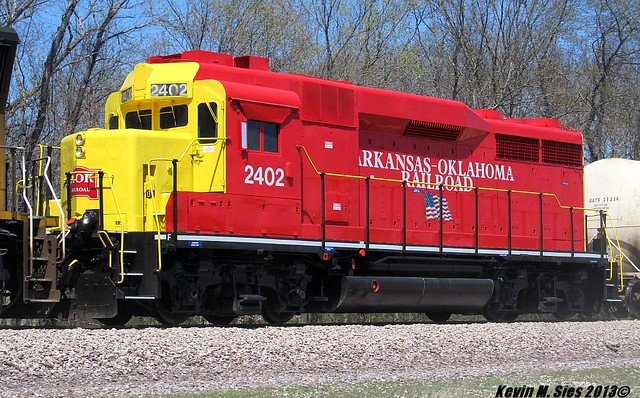
Freshly repainted GP30M #2402 seen in transit on the Union Pacific on the Union Pacific outside of Livingston, IL on April 19th. Kevin Sies photo
ARKANSAS-OKLAHOMA RAILROAD- The Arkansas-Oklahoma railroad has acquired a quartet of former BNSF GP30M's from Larry's Truck and Electric of MacDonald, OH. In addition to the four GP30M's, the A-OK has also acquired a former Idaho Northern & Pacific (ex Wheeling & Lake Erie, nee Southern) ALCo-trucked GP35. The EMD's are expected to replace five former Conrail B23-7s that have been on the railroad since 2005.

The A-OK runs between McAlester and Howe, OK and leases a 36 mile former Union Pacific branch between Shawnee and Oklahoma City. Commodities handled include coal, frac sand, wheat, plastic, corn, acid, aggregates, lumber and feed. The 118 mile former Rock Island line between Shawnee and McAlester had been dormant for several years due to an unstable bridge over the North Canadian River. The AOK has been working to restore service between McAlester and Shawnee, and progress was made at the end of 2012 when the AOK successfully reopened the bridge over the North Canadian River.

Florida East Coast SD40-2 #714 is seen with Jacksonville-bound intermodal freight #226 as it crosses the San Sebastian River in St Augustine, FL on March 10th.
Bob Pickering photo
FLORIDA EAST COAST- The Florida East Coast has begun repainting units in a red and yellow scheme reminiscent of the line's early diesels. This would not be the first time the FEC has painted a unit in what has been referred to as Flagler or Champion colors- more than a decade ago, GP40 #2000 was painted in similar colors as a one off.

FEC's motive power fleet consists of GP40s in a dark blue and white scheme, SD70M-2s painted in colors closely copying the Alaska Railroad (blue and gold) or Rail America (red white and blue) and former Union Pacific SD40-2s that have been operating in UP's Armour Yellow for years. So far, the colors have been applied to the former UP SD40-2s.

The move is likely an effort to boost the railroad's corporate image ahead of an anticipated increase of intermodal traffic that is expected to coincide with the widening of the Panama Canal. The massive project is expected to be completed in 2014 or 2015 and the FEC has been working with the Port of Miami and Port Everglades to include on dock rail facilities as part of their expansion plans.

The Florida East Coast was acquired by Fortress Investment Group [NYSE: FIG] in 2007- they also owned a stake in Rail America until their 2012 sale to Genesee & Wyoming. Although the FEC was largely operated independently of other Rail America properties, some of the new SD70M-2s were delivered in Rail America colors (while still lettered for FEC) and Rail America subsidiary New England Central received GP40s and SD40-2s from Florida East Coast beginning in 2009 before they were relettered for the NECR in 2011.

Painted in Delaware & Hudson-inspired colors, Saratoga & North Creek B39-8 #8524 is seen trundling through the golf course at Stony Creek, NY with the railroad's first revenue freight train on February 11th. John Sesonske photo
SARATOGA & NORTH CREEK- It was a short, one car train- reminiscent of a bygone era for shortlines in the Northeast- but Iowa Pacific is hoping this could be just the beginning.

A lone boxcar carrying garnet bracketed by a Saratoga & North Creek B39-8 and Delaware & Hudson painted bay window caboose left North River, NY on Feb 11th in what was the first freight movement over the former Delaware & Hudson branch in more than 25 years.

“We’re open for business,” Iowa Pacific President Ed Ellis said Wednesday. “We’ve broken the ice here. We’re thrilled that Barton is working with us. We’re hopeful this means we’ll be moving a lot more different things moving forward.”

Lumber, logs and rock tailings from an old mine in Tahawus are other possibilities.

In Corinth, officials are optimistic that freight service will lure new industry to the former International Paper Co. site.

“This is what we’ve been waiting for, not just passenger service,” Supervisor Richard Lucia said.

A rail spur goes to the former International Paper property, whose large old buildings have been razed. In addition to rail service, however, the location has ample water, a waste treatment plant, landfill and a new million-dollar electric substation.

“I still feel this is the best heavy industrial site in eastern New York,” said Jack Kelley, director of economic development for Prime Companies, an Albany-based realty firm. “Freight service makes it even more desirable for someone to move in.”

Most recently, an Italian solar panel manufacturer expressed interest, but plans never moved forward.

Kelley said he believes anything from wood products to natural gas power generation make sense for the site, or perhaps an intermodal facility similar to one in Mechanicville where products could be unloaded for transport by truck to their final destination.

“There aren’t an awful lot of places in this area where trains can sit while they’re loaded and unloaded,” Kelley said.

Barton’s facility in North River is at the south end of a recently reopened 30-mile stretch of track from North Creek north to Tahawus. Barton’s garnet abrasives are used around the world for waterjet cutting, coatings removal and other special uses such as surface preparation.

At the north end of that line, in Tahawus, NL Industries owns a former ilmenite mine that was used to make titanium during World War II. The line sat idle for many years until Iowa Pacific readied it for re-use last year, despite objections from environmental groups.

A portion of track runs through Adirondack Forest Preserve.

Ellis said a large market exists for waste rock to be used in road building and similar large-scale construction jobs. NL Industries has hired a firm to find potential buyers, he said.

“I believe there will be stone moved in 2014,” he said, adding that freight revenue should account for about half the railway’s revenue within two years.
The dormant line was purchased by Warren County in the 1990s and the Upper Hudson Railroad operated excursions over a portion of the line until 2010. In 2011, Iowa Pacific was awarded the contract to operate the entire 57 mile line and began operating passenger excursions between North Creek and the Canadian Pacific interchange in Saratoga, NY in July 2011. The line also directly interchanges with Amtrak's Ethan Allen and Adirondack passenger service as well.

Monday, May 27, 2013

Today's Train of Thought- A Grave Endeavor, March 27th 2013


To this day, working railroads can be found running through a number of unlikely venues- such as the middle of a street or a golf course. Although some rail lines skirt the periphery of cemeteries and burial grounds, it's a little unusual for a line to run right through the middle of one.

One notable exception is the Nashville National Cemetery, however. The burial ground first opened up shortly after the Civil War just to the north-east of Tennessee's capitol. By 1879, nearly 19 additional acres had been conveyed to what is now the Nashville National Cemetery. Not surprisingly, much of this land was to accommodate soldiers from both the Confederacy and Union that were killed during the Civil War.

Yet to this day, the Nashville National Cemetery remains bisected by an operating rail line- an easement was granted to CSX predecessor line Louisville & Nashville in 1912 to operate the line 'in perpetuity'.

Here, railpictures.net contributor Doyle Massey caught a southbound CSX Q649 (Chicago to Birmingham, AL manifest freight) with C40-8 #7643 heading through the 64.5 acre burial ground in April 2009, more than halfway through her journey from the Windy City to the heart of Dixie. According to Massey, the Nashville National Cemetery was closed for burials by the late 1990s and was also added to the National Register of Historic Places around the same time.

Sunday, April 14, 2013

Today's Train of Thought- Safe(Co) At Home, April 14, 2013


My oh my!

One does not necessarily need to be a Mariners fan or resident of the Pacific Northwest to know about some of the quirks of Seattle's SafeCo Field. Opened in 1999, the ballpark features a massive retractable roof that can be closed so that the ballgame can continue in the event of one of Seattle's infamous rainy days. The roof slides open and closes on massive tracks and on the east end of the ballpark. Of course, abutting the east end of the ballpark is the BNSF mainline through downtown Seattle, with the roof hanging over the line when its fully open.

This has led to broadcasters, including Ford C Frick award winner Dave Niehaus, having to pause their play-by-play not just for a word from their sponsors or station ID but also the air horns of passing trains from the BNSF, Amtrak's Cascade service or Seattle's Sounder commuter rail service. On a clear day or night, the sound of passing trains carries with the roof open since the gantry supporting the tracks the roof opens and closes along overhangs a stretch of the line where the trains have to blow their horns for the South Royal Brougham Way crossing (immediately north of the stadium). Some of the right-field seats reportedly offer a more commanding view of the tracks than they do the field, depending on which way you're facing.

So with that in mind, today's Train of Thought takes us to the Emerald City. Here, railpictures.net contributor John Ryan caught BNSF ES44AC #7598 leading a trio of GE's trundling southbound past the ballpark (and the Seahawk's Qwest Field in the background) with a double stack train destined for the Port of Seattle just to the south on September 11, 2008. The Mariners beat the Rangers by an 8-7 final the night before and will be on the road in Anaheim later on that night. Just to the right is the tower of the ex Great Northern and Northern Pacific King Street Station, which was completed in 1906 and still sees regular use from Amtrak's regional Cascades as well as the Empire Builder or Coast Starlight in addition to Seattle's Sounder commuter rail

Interesting footnote is that the western end of I-90 is just to the east of the ballpark and BNSF line. Up until the 1990s- the easternmost end of I-90 was the Mass Pike which passees right by Fenway Park. After completion of the Big Dig, I-90 was extended further east to Logan International Airport.

Wednesday, February 20, 2013

Today's Train of Thought- The Snow Me State, February 20, 2013

Today's train of thought takes us to Louisiana, Missouri- which may sound like two states rolled into one, but is actually a town of about 3300 in northeastern Missouri on the western banks of the Mississippi River. While Louisiana, MO doesn't have much in the way of Mardi Gras parades or cajun cuisine, the town does feature both a road and rail crossing from Illinois to Missouri in addition to the Kansas City Southern's Springfield, IL to Kansas City mainline crossing BNSF's Hannibal Subdivision.

Here, railpictures.net contributor Mike Mautner caught leased NREX B39-8 #8599 getting ready to resume its journey east with intermodal freight IKCVN [Intermodal- Kansas City to VeNice, IL] after stopping to take care of some EOT problems after apparently crashing their way through a number of snowbanks on December 1st, 2006. Interestingly, like the Oakways mentioned in the previous Train of Thought, these grey white and red 3900 HP behemoths would've been right at home on the BNSF not too long ago.

Built in 1988 for Locomotive Management Services and immediately subleased to the Burlington Northern, these grey and white GE's- sometimes called 'sharks' roamed the Burlington Northern system primarily hauling intermodal freight. Arriving on the BN property at around the same time as the Oakway SD60s appeared, the 100-unit fleet was returned to lessor and the fleet was dispersed, with individual units ending up in far flung locales from Maine to British Columbia and even Peru.

In their post-BNSF careers, it seems as though a disproportionate number of ended up on New England shortlines and regionals such as the Providence & Worcester, the Montreal, Maine & Atlantic and Rail America's Connecticut Southern.

Monday, November 12, 2012

Today's Train of Thought- Get Your Kicks, November 12, 2012

When one thinks of California's Mojave Desert, up until fairly recently one would think of Route 66 or Edwards Air Force Base, which is where NASA's space shuttle landed after completing a mission. The actual color of the landscape tends to be the same for the most part, so one doesn't neccesarily think of 'Mojave Desert' and 'Fall colors' in the same sentence.

Yet in a limited number of circumstances, its entirely possible in parts of the high desert. While there isn't much in the way of vegetation in the Mojave, groves of trees cling stubbornly to adjacent riversides and in scattered oasises and their leaves start to change color and fall off like their counterparts in more temperate climates.

North of Cajon Pass and San Bernardino, the Mojave River, the former Santa Fe line and old Route 66 roughly parallel each other between Hesperia and Barstow, which is home to a major rail classification yard. Although Route 66 became less travelled since the completion of the roughly parallel I-15, the Santa Fe line presently sees traffic from both BNSF and Union Pacific. The line is part of the Santa Fe's transcontinental line and Union Pacific's Los Angeles-Salt Lake Route and sees considerable traffic from both roads on a daily basis.

Here, an unnamed photographer caught a quintet of BNSF GEVO's led by BNSF #7211 is seen leading a nortbound intermodal freight past Rockview park in Victorville, CA as ES44DC #7628 eases southbound in November 2011. In the rock-strewn foreground is a trickle of water known as the Mojave river and some aspen trees while in the background and just out of view behind the southbound freight is Historic Route 66.

Tuesday, October 9, 2012

Today's Train of Thought- Turning Over A New (River) Leaf, October 9, 2012,


Today's train of thought takes us to a fairly remote and isloated stretch of the Mountaineer State just as the leaves are beginning to turn color.

Founded at the turn of the last century, the tiny West Virginia village of Thurmond is nestled along the New River and the former Chesapeake & Ohio mainline from Virginia to the Midwest. The town in Fayette County reportedly wasn't accesable by road until the 1920s and to this day, a combined single lane road bridge and single track rail line that accomodated a C&O branchline to one of the coal mines to the west.

Like many other towns throughout Appalachia, Thurmond's fortunes rose and fell with the coal industry and two massive fires tore through downtown Thurmond in 1922 and 1930. Many merchants used the town's one and only road to set up shop elsewhere. By the mid 1950s, the Chesapeaske & Ohio had begun dieselization, phasing out the labor intensive steam locomotives that were serviced in Thrumond and facilities elsewhere along the C&O.

Perhaps the biggest developments in Thurmond since the C&O dieselized were the 1978 establishment of the New River National River by the National Parks Service and the 2005 sale of the CSX (former C&O) branchline between Thurmond and Mt. Hope, WV to shortline operator RJ Corman.

Although technically a 'ghost town', the 2010 census listed 5 full time residents and the isolated village is actually a flag stop on Amtrak's Chicago-Cincinnati-Washington D.C. Cardinal. The little C&O passenger depot is still used as visitor's center by the National Parks Service and occasionally for its intended purpose as the area is popular with campers, hikers, rail enthusiasts and boasts some of the best whitewhater rafting in the country.

Above, railpictures.net contributor JB Lockard caught CSX C44-9W #461 leading a coal drag past downtown Thurmond on October 9, 2011. In the background, one can see a new banner welcoming visitors to town and that the leaves are beginning to change in along the New River.

Monday, September 3, 2012

Iron Horse Update for August 2012- Heritage Units Gather for Massive Norfolk Southern 'Family Portrait' in North Carolina; Rails to Trails- and then Back to Rails; New Genesee & Wyoming Line in Alabama


NORFOLK SOUTHERN- There was more to the 30th anniversary celebration of Norfolk Southern than the 21st Century Steam program, as it turned out.

Although it had initially planned a total of 18 'heritage' units- new locomotives painted in the colors of various Norfolk Southern predecesors- the total was bumped up to 20 earlier this summer with the belated additon of the Penn Central and Monongehela as part of the heritage fleet.

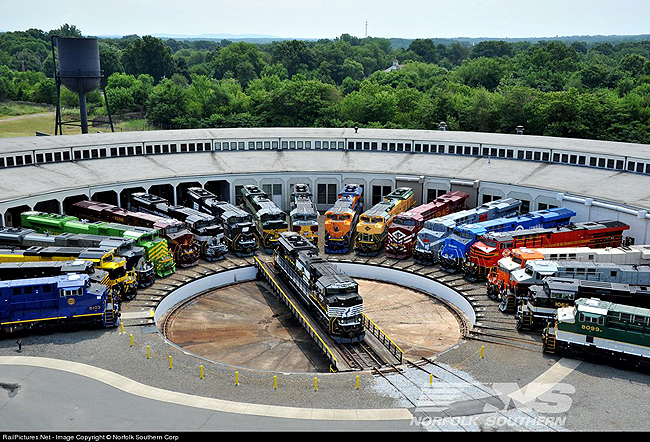
While just about all of the heritage units were placed in revenue service after arriving from GE's Erie, PA plant of Progress Rail's EMD facility in Muncie, IN, in late June, all 20 units were sent to the North Carolina Transportation Museum at Spencer, NC for a one-of-a-kind 'family portrait' at the Museum's massive roundhouse.

In the above official Norfolk Southern image, the heritage units on display include Norfolk & Western ES44AC #8103, Nickel Plate ES44AC #8100, Virginian SD70ACe #1069, Wabash SD70ACe #1070, Illinois Terminal SD70ACe #1072, Pennsylvania #8102, New York Central #1066, Penn Central SD70ACe #1073,  Erie SD70ACe #1068, Delaware Lackawana & Western SD70ACe #1074, Central Railroad of New Jersey SD70ACe #1071, Reading SD70ACe #1067, Lehigh Valley ES44AC #8104, Monongehela ES44AC #8025, Conrail ES44AC #8098, Norfolk Southern ES44AC #8114, Interstate ES44AC #8105, Wabash SD70ACe #1070, Savannah & Atlanta SD70ACe #1065 and Southern ES44AC #8098.

Norfolk Southern had also made it a point to have some of the heritage units accompany the steam-powered employee specials earlier in the summer with 'Nickel Plate' GE #8100 accompanying Nickel Plate #765 in Pennsylvania and 'Savannah & Atlanta' EMD #1065 accompanying the Southern #630 on trips through Tennessee and Virginia. Reportedly the Wabash #1070 will accompany the Fort Wayne Historical Society's big Nickel Plate Berkshire to St Louis this month for additional employee specials.

Although Union Pacific and Pan Am have both paid tribute to predecessor roads with specially painted locomotives, the size and scope of Norfolk Southern's heritage program is unprecedented. About half the roads honored in the NS Heritage program are due to the carrier's 1999 joint takeover of Consolidated Rail Corp- better known as Conrail- with CSX. Conrail was hastily formed from the remnants of the Penn Central, Erie Lackawana, Central Railroad of New Jersey, Reading and Lehigh Valley in 1976. Conrail also acquired a controlling interest in southwestern Pennsylvania coal hauler Monongahela in 1993.

A pair of Wheeling & Lake Erie SD40-2s dropping ballast in the yard adjacent to the MarkWest Liberty Mid-stream processing plant in Westland, PA on Aug 2nd, 2012. To access the facilities, the Wheeling & Lake Erie had to re-lay track over a 4½ stretch of former Montour Railroad track that was abandoned nearly 30 years ago and converted into a hiking trail. Jason Capra photo
WHEELING & LAKE ERIE- A portion of a rural branchline in the southwestern corner of Pennsylvania that was abandoned and torn up in 1984 is once again seeing trains thanks to the ongoing natural gas bonanza from the Marcellus Shale.

A subsidiary of the Pittsburgh & Lake Erie, the Montour Railroad was down to 23 miles in the early 1980s when their last major shipper- the Westland Coal Mine- announced they were closing down in 1984. In the early 1990s, the Montour Trail Council was formed to convert much of the remaining Mountour Railroad right-of-way into a hiking trail in the Pittsburgh area.

In 2005, a natural gas well was drilled in rural Washington County, PA using a relatively new technology called hydrofracking where sand, water and certain chemicals are used to drill through layers of shale for natural gas. Although geologists had long believed there were abundant natural gas reserves in the Marcellus Shale outcropping- which stretches from Upstate New York to eastern Tennessee- accessing it in an economic manner was problematic until the hydrofracking process had been proven successful.

Although Denver-based MarkWest energy [NYSE: MWE] had completed a massive cryogenic processing plant in Westland, the natural gas byproducts were loaded up in tractor trailers that had to negotiate at least 8 miles of relatively narrow, 2-lane roads before reaching interstate 79 in nearby Cannonsburg, PA. But in 2011, MarkWest Liberty announced their plans to re-open a portion of the former Montour Railroad which would give the cryogenic facility access to the Wheeling and Lake Erie railroad's line between Mingo Jct, OH and the former Norfolk & Western Rook Yard in Pittsburgh as well as interchange with CSX, Norfolk Southern and multiple Genesee & Wyoming properties.

The first train to operate over the newly-opened line was a short ballast train in June powered by two W&LE SD40-2s. In August, MarkWest Liberty began shipping byproducts by rail out of the Westland yard for the first time.
Currently, the rail loading facility has the capability of loading 12 tankers, but plans are to expand the number of loading racks so that up to 24 tankers can be loaded per trip.

The gas is piped to the rail loading facility from the processing plant in pure product lines, mostly propane or butane. The butane will be transported to petrochemical refineries while most of the propane is shipped to the East Coast for home heating use. There also will be shipments of isobutane and natural gasoline, McHale said. The natural gasoline is expected to be shipped to Canada for processing. All of the byproducts markets are subject to negotiated contracts with the producers and, in Washington County, MarkWest processes natural gas exclusively for Range Resources.

While the train is currently making one trip a day with 50 tankers, eventually that will become four trips a day for a total of 200 tankers. Each rail tanker takes four trucks off the road.
As for the rails-to-trails portion, there is still a trail involved. Contractors for MarkWest Liberty also completed a parallel portion of the Montour Trail along the line, with the fence separating the hiking trail from the railroad line.


A pair of Columbus & Chatahoochee SD40-2s lead two more Genesee & Wyoming units southbound with a mixed freight along Brickyard Rd in Girard, AL on July 1st during the innagural run of the C&C.
Frank Orona photo
GENESEE & WYOMING- Shortly before the Genesee & Wyoming's [NYSE- GWR] purchase of competing shortline holding company Rail America [NYSE- RA] was announced, GWR started up operations on yet another Southeastern shortline.

Operations for the 26 mile Columbus and Chatahoochee began on July 1, 2012 on a former Norfolk Southern branch between Girard and Mahart, AL. The deal also includes trackage rights on Norfolk Southern between Girard, AL and Columbus, GA to reach the Norfolk Southern Yard and sister GWR road Georgia Southeastern.

Power for the line is a pair of SD40-2s in GWR's trademanrk orange and black. At its startup, the line is also borrowing power from sister railroads Chattooga and Chickamagua and The Bay Line in the form of 3 GP38s. The Columbus & Chatahoochee is the ninth GWR railroad to start up operations in the region- a number of the other lines include formerly independent shortlines and regionals such as the Georgia Central, Altanta & St Andrews Bay, Georgia Southwestern, Chatahoochee Industrial or Meridian & Bigbee.

Sunday, July 1, 2012

Today's Train Of Though- A Parry Merry Canada Day, July 1 2012


Today's Train of Thought takes us to the hometown of legendary Boston Bruins defenseman and NHL Hall of Famer Bobby Orr.

Located about 150 miles north of Toronto, the town of Parry Sound, ON is located along an inlet on the Canadian side of Lake Huron. For more than a century a large steel trestle remains highly visible throughout most of Parry Sound. The soaring 1,695 bridge over the Seguin River carries Canadian Pacific's transcontinental mainline. Canadian National's Bala subdivison is nearby, but Canadian National and Canadian Pacific have entered into an agreement where northbound CN and CP trains use directional runningon the CP line through town while southbound trains from bouth railways use the nearby CN line.

So despite the fact we're seeing a solitary Canadian National locomotive charging northward across the Seguin River, the trestle and rails are in fact Canadian Pacific.

Here, railpictures.net contributor Don James caught Canadian National C40-8M #2407 handling a mixed freight as it makes its way north over the Seguin Rive on an August 2010 afternoon.

Thursday, June 14, 2012

Today's Train of Thought- O Say Can You CSX? June 14, 2012


In honor of Flag Day, Today's Train of Thought takes us to the far Southwestern corner of Old Dominion.

I'm starting to think Flag Day should be the Thanksgiving to the 4th of July's Christmas, when all the larger than life and ornate flags, bunting or banners should be front and center for several weeks.

Then again, most people don't limit their flying the American flag to a select few national holidays.
Here, CSX ES44AC #788 is seen exercising trackage rights over the Norfolk Southern through Big Stone Gap, VA on July 2nd, 2008. Not only did railpictures.net contributor Ron Flanary catch the big GE lugging 67 cars upgrade through a pastoral rural setting, but he managed to frame it with this patriotically adorned home on Baum Hollow Rd, complete with the stars and stripes as well as red white and blue bunting to brighten up an already lively scene.