Showing posts with label Conrail. Show all posts

Thursday, July 4, 2013

Today's Train of Thought: Pitt-riotic Display, July 4th, 2013

Image and video hosting by TinyPic
Today's Train of thought takes us to one of the busiest portions of rail line in the Keystone state- and the Norfolk Southern system for that matter.

I make sure there's zero ambiguity regarding my love for the main streets of small towns (and/or curvaceous bikini clad women) decked out in bunting for 4th of July Parades, but from rickety branchlines that see maybe one train a month to well polished mainlines that get 70 trains a day, nothing says "America- fuck yeah!" to me more than the rail network. Do you want to know why we don't have high speed intercity passenger trains outside of the northeast? It's not because of an ignorant and intransigent public like some HSR advocates claim- it's because of the sheer volume of goods and commodities that move to market by rail. High Speed Rail would either take one of these vital arteries offline by using it for dedicated passenger service or future HSR lines would have to be built from scratch- both of which are cost prohibitive. Freight- for lack of a better term- pays the freight.

During the 1999 breakup of Conrail, Norfolk Southern obtained the former Pennsy Pittsburgh line between the Enola and Conway yards [just outside of Harrisburg and Pittsburg, respectively- NANESB!]. Dubbed the Pitt Line, this 248 mile mainline traverses some of the most difficult terrain east of the Mississippi. Between Harrisburg and Altoona, the line avoids the difficult terrain by hugging the western bank of the Susquehanna River before turning west and paralleling the Juniata River for much of the way into Altoona. West of Altoona, the Pitt Line's assault on the Alleghenies begins in earnest, climbing grades as steep as 1.86% before traversing the famed Horseshoe Curve and cresting the Alleghenies at the town of Gallitzin- a mountain town named after an 18th century Russian aristocrat who became one of the first ordained Catholic priests in the newly-formed USA. Along the route, the Pitt line cuts through an interesting and often overlooked cross section of American history that dates from before the French established Fort Duquesne to the current natural gas drilling boom along the Marcellus Shale.

Heading west, the line coasts downgrade about 25 miles towards Johnstown, PA. From Johnstown, the Pitt Line follows the Conemaugh and Kiskiminetas Rivers into Pittsburgh and onto the massive yard at Conway, PA from there.

The line provides a sampler of early US History along its route- Harrisburg was a key supply and logistics center for the Union and the ultimate objective for Robert E Lee's Army of Northern Virginia during the Battle of Gettysburg. Further west, despite being rendered obsolete nearly a decade before the Civil War, the Allegheny Portage railroad (which hauled passengers, cargo and barges between canal termini in Hollidaysburg and Johnstown) feature America's first railroad tunnel in Conemaugh township and is now part of a National Historic Park. Horseshoe Curve itself is considered an engineering marvel and was important enough for the US Army to assign troops to guard it against sabotage during the Civil War and World War II.

West of the Alleghenies are the six counties who were among the first locales to rebel against the United States government during the 1791 Whiskey Rebellion after the government attempted to levy a tax on the production of distilled spirits. Johnstown itself is infamous for a catastrophic 1889 flood that killed more than 2000 people. A Pennsylvania Railroad employee became part of Johnstown flood lore that day when Engineer John Hess saw a massive wall of water and debris heading towards his locomotive in East Conemaugh, PA. Acting quickly, Hess reportedly tied down the steam whistle and threw the engine into reverse, the shriek of the steam whistle serving as a warning to the townspeople of Conemaugh of the deadly wall of water and debris hearing their way. Hess was said to have barely escaped his locomotive by the time the deadly onslaught caught up with him.

More recently Johnstown was put back on the map thanks to the eccentric goons of the fictitious Charlestown Chiefs in the 1977 cult hockey comedy Slap Shot. The 'Charlestown Chiefs' are widely believed to be a stand-in for the real life Johnstown Jets of the early 1970s and much of the movie was filmed in and around the Johnstown, PA area with the closure of a steel mill being one of the movie's backstories. Less than a decade later, the East Coast Hockey League established a team in the city and a contest was held to name the new ECHL. Sure enough, the fictional Chiefs were the hands down winner and the team remained in Johnstown for 22 seasons before moving to South Carolina in 2010 in what was clearly a case of life imitating art.

Here, eastbound Norfolk Southern Conway-Enola freight 10A is seen beginning its attack on the Alleghenies at Vandergrift, PA on June 21st, 2008. This mixed freight set to traverse this historic line and the communities alongside it with former Conrail C40-8W #8415 (still in blue) leading and a Helm leasing former Union Pacific SD60 still in armour yellow. Railpictures.net contributor Tom Granville framed this shot beautifully with Old Glory in the foreground.

Tuesday, June 11, 2013

Today's Train of Thought- It's Miller Time! June 11, 2013

Today's Train(s) of Thought takes us to a once dormant corner of western Massachusetts. Although the Hampden County town of Palmer, MA has rightfully earned itself a reputation as a train-watcher's haven, Millers Falls in Franklin county deserves an honorable mention for hosting not one, but two resurgent railroads.

Best known for the Millers Falls Tool company, this Western Massachusetts village of about 1100 is situated at the confluence of the Millers and Connecticut River as well as Massachusetts Route 63 and the Mohawk Trail (Route 2- sometimes known locally as the French King highway). The village is also located at the crossing of what was once the Central Vermont Railroad and Boston & Maine's Fitchburg Division. The railroads that served Millers Falls, MA went into a precipitous decline starting in the late 1960s. The B&M started off the 1970s by entering bankruptcy in March 1970 and the CV's line between the Vermont-Quebec border and New London, CT had always been something of a backwater in the Canadian National system.

Along with the Maine Central and Delaware & Hudson, the somewhat resurgent Boston & Maine was brought into the Guilford fold in the early 1980s, ushering in a period marked by declining traffic, reduced salaries, deferred maintenance, layoffs, shop closures and labor strife. By 1988, Guilford abandoned any plans of operating a unified system stretching from Washington DC to northeastern Maine by declaring the Delaware & Hudson bankrupt. While the D&H would continue running with the New York, Susquehanna & Western as their designated operator for a few years, Canadian Pacific purchased the line outright in 1991. For better or worse, this left the Boston & Maine and Maine Central in the Guilford fold.

Around the same time the D&H was purchased by CP Rail, rumblings began on a possible privatization of the Canadian National Railway and its subsidiaries. Although the Central Vermont had operated as a subsidiary of the Canadian National since 1923, a newly privatized CN began looking to sell off marginal lines [even before privatization, they sold off their former Grand Trunk Eastern line between Sherbroke, Quebec to Portland, ME to Pennsylvania-based Emons Industries in 1989- NANESB!]. So one of the lines that ran through this western New England burgh was basically a wholly owned subsidiary of the Canadian government. To hardly anyone's surprise, the candidates for divestment included the Central Vermont, and they soon found a buyer in San Antonio-based RailTex in 1995. The line's name was changed to the New England Central and new(er) blue and yellow GP38-2s became the mainstay of the NECR fleet.

Meanwhile, Guilford's fortunes were seemingly tied to Maine's paper industry. At the time, Conrail provided the fastest route in and out of New England on their former Boston & Albany mainline between Beacon Hill yard in Boston and the massive former Penn Central yard in Selkirk, NY. If they used Guilford at all, shippers typically preferred the absolute minimum- this typically involved handing off trains to Guilford at Worcester, MA so they could continue to Ayer, MA and points northeast. This meant the underutilized Fitchburg division languished further- although coal trains from western Pennsylvania and general freight was handed off to Guilford by CP Rail at Mechanicsville, NY. While not in direct competition with each other, it seemed as though the Guilford's fortunes faded as New England Central's rose.

In 1998- Guilford's management made a curious move that wouldn't generate much attention until nearly a decade later. They purchased the rights to the name of the defunct Pan Am Airlines. By 2006, Guilford Transportation was re-branded as Pan Am Railways.

Interestingly, this wasn't simply a matter of slapping a new logo on the locomotives and rolling stock and hope that nobody noticed how badly the railroad had sucked for the last 20 years. Earnest efforts were made to retain current shippers and attract new ones or ones that had stopped using them.

By 2008, Pan Am had entered into an agreement with Norfolk Southern to upgrade trackage on the Fitchburg Division between Mechanicsville, NY and Ayer, MA- giving NS access to Boston area shippers. While unit coal trains from Western Pennsylvania continued running to the power plants in Mt Tom, MA and Bow, NH, Pan Am sought to expand upon that.

For instance, First Light Power began experimenting with blending coal from Colombia at the former Northeastern Utilities power plant in Mt Tom. The coal would be shipped from Colombia's Atlantic coast to Rhode Island, where it was then loaded into a dedicated unit train for the Providence & Worcester. From there it would travel between its two namesake cities. Once at Worcester, it would continue to the northwest to the Guilford/Pan Am interchange at Gardner, MA and on to Mt Tom (via Millers Falls and the East Deerfield yard) from there.
In the above image, NERail Photos contributor Bill Wehmeyer caught a Pan Am train at Miller's Falls, MA having something of an identity crisis. Here, Providence & Worcester B23-7 #2201 is seen leading a P&W GP38-2 with unit coal train PWMT [Providence & Worcester interchange at Gardner, MA to the Mount Tom power plant]- heading eastbound on June 15, 2012. The train utilizes P&W power for the duration of its run to the power plant.

Norfolk Southern's investment seems to be paying off for both parties- in addition to traffic destined for the Canadian Pacific at Mechanicsville and the unit coal trains originating on the Norfolk Southern or Providence & Worcester, the Fitchburg division of the Pan Am is also hosting unit grain trains, unit clay slurry trains from the Vermont Railway and dedicated unit trains of crude oil from North Dakota's Bakken Shale that is handed off to them by the CSX in Rotterdam Jct, NY on a weekly basis. Shippers that once preferred to avoid Guilford or the rails altogether are rediscovering Pan Am, with paper and forestry products moving out of Maine via the old B&M Fitchburg division instead of the former Boston & Albany (now CSX) line. In fact, traffic has increased so sharply on the Pan Am that the line finds itself short on locomotives at the moment- in addition to trying to wring every possible mile out of their secondhand GP35s and GP40s or run-through power from CSX, Union Pacific, BNSF and Norfolk Southern, Pan Am has also been borrowing SD40-2s from Helm Leasing and Norfolk Southern to try and fill in the gap.

New England Central- which had operated under the Rail America umbrella since 2000- has been no slouch, either. Hauling seemingly everything from construction debris to America's Cup yachts, New England Central began handling unit ethanol trains in conjunction with the Canadian Pacific, Vermont Railway and Providence & Worcester starting in 2010. The former Central Vermont line also accommodates Amtrak's Washington DC-St Albans, VT Vermonter. Despite sustaining heavy damage during the 2011 Tropical Storm Irene, the NECR was nearing completion on a massive upgrade of their line between Northfield, MA and St Albans, VT that is expected to benefit the NECR, Amtrak and to a lesser extent, Pan Am [which still uses the line to haul salt, plate steel and LPG as far north as White River Jct, VT- NANESB].

Perhaps the most significant development for the NECR has been the sale of parent company Rail America to Genesee & Wyoming holdings at the end of 2012. Within weeks, NECR locomotives were among those in the former Rail America network being repainted in G&W's trademark orange and black.


Above, raiplictures.net contributor Gary Senecal caught northbound NECR SD40-2 #6281 leading train #611 as it made its way north across the Millers River trestle just outside of the center of town while a passing storm makes its way east off in the distance on May 8th, 2010. Its not uncommon for NECR trains to perform interchange work with Pan Am at Millers Falls instead of at White River Jct, VT on the Connecticut River line

Despite being a New England Central train, the motive power gives no indication that this is a train belonging to any Rail America railroad- #6281's Conrail markings are very much intact while Florida East Coast SD40-2 #722 still retains its Union Pacific Armour Yellow and grey. By 2011, the former FEC SD40-2s and a couple of blue FEC GP40-2s were re-lettered for NECR, although as of March 2013, #6281 still retained the Conrail logo.

Sunday, December 2, 2012

Quickie Iron Horse Roundup- Conrail Freight Derails, Spills Chemicals in New Jersey; Canadian National Begins Testing LNG-Fueled Locomotives

AP Photo

CONRAIL- Officials from the NTSB are investigating the Friday morning derailment of a Conrail Shared Assets freight train in Paulsboro, NJ that sent several tank cars tumbling into Mantua Creek [a video of the bridge in action before the derailment can be viewed here- NANESB!].

The Conrail freight was pulling 84 cars and heading southbound along a branchline when the derailment occurred Friday morning. At least one of the cars ruptured, sending a cloud of vinyl chloride into the air and forcing the evacuation of hundreds of residents nearby- 70 people were also hospitalized with respiratory problems.

Conrail and investigators from the National Transportation Safety Board are focusing on the 139 year old bridge- a movable 'A Frame' type span. The bridge was manually operated and had a bridge tender on site until the last decade or so. There was reportedly a minor derailment along the same bridge in 2009 and Conrail was investigating problems with trackside signals near the bridge in the week or so before Friday's derailment.

The swing bridge opens and shuts to accommodate boat traffic along the river and crews were reporting that the signals leading up to the bridge would remain yellow instead of turning green.
The veteran two-person crew operating the CSX train Friday was familiar with the route and had run it the three previous nights. They had started their shift at 3 a.m. in Camden and were surprised to get a yellow signal when they approached the bridge at about 7 a.m. They used a keypad device, similar to a garage door opener, to try to get a green light, to no avail. The pair then stopped the train for several minutes, examined the tracks, and got permission from a dispatcher to proceed, Hersman said.

The two locomotives and five tanker cars made it across before the crew looked back to see the bridge “collapse” and a pileup of cars in the creek. The one that ruptured had been struck by another tanker, she said.

Recordings of various data so far support the crew’s account, investigators said. However, authorities are not yet sure whether the bridge deck actually collapsed or shifted.
Officials are also considering tidal surges from the passing of Super storm Sandy may have factored into the derailment, undermining the 1873-built bridge. However, NTSB investigators can't do a thorough on site examination until the remaining chemicals are cleaned up.

Bracketing a Liquified Natural Gas tank car, rebuilt SD40-2s #5262 and #5258 are seen in handout photo from Canadian National Railways. CN is experimenting with rebuilding locomotives to run on LNG

CANADIAN NATIONAL- Canadian National Railways [NYSE- CNI; TSX- CNR] has begun testing a pair or LNG-powered locomotives to determine the feasibility of using natural gas instead of diesel fuel.

The conversion kits was supplied by Energy Conversions, Inc of Tacoma, WA and Calgary-based natural gas producer Encana [NYSE- ECA; TSX- ECA] will be providing the fuelling and the maintenance. Officials with Canadian National and Energy Conversions say that the move could cut carbon dioxide emissions by 30%. While Alberta is a leading energy producer thanks to crude oil and the oil sands, the province also sits on top of considerable natural gas deposits. However, the current glut has driven natural gas prices down- although this would put CN at an advantage should the prices persist as it expands the LNG-powered locomotive program.

Canadian National's LNG project is similar to an earlier natural-gas powered locomotive project from Energy Conversions. Between 1991 and 1996, the Burlington Northern Railroad ran coal trains between Wyoming's Powder River Basin and the midwest with a duo of SD40-2s bracketing an LNG tanker/tender modified by Energy conversions. Although the Burlington Northern program stopped around the same time as the merger with Santa Fe to form BNSF, Energy Conversions would do similar work for the Napa Valley Wine Train, the state railways of Thailand and Brazil's Companhia Vale do Rio Doce's [NYSE- VALE, BOVESPA- VALE3 & VALE5] rail operations.

The locomotives used for CN's LNG pilot program are a pair of 1975-built SD40-2Ws that are now sporting flared radiators- like the SD40-2s Burlington Northern used 20 years ago. Both locomotives and the LNG tanker/tender will be assigned to the 480km Canadian National line between Edmonton and the Athabasca oil sands hub of Ft McMurray, AB. Built in the 1920s, the line was originally part of the Northen Alberta Railway until NAR was taken over by CN in 1981. By 1994, CN ceased operations and the line was acquired by Rail Link's Lakeland & Waterways- who were brought into the Rail America fold by 1999. In the summer of 2000, Rail America halted operations on the Ft. McMurray line and within a few months, Canadian shortline operator CANDO contracting acquired the line outright from CN, only to have CN repurchase the line at the end of 2007.

Presently, the Canadian National hauls construction materiel, pipe and heavy machinery up to Ft McMurray and brings oil sands extraction byproducts like petroleum coke and sulphur south.

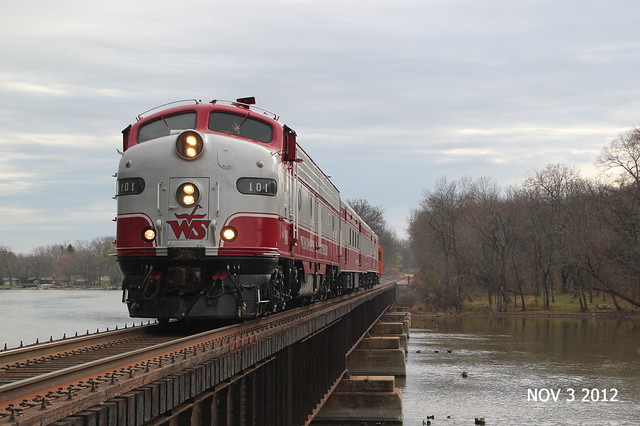
Wisconsin Southern E9A #101 seen hauling the Toys for Tots train cross the Rock River east of Edgerton, WI on November 3rd, 2012. photo- Brian Allen
WISCONSIN- Just a quick update out of the Badger State. I had earlier reported that Soo Line 2-8-2 Mikado #1003 was scheduled to haul a Toys for Tots holiday train over the Wisconsin & Southern last month.

However, shortly before the scheduled November 3rd departure, the #1003 was sidelined with an unspecified mechanical problem. Wisconsin & Southern E9A #101 handled the Toys for Tots train between Milton and Middletown, WI.

The #1003 was pulled from service two years ago in order to under to undergo her FRA-mandated 15 year boiler inspection. Due to rising costs, there were some concerns from the preservation community that the #1003 would never return to service again.

OHIO- Two Ohio-based preservation groups have announced plans to begin restoration of a 100 year old ALCo steam engine to service.

Colombus-based American Steam Railroad Preservation Association has reached an agreement with the Cleveland-based Midwest Railway Preservation Society to house the restoration of former St Louis-San Francisco 2-8-2 Mikado #1352 at the MRPS' former Baltimore & Ohio roundhouse in Cleveland.

The #1352 was built by ALCo in 1912 and operated on the Frisco for nearly 45 years before her 1956 retirement. The Frisco donated the #1352 to Kansas City where she was on display at Swoop Park, but soon fell victim to neglect and vandalism. A group of concerned preservationists eventually purchased the 1352 and moved her into storage in rural Illinois.

The MRPS is also home to another, slightly newer ALCo 2-8-2 Mikado- former Grand Trunk Western #4070. The #4070 was built in 1918 and most recently operated in 1990 on the nearby Cuyahoga Valley Scenic Railroad.

Wednesday, October 31, 2012

Today's Train of Thought- Pumpkin Patchwork, October 31, 2012

Today's train of thought takes us to New Jersey in far better times in the not-too-distant past. While one might associate the northeastern corner of the Garden State with a seemingly unending string of refineries, chemical plants and marshland there apparently are still some open spaces ideal for agriculture.

Take seasonal crops like squash and pumpkins, for instance. Despite the recent disaster that has affected the region, this was a pretty good year for the pumpkin harvest in New Jersey. Growing conditions are usually favorable enough that pumpkins can be grown in every county in New Jersey, from Montague to Cape May. Some of these are grown on family operated farms that offer hayrides or for a fee let you venture out into the field to pick your own pumpkins.

Here, Conrail Shared Assets train WPSA-31 is seen trundling past a pumpkin patch in the bourough of Freehold, NJ. Still in Conrail blue, Norfolk Southern GP38-2 #5286 heads past the field towing some mixed freight the day prior to Haloween in 2008. According to photographer and railpictures.net contributor Andrew Blaszczyk, all the good pumpkins in the field in the foreground had already been picked, leaving just misshapen ones and 'runts'.

Monday, January 31, 2011

Today's Train of Thought- Yellow Streak, Jan 31 2011


Today's train of thought brings us a little splash of color in a wintry Appalachia, as railpictures.net contributor J.B. Lockard catches armour yellow Union Pacific C40-8 leading a Norfolk Southern SD50 still in Conrail paint. The visitor from out west is in charge of Norfolk Southern's Middletown, OH to Williamson, WV coal empties train 81Z on Pocahontas Division at Glen Alum, WV on December 27, 2010.

The leased yellow Dash 8s from out west had been making a number of appearances on Norfolk Southern's lines across the Mountaineer State, breaking up the monochrome of NS's own black and white 'Thoroughbred' paint scheme.

Wednesday, July 28, 2010

Today's Train of Thought: Small Wonder- July 28, 2010

Today's train of Thought features another line that's gone through a number of owners over the last few decades. The former Reading line between Wilmington, DE and Reading, PA was not included in the 1976 formation of Conrail, nor was the branch that extended southeast from Chadds Ford, PA to the Maryland state line at East Nottingham Township, PA.

The Commonwealth of Pennsylvania immediately claimed the lines in the hopes of eventually expanding the SEPTA Network south and west to Chester county, PA.

Even with the line cut back to Coatsville, PA as its northern terminus, there was still frieght to be hauled on the line, including Herr Foods in Nottingham. The first such operator was the Octoraro Railroad, which started up in 1977 but filed for bankruptcy in July 1994. One of Rail America's earlier properties- the Delaware Valley Railroad was designated by the Pennsylvania DOT to take over operations of the line until 1998 when the Bethlehem Steel-owned Brandywine Valley Railroad got permission from PA DOT to operate the length of the line from Coatsville to Wilmington. However, Bethlehem Steel would go bankrupt in 2001 and its assets sold off to International Steel Group (later Arcelor-Mittal) two years later, with the Brandywine Valley reduced to the steel mill trackage around Coatesville.

This left the PA DOT scrambing to find another operator- this time New Jersey Based Morristown & Erie in 2003 was given the reigns until arrangements were made in late 2004 with the East Penn Railroad- a shortline operator with extensive background in operating several disconnected branchlines in the reigon. The former Octoraro/Delaware Valley line became the East Penn's Wilmington & Northern branch and to this day sees some failry robust carloadings in the form of scrap, steel, paper, grain, cotton seed oil and foodstuffs for Herr's. And even back in the Octoraro days, the need for bigger power was understood. The East Penn went with GE Dash 7s purchased secondhand from Conrail and Union Pacific.

Here
, railpictures.net contributor Steven Jansen caught two of the ex Espee GE's rounding a tight curve at Granouge, DE heading south to the CSX interchange at Elsmere, DE on the next-to-last day of 2009 after starting it's trek ion Kennet Square, PA. B30-7 #7874 is in charge of this southbound with what looks like a cut of finished product from the Arcelor-Mital plant in Coatesville.

Friday, April 9, 2010

Today's Train of Thought, April 9th 2010- Mastering The Domain of 6th Street

Spring has sprung and with the sporting world's attention focused on Augusta, GA for the Masters, railpictures.net contributor Anthony Davis highlights the downtown area of the city featuring parks, shops, trees in bloom and the Norfolk Southern mainline running down the middle of 6th street and across the Savannah River into South Carolina.

Here, Anthony Davis has caught Train 155 traversing the middle of 6th Street led by Norfolk Southern C40-8 #8304 still in Conrail paint and a standard cab SD60 with the trees still in blossom on March 26, 2010.

Norfolk Southern and CSX transportation divided up Conrail in 1999- although Conrail never ventured further South than Virginia, both railroads inherited Conrail's fleet of blue locomotives. More than a decade later, not every Conrail unit has been repainted.