Showing posts with label Syria. Show all posts

Wednesday, December 17, 2014

Russia's Rouble Collapsing as Oil Prices in Freefall


As the price of oil plummeted to below $60 a barrel on increased Saudi production, Russia's already sluggish economy took a significant hit when Russia's central bank announced they would increase the key interest rate from 10.5% to 17% in a drastic move announced earlier this week.

The move was done in part to halt the Russian Ruble's drastic slide against the Dollar and Euro- as of Wednesday afternoon, the Ruble was trading at just over 60 to the dollar [down from 68 prior to interest rate hikes- NANESB!] and just under 75 to the Euro.

Although Russia has been on the receiving end of lukewarm sanctions from the USA and European Union after Russia annexed the Crimea and parts of eastern Ukraine, it's apparent that the recently plummeting energy prices have played a role in Russia's latest economic crisis.

This leaves Putin with the difficult choice of trying to prop up the mostly resource-based Russian economy or continue his costly military campaign against the Ukraine [I'm of two minds on this- while I'm glad Putin's finally reeling after attacking a neighboring country unprovoked, let's also keep in mind that no matter how dangerous and belligerent a Kremlin flush with petrodollars was the Eastern Europe, an unstable Russia that feels it has nothing left to lose may end up being more dangerous to the region. Also, who's to say the contagion would be confined exclusively to Russia?- NANESB!].


Over the last several weeks, the implied rationale behind Saudi Arabia's increase in production was that they were attempting to undermine the fracking boom in the US and Canada, temporarily saturating the global market with cheap oil and making the labor intensive practice unprofitable for North American companies. While this strategy would mean the Saudis would lose money in the short-term, they would (in theory) benefit in the long run from reduced competition from oil shale in west Texas and North Dakota.

However, others have theorized that Russia was the intended target of a clandestine Saudi economic attack all along. With President Obama ignoring his own self-declared 'Red Line' in Syria and seeking rapprochement with Iran- despite the Islamic Republic's stated desire to obtain nuclear weapons- the Arabian kingdom has decided to act unilaterally and go after Syria and Iran's benefactor in Russia economically. If that is the case, then undercutting Russia's state-run Gazprom by flooding the global marketplace with cheap oil has proven devastatingly effective so far- moreso than tepid the tepid sanctions levied on Russia after invading the eastern Ukraine.

Whether it's to undercut Russia or the fracking boom in the USA, the Saudi strategy is sure to cause problems among other OPEC members who are just as reliant on oil as Russia and may not be able to ride out low prices like the House of Saud. Even more problematic for some OPEC nations such as Iran and Venezuela is that Russia is their primary benefactor.

The move by Russia's Central Bank comes a little over a month after Russia and China agreed to a lucrative $300B energy deal which would give China's quasi-state run China National Petroleum Corp a partial stake in west Siberian oil and gas fields. In October, China and Russia had signed an agreement to swap nearly $100B of currency, so China may be on the hook as well if the Ruble continues its collapse.

The rate increase has also triggered bickering amid Putin's inner circle and prompted many Russians swarming markets to buy goods before the prices went up.

Thursday, June 12, 2014

Islamists Seize Control Of Northern Iraq, Move to Within 100km of Baghdad


Disturbing reports out of Iraq this week as fighters from the Islamic group Islamic State of Iraq and the Levant (ISIS) swept through multiple cities in northern Iraq as security forces fled, in many cases leaving behind weapons, uniforms and vehicles for the battle-hardened terrorist group to use when further pressing their attack.

Iraqi forces were reportedly engaging ISIS fighters in Samarra while thousands of men in Baghdad turned up to volunteer to join the Army and halt the ISIS advance on the capital on Thursday. Cities captured in the ISIS offensive so far include Saddam Hussein's hometown of Fallujah, Ramadi, Tikrit and Iraq's second largest city- Mosul. According to Al Aan TV reporter Jenan Moussa, ISIS released statements through their twitter feed outlining strict new laws for the occupied cities that were to go into effect immediately- no alcohol, no tobacco, no firearms, women must cover up and only go outside 'when necessary'. The group has also promised to destroy shrines, monuments and graveyards and told Iraqi police and soldiers in the occupies territories to 'repent or die'. The International Business Times reports that ISIS may now be the wealthiest jihad group in the world after looting more than 500 Billion in Iraqi dinars (the equivalent of US$429 million) from Mosul's central bank.

Iran, which has considerable commercial and strategic interests in Iraq, reportedly sent the Quds unit of the Revolutionary Guards to help Noor Al-Maliki's government fight the emboldened ISIS movement as well as guard certain Shi'ite shrines from ISIS demolition. According to a Wall Street Journal report, Iranian officials authorized their Air force to bomb ISIS convoys if they come within 60 miles of the Iran-Iraq border.

Meanwhile, the Kurdish Peshmerga militia moved into positions abandoned by the retreating Iraqi Army in the oil-rich city of Kirkuk. Although both Shiite and Sunnis are wary of Kurdish involvement in the conflict, the battle-hardened Peshmerga is the most cohesive fighting force remaining in Iraq to go up against ISIS.

ISIS was formed roughly three years ago in Syria's Civil War as one faction that took up arms against the Bashr Al-Assad regime. However, the group also battled with the more secular Free Syrian Army which was made up of deserters from Bashr Al-Assad's security forces. An Al Qaeda offshoot, ISIS seized large swaths of territory from both Assad's security forces and the Free Syrian Army in eastern Syria before turning their attention to Iraq earlier this year.

Wednesday, November 20, 2013

At Least 23 Reported Killed In Twin Bombings of Iran's Embassy in Lebanon

Hussein Mala/ AP

More islamist-on-islamist violence; almost certainly a spillover from the Syrian civil war.

Iran's cultural attaché to Lebanon was among more than 20 people reported killed in a terrorist attack targeting Iran's Embassy in the Lebanese capital of Beirut. Beirut is considered a stronghold of the Iranian-backed Islamic militia Hezbollah and their political arm collapsed the Lebanese government as recently as 2011.

A lesser-known Al Qaeda affiliated group called the Abdullah Azzam Brigades claimed responsibility for the attack, claiming the bombings were retaliation for Hezbollah and Iran's support for the government of Bashr Al-Assad in Syria. Forces loyal to Assad have been fighting deserters from the Syrian army and Al Qaeda-aligned militants in a grinding, prolonged insurgency that has dragged on for nearly two years.

A Lebanese security official said the first suicide attacker was on a motorcycle that carried two kilograms (4.4lbs) of explosives. He blew himself up at the large black main gate of the Iranian mission, damaging the three-story facility, the official said.

Less than two minutes later, a second suicide attacker driving a car rigged with 50 kilograms (110lbs) of explosives struck about 10 metres away, the official said.

Iranian Ambassador Ghazanfar Roknabadi identified the dead diplomat as Sheikh Ibrahim Ansari. Speaking to Hezbollah's Al-Manar TV, he said Ansari took his post in Lebanon a month ago and was overseeing all regional cultural activities.

Lebanese Health Minister Ali Hassan Khalil said 23 people were killed and 146 wounded in the blasts.

Syrian officials indirectly blamed Saudi Arabia.

'Each of the terrorist attacks that strike in Lebanon, Syria and Iraq reek of petrodollars,' a Syrian government statement said, in a clear reference to oil-rich Gulf Arab countries that have sided with the Syrian rebels.

'People aren't sacred anymore. We aren't safe,' said a mechanic whose store windows were shattered by the blasts.

He declined to be identified because he did not want to be seen as involved in sectarian tensions that have split the Lebanese over Syria's conflict.


'People fight outside (Lebanon), but send their messages through Lebanon. With bombs. It's their SMS service,' he added.

Lebanese security officials confirmed the two bombings were both suicide attacks. They spoke on condition of anonymity in line with regulations.

Earlier this year, a car bombing in a Hezbollah-controlled suburb of Beirut killed 27 people and injured more than 300. Syrian troops had occupied Lebanon as recently as 2005 until the assassination of former Prime Minister Rafik Hariri triggered a wave of mass protests dubbed the Cedar Revolution that ultimately put pressure on the Assad to withdraw his army from Lebanon.

Sunday, August 25, 2013

Hundreds of Civilians Reported Dead After Chemical Attack in Suburban Damascus


An international aid group operating in Syria reports that at least 355 people were killed and more than 3000 critically injured after purported nerve gas attacks on civilian neighborhoods in the Damascus area this week.

Doctors Without Borders said three hospitals it supports in the eastern Damascus region reported receiving roughly 3,600 patients with "neurotoxic symptoms" over less than three hours on Wednesday morning, when the attack in the eastern Ghouta area took place. Of those, 355 died, said the Paris-based group.

The report provides some of the clearest evidence yet by an independent organization that chemical weapons have been used in the conflict between Syrian President Bashar al-Assad's regime and rebels fighting to oust him.

Although Doctors Without Borders said in its statement that it could not definitively confirm that chemical weapons were used, and if so, by whom, its report raises the pressure on the international community to respond.

The patients in the three hospitals the organization supports near the reported attack were given atropine that it had supplied. Atropine is a drug used to treat neurotoxic symptoms, including exposure to chemical weapons. Doctors Without Borders said it is now trying to replenish the facilities' stocks of atropine.

"The reported symptoms of the patients, in addition to the epidemiological pattern of the events—characterized by the massive influx of patients in a short period of time, the origin of the patients, and the contamination of medical and first-aid workers—strongly indicate mass exposure to a neurotoxic agent," the organization said.
The attack came nearly a year to the day after the White House warned the Assad regime that the use of chemical weapons or other weapons of mass destruction would constitute a 'red line' that would change its outlook on directly intervening in the 36-month civil war.

However, it remains unclear who actually launched the attack with Syria's military accusing Al Qaeda affiliated rebels and western governments convinced the Al-Assad regime carried out the attack. Both sides have been accused of using chemical weapons and nerve agent on each other earlier this year. The rebels, which include defectors from the Syrian Army and the Al Qaeda-linked Al Nursa Front reportedly seized a Saudi-owned chemical plant outside of Aleppo towards the end of 2012. In June, Iraqi officials raided an alleged Al Qaeda workshop that was manufacturing sarin and mustard gas outside of Baghdad. Although Syria officially denies that it has a WMD program, it's also a possibility that the rebels could have captured chemical weapons or precursors from a Syrian installation.

If this attack was indeed launched by the Assad regime, it not only comes nearly a year to the day from President Obama's 'red line' warning, but also just days before the arrival of UN weapons inspectors as Syrian ground forces makes considerable gains against the rebels. In short, while I wouldn't put it past Al-Assad to gas his own citizens, to do so soon just miles outside of his capital before a visit from UN weapons inspectors would benefit his regime very little.

Of course, if the Assad regime isn't to blame then this raises the even more disturbing possibility that Al Qaeda-linked Islamists now have access to chemical weapons and could be using Syrian neighborhoods as a proving ground as a test-run for future attacks.

Thursday, August 8, 2013

Sattelite Images Show Most of Syria's Largest City Reduced to Rubble After a Year of Fighting


Bird's eye view images of Syria's largest city posted on the Amnesty International website show blocks of apartments, mosques and shops leveled by more than a year of fighting between the Syrian military and anti-Assad forces. The satellite photos show an orchestrated campaign of aerial bombardment, demolition of houses and killing of civilians by Syria's army according to the London-based human rights group.
Gripped by more than a year of conflict the thriving commercial hub has been transformed into a series of battlefields and front lines, its residents struggling to live on amid the widespread disease, dirty water and crippling food shortages.

The aerial pictures show the extent of the destruction of the city, one of the oldest and most historically rich in the world. The Ancient City of Aleppo is a Unesco World Heritage site, this year placed on the UN organisation's list of World Heritage in Danger.

“Aleppo has been utterly devastated, its people fleeing the conflagration in huge numbers," said Amnesty International's Senior Crisis Response Adviser Donatella Rovera.
In addition to being Syria's largest city, Aleppo is one of the oldest continually inhabited cities in the world with the city [then known as Halab- NANESB!] being mentioned in Babylonian records around 2000 BC. A 2004 Census listed Aleppo's population as more then 2 million- the fighting has in Aleppo alone has killed at least 10,000 people with more than half of the casualties being civilians.

Meanwhile, the Assad regime denied reports that rebels had ambushed president Bashr Al-Assad's motorcade on its way to a Damascus mosque.

Although Assad's troops have been able to successfully re-take many key parts of central Syria, foreign jihadists with the Jaish al-Muhajireen wa Ansar group seized an airfield outside of Aleppo on Monday. Besides taking the airfield, control of the northern part of Syria leaves supply lines to neighboring Turkey open for the rebels. Earlier in the year, rebel forces had managed to seize Damascus' international airport before being re-taken by the Syrian military. However, there were unconfirmed reports that fighters from the Free Syrian Army managed to shoot down an Iranian cargo plane on approach to the airport on Thursday- Iran and Russia have been key backers of the Al-Assad regime since the outbreak of Syria's Civil War.

The two year old Syrian civil war has claimed the lives of at least 100,000 people, drawn foreign fighters seeking to establish an shari'a governed Islamic state and at times has also threatened to spill over into neighboring Turkey and Lebanon as well.

Tuesday, May 7, 2013

Israel Launches Airstrikes Deep Within Syrian Territory

Syrian military facilities under the control of forces loyal to Syrian president Bashr Al Assad were struck by the Israeli air force in multiple raids over the weekend.

The first airstrike reportedly targeted Damascus International Airport where long-range missiles from Iran and reportedly destined for Hezbollah in Lebanon were targeted.

The second strike was considerably more dramatic.


On Sunday, Israeli warplanes struck Syria's Jamraya Military research center- where Western observers believe Assad's military develops unconventional weapons. The facility is also home to a Presidential Guard brigade said to be commanded by Bashr al-Assad's brother, Maher al-Assad.
Damascus was shaken by repeated explosions coming from the north-western suburbs.

Amateur video footage and eye witness testimony suggested rocket attacks had hit weapons dumps, triggering dramatic orange-flamed blasts.

The area houses numerous military facilities, including the Jamraya research centre, designated by Syria as a scientific research centre "in charge of raising our level of resistance and self-defence".

A state TV bulletin said: "The new Israeli attack is an attempt to raise the morale of the terrorist groups, which have been reeling from strikes by our noble army."

Damascus-based journalist Alaa Ebrahim told the BBC it was "the biggest explosion" the city had seen since the conflict began two years ago.

He said residents living near Jamraya reported feeling a "mild earthquake" just before the blast, indicating that the rockets may have hit an underground facility.

In addition to being located on the outskirts of Damascus, the Jamraya facility is located close to the Lebanese border, which makes facilitating the transfer of weapons to Hezbollah fairly easy.

While Israel has seemed reluctant to involve itself in Syria's ongoing civil war, this weekend's strikes were meant to send a message to Bashr al-Assad and Hezbollah's main benefactor, Iran. The missiles that were reportedly destined for Hezbollah were Iranian-made Fateh 110 ground to ground missiles, which have a range of 200 miles.

Although the Assad regime and Syria's state-run media have claimed that Israel is acting in concert with the Free Syrian Army and other rebel groups, Israel actually stands to gain very little from the uncontrolled collapse of the Assad regime on their doorstep.

Saturday, March 16, 2013

Syrian General Defects As Two Year Anniversary of Civil War Approaches

Anwar Amro/AFP
As Syria's civil conflict ground into its second year, one of president Bashr Al-Assad's top generals has reportedly defected to the rebels, claiming that morale among Syria's armed forces was plummetting.
Maj. Gen. Mohammed Ezz al-Din Khalouf told Al-Arabiya TV that many of those still with Assad's regime have lost faith in it.

"It not an issue of belief or practicing one's role," he said. "It's for appearance's sake, to present an image to the international community from the regime that it pulls together all parts of Syrian society under this regime."

Activist videos posted online Saturday showed Khalouf sitting with a rebel fighter after his defection and riding in a car to what the video said was the Jordanian border.

The video said he was Chief of Staff for the army branch that deals with supplies and fuel.
While there have been ongoing defections of enlisted personnel as the conflict in Syria, Khalouf's defection represents one of the highest ranked Syrian army officers that has either fled the country or switched alleigances.

Meanwhile, the Assad regime has recently activated an all-female militia called the 'Lionesses for National Defense'.
The women have already been deployed on the streets, and though their duties seem confined to checkpoint control, the frequency of rebel attacks against government checkpoints effectively puts them on the front line.

The trainer explains that the women are trained to use Kalashnikovs, heavy machine guns and grenades, and taught to storm and control checkpoints. “I’m an employee, but I think it’s good to learn how to carry weapons and protect my country,” one of the recruits tells the camera.

The formation of the force comes amid speculation that the regular Syrian army, depleted by defections, desertions and thousands of casualties, is becoming stretched by the effort to suppress Syria’s 22-month-old uprising.
The United Nations estimates that at least 70,000 Syrians have been killed since the Al Assad regime began cracking down on street protests in Damascus that began in March 2011.

Wednesday, December 5, 2012

Report: Syrian Forces Prepping Nerve Agent For Use Against Rebels, Civilians


Forces loyal to the regime of Syrian president Bashr Al-Assad have begun preparing chemical weapons for possible use against rebel-held positions throughout the country, according to reports from NBC and FOX news late Wednesday.

The reports cite an unnamed US Intelligence official who said that the precursor chemicals for the nerve agent sarin had been prepared and were ready to be deployed should Al-Assad give the order. Once mixed, the sarin would have to be used within 60 days before becoming inert.

Sarin attacks the respitory system and causes convulsions, nausea and resiptory failure- the chemical agent was used on the Tokyo subway system in a terrorist attack carried out by the Japanese doomsday cult Aum Shinrikyo in 1995. Thirteen people were killed in that attack.

Syria has never overtly acknowledged having a chemical warfare program of their own, but military and intelligence officials believe the Assad regime has the Middle East's most prolific stockpile of chemical munitions. Some maintain that Syria developed their own chemical weapons independently while others believe Saddam Hussein was able to safely transfer large portions of his WMD inventory to Syria prior to the outbreak of the 2003 Iraq war [the two are not mutually exclusive- the Assad regime could've used a fairly small quantity of Iraqi WMD's as the foundation of their own chemical warfare program- NANESB!].

Western Diplomats warned that the Syrian military using chemical weapons would provoke a more direct involvement from the USA and NATO. The warnings on Syria's chemical weapons comes as fighting rages in the suburbs of Damascus- Syrian rebels had reportedly advanced close to Damascus' International Airport only to be hammered by airstrikes, heavy artillery and rockets. The fighting, which has raged since March of 2011, has at times spilled over into neighboring nations like Turkey and Lebanon.

OTHER SYRIAN NEWS- President Bashr Al-Assad's former press liason, 22 year old Sheherazad “Sherry” Jaafari, is reportedly studying at the New School for Social Research New York despite being accepted to the more prestigous Columbia University earlier this year.

Students at Columbia, along with exiled Syrians, had urged that Columbia rescind Jaafari's admission due to her previous work as a spokeswoman for the Al-Assad regime. Jaafari declined to enroll at Columbia, claiming she didn't want to be harrassed due to her work with Al-Assad.

The raven-tressed Muslima is the daughter of Al-Assad's UN Envoy and also attempted to use her high profile position in the regime and contacts with western reporters to land a job at a western news agency. Earlier this year, ABC News' Barbara Walters admitted to contacting colleagues at CNN to reccomend they hire Jaafari. Walters also contacted a former ABC chief who was a lecturer at Columbia to give Jaafari 'special' consideration for enrollment into the journalism school.

The requests by Jaafari came after Al Assad was interviewed by Walters in December 2011. However, a series of e-mail correspondence between Jaafari and Al-Assad that was released by hackers at Anonymous showed that she had coached Al-Assad on how best to manipulate American public opinion while minimizing the ongoing fighting that had killed an estimated 4000 Syrians by that point [including comparing the regime's crackdown to American law enforcement agencies attempting to break up the Occupy Wall Street encampments- NANESB!].

Walters would not be the only US Media figure duped by somebody from the Assad regime. Obama fundraiser and Vogue editor Anna Wintour published a piece favorably covering Syrian First Lady Asma Al-Assad and Syria under the Assad regime and ruling Ba'ath Party in February 2011.

Bloomberg news has reported that Wintour is interested in becoming the American ambassador to England during the second Obama term.

Sunday, November 18, 2012

IDF Preparing For Ground Assault on Gaza Strip After Hamas Fires Rockets

Explosion and smoke seen during an Israeli airstrike on Gaza City. Reuters/Suhaib Salem photo

Air raid sirens sounded across Israel over the weekend as Hamas launched hundreds of rockets from the Gaza strip and the IDF retaliated with airstrikes targeted assassinations of Hamas leadership.

After the southern towns of Ashkelon and Beersheeba came under fire from rockets launched in the Gaza strip, the IDF killed senior Hamas leader Ahmed Jabari in an airstrike as Jabari and his aides were travelling by car on Wednesday. Hamas officials claim that additional Israeli airstrikes have killed 11 civilians in the Gaza strip. However, Hamas officials had been caught attempting to pass photos of Syrians killed in that nation's ongoing civil insurrection as Gazans victimised by Israeli violence earlier this week, casting doubt on the credibility of their claims.

Israeli officials said that most of the rockets- including the long-range, Iranian-made Fajr-5 capable of reaching Tel Aviv- were launched from civilian areas in the Gaza strip. Senior IDF officers say that the majority of the incoming rockets has been intercepted by the newly-deployed 'Iron Dome' interceptor system.

Israeli troops and armor have been massing along the Gaza border over the last few days as IDF commanders weigh an ground assault against Hamas targets in Gaza City. The Israeli army has also begun calling up thousands of reservists and erecting roadblicks in the southern portion of the country as both Hamas and the IDF took to social media to try and gain support worldwide.

While Israeli and Egyptian diplomats were meeting to discuss a ceasefire in Gaza, although Hamas has reportedly rejected any talk of a ceasefire.

Saturday, October 13, 2012

Turkey Forces Syrian Passenger Jet to Land, Claims Civilian Aircraft Was Carrying Military Equipment From Russia

Turkish authorities ordered a Syrian civilian airliner flying in Turkish airspace to land in Ankara this week. The Turks claimed they had recieved intelligence that the Damascus-bound airliner was carrying cargo that violated international sanctions against Bashr Al Assad regime. Not surprisingly, both Damascus and Moscow claim an entirely different series of events than what the Turks claim happened.
The civilian A320 plane, which was carrying 35 passengers, landed in Damascus early Thursday after Turkey allowed it to take off, but Turkish officials will continue to investigate the confiscated cargo, Mr. Erdogan added.

"These are equipment and ammunition sent to the Syrian Defense Ministry from the Russian [state-owned arms manufacturer]. At the moment, our authorities are continuing their investigation of these items and the further statements will be made as necessary," Mr. Erdogan said at a news conference in Ankara.

Asked to clarify precisely what the plane's cargo included, the prime minister's spokesman said that "it would be more accurate to refer to call it military equipment and not ammunition."

According to Syrian authorities, Turkish air-traffic control contacted the pilot at 5:20 local time and altered the GPS coordinates of the preset flight course. Turkish jets then appeared without warning to force the plane to land in Ankara, where the airliner sat for two hours before being searched.

Turkish authorities contested those charges, stressing that the Syrian plane was warned before it entered Turkish airspace that it would be forced to land, but the pilot opted not to change course.

Once grounded, the passengers' needs were catered for and that their safety was compromised are "baseless," the Turkish authorities said.
Although Turkish authorities declined to specify what exactly was among the cargo, a number of private and state-run media outlets throughout Turkey reported that the contraband included military-grade communications devices bound for al-Assad's army upon arrival in Damascus. Other sources had claimed the cargo possibly included missile components, but Russian officials denied any weapons or weapons components were on board.

Russia has provided Syria with arms since the Cold War, and until the mass uprisings against Bashr Al Assad's regime began in 2011 Turkey has enjoyed fairly cordial relations with both Syria and Russia. Since the uprisings began, Turkey has taken in a number of refugees from Syria and in recent weeks has traded artillery fire with forces loyal to Syrian president Bashr Al Assad after the Turkish border town of Akçakale was hit by mortar fire earlier this month, killing five Turkish civilians.

Shortly after the Syrian aircraft was forced to land at Ankara, Russian president Vladmir Putin announced that he was postponing a scheduled visit to Turkey.

Sunday, October 7, 2012

Syria-s Business: Syrian Troops Launch Mortars Against Turkish Border Town; NATO Member Turkey Responds With Artillery


Immediate aftermath of Syrian mortars being fired on the Turkish border town of Akçakale. Five civilians were reportedly killed in the barrage and the Turkish military returned fire with heavy artillery
A barrage of mortar fire, reportedly launched by Syrian troops loyal to the Bashr Al Assad regime, killed 5 civilians and wounded another 12 in a southeastern Turkish border town earlier this week.
A mortar bomb fired from Syria landed in a residential district of the southeastern Turkish town of Akcakale, killing a woman and four children from the same family and wounding at least eight other people.

Footage taken shortly after the attack shows how a cloud of dust and smoke rose up over low-rise buildings as residents ran to help the wounded. Others, infuriated by the increasing spillover of violence from Syria's civil war, took to the streets shouting protests against the local authorities.
Turkey's military responded to the attack by directing artillery fire on the Syrian town of Tal Abyad which was reportedly controlled by forces loyal to Bashr Al Assad. State and privately run media sources in Turkey report that a lengthy convoy of armored personnel carriers and artillery was enroute to the Akçakale district of Şanlıurfa province.

The two sides have been trading fire since the October 3rd attack. Over the weekend, an AP reporter observed a mortar round fired from Syria land 200m inside Turkish territory, although there were no reports of additional injuries.

Earlier this year, Syria shot down a Turkish Air Force jet over the Mediterrenian Sea. Syrian officials defended their actions, claiming they had assumed it was an Israeli aircraft that had violated their airspace. A report from Dubai-based Al Arabia network alleges that the pilots had bailed out and were captured by Syrian forces, but were subsequently ordered executed on direct orders from Damascus.

The cross border conflict could have broader repurcussions as an attack on the sovereign territory of one NATO member means they can counterattack with the full military backing of NATO.

Tuesday, July 31, 2012

British Specialists to Help Iraq Destroy Stockpiles of Saddam-Era Chemical Weapons

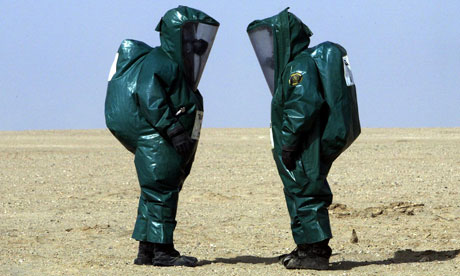
British soldiers wearing protective suits in Iraq circa 2003
The UK's Ministry of Defense announced that they would be sending a team of experts to Iraq to help the government there dispose of chemical warfare agents dating back to Saddam Hussein's regime.
The British Defense Ministry will start training Iraqi technical and medical workers this year, an embassy statement said. The teams will work to safely destroy remnants of munitions and chemical warfare agents left over from Saddam’s regime.

Saddam stored the chemical weapons near population centers so that he could access them quickly, despite the danger to his civilian population.

Most of Iraq’s chemical weapons were destroyed by military forces in 1991 during the first Gulf War or by U.N. inspectors after the fighting. The inspections halted just before the invasion.

The head of the Iraqi National Authority, Mohammed Al Sharaa, said the remnants "represent a great challenge to the Iraqi experts to safely dispose." He called the agreement with British authorities "a good opportunity for Iraqi experts to benefit from the well-known expertise of U.K. experts."
Most notoriously, the Saddam Hussein regime used chemical weapons against civilians and the Kurdish peshmerga militia in the village of Halabja in 1988.

Hussein was deposed during the American-led invasion in 2003, captured and eventually executed by Iraq's civilian government. Many anti-war activists and politicians had claimed there were never any chemical weapons to begin with and such talk was merely a fabrication to justify the an American-led invasion.

Althought no massive WMD cache was discovered by American or coalition forces, Sarin was discovered in a 2004 roadside bomb and in 2008, the Pentagon was approached by Iraq's civilian government to ship more than 500 tons of uranium out of Iraq to Canada for disposal by Cameco [NYSE- CCJ; TSX- CCO].

Some have speculated that Hussein was able to spirit away major components of his WMD program to Syria before the start of Operation Iraqi Freedom. This claim had been revisited when Syria's Bashr Al Assad threatened to use chemical weapons- including mustard gas, VX and Sarin- against armed insurgents clashing with his military or foreign forces who intervened in the ongoing conflict. However, Syria has had its own WMD program independent of Saddam Hussein's since before Operation Iraqi Freedom.

Tuesday, May 29, 2012

Syrian Diplomats Expelled From Western Nations After 108 Civilians Massacred in Village of Houla


In a clear indicator of the escalating violence in Syria, 108 people were massacred in a pair of opposition-controlled villages in the Houla region of Central Syria on Friday. Although there were signs that heavy artillery and armour were used- equipment only available to Bashr Al-Assad's army- the United Nations Human Rights Office said there were indications that many of the dead- which include nearly 50 children- were summarily executed.

According to local eyewitness accounts and the opposition Free Syrian Army, the Syrian army and militias loyal to president Bashr Al-Assad began their assault during Friday prayers.
Shelling of the town began at about 12.30pm after prayers and lasted about two hours.

Then, from around 3pm, groups of armed civilian militias — known as the Shabiha — began moving house to house and the killings, using knives and firearms, began.

According to both sources speaking independently, it went on for hours, family by family. Both groups say the killings continued until about 2am on Saturday.
In a UN report finished just days before the Houla killings, Brazilian diplomat and legal scholar Paulo Sergio Pinhiero accused Assad's regime of sending the Army to towns with a list of wanted opponents and executing their entire families. The Syrian regime has denied any involvement with the Houla massacre, claiming that the rebel Free Syrian Army and foreign mercenaries were responsible for the bloodbath.

Human rights groups accuse the Syrian Army and Shabiha [or 'ghost militia'- NANESB!] of handcuffing some of the children in Houla before killing them as well as setting fires to homes and businesses before using snipers to pick off residents as they flee the burning structures.

In response to Friday's killings and the Assad regime's rejection of any ceasefire agreement with opposition forces the USA, Canada, Australia, UK and many European Union nations have expelled Syrian diplomatic personnel on Monday.

Proving that Democrats have never met a mass murdering dictator they didn't want to coddle, Nancy Pelosi is seen meeting Bashr al Assad in Damascus in 2007.
The massacre even prompted a rebuke from Russia- Assad's most powerful international ally and arms supplier. However, Russia is still considered unlikely to distance themselves from the Assad regime despite diplomatic efforts from the West.

Thursday, April 19, 2012

Syrian Forces Open Fire on Refugee Camp Across Turkish Border; Suspected Iranian Arms Shipment Diverted to Turkey


Gunmen fired from Syria into a refugee camp across the Turkish border a few days prior to a UN-brokered ceasefire between the forces loyal to Syria's Assad regime and rebel soldiers and defectors from the Syrian army.

Syrian activists claim that Syrian forces were responsible for a fusillade of gunfire that raked a refugee encampment near the south central Turkish city of Tilis earlier this month.
At least 15 other people were wounded outside the facility as they were fleeing Syria into Turkey, the activists said.

Clashes between Syrian forces and Free Syrian Army rebels are taking place regularly during the night along the Turkish-Syrian border, activists told The Times. However, this reportedly was the first known incident of direct fire at a refugee camp.

"There were clashes in the border area between FSA and the regular army," said an activist at the camp who requested to be identified only as Tariq. "It started around 3 a.m. We hear gunfire every night. But it is the first time they directly fire at the camp.”


The camp is 400 to 500 yards from the border and hosts about 8,000 refugees, though it has a capacity of 12,000, he said.

"The regular army fired at the camp around noon," he said. "There are four wounded, including a Turkish nurse, and two Syrian refugees who were killed. They were both standing next to me on a higher ground, watching the clashes; I was filming when they were killed."
The incident could be construed as an attack on Turkey by Syria, which could trigger a mutual defense agreement Turkey retains with the rest of NATO.

On Wednesday, Turkish police and customs officials boarded a German cargo ship in the Mediterranean after a Der Spegiel magazine investigative report claimed the Atlantic Cruiser was carrying Iranian weapons destined for Syria.
Turkish Foreign Ministry and port officials said the ship was being towed into the port which is located on Turkey's eastern Mediterranean coast just over 100 km (60 miles) north of Syria, on suspicion it was carrying weapons.

The officials could not confirm if there were weapons aboard but said they were planning to inspect all the ship's cargo once it had been offloaded. The ship had been due to offload some of its cargo in Turkey as part of its route, they said.

A Reuters reporter in Iskenderun said he could see Turkish police from the customs and smuggling department on board the ship. Port officials said they had already inspected parts of the ship and would allow photographers aboard once the ship was docked.

German shipping company W. Bockstiegel, which owns the Atlantic Cruiser, ordered the vessel on Monday to turn its transponder back on after the ship switched off the tracking system because its crew feared attack.

The company has said it has no information about any weapons on board the ship which was originally destined for Syria.

White Whale Shipping, the Ukrainian company that chartered the Atlantic Cruiser has denied there were arms on board and said its cargo was civilian goods. Sending weapons to Syria would be in violation of a European Union arms embargo.
A website which tracks maritime shipping reported that the vessel was flying an Antigua Barbuda flag while Turkey's Dogan news agency had reported that the ship was displaying the Bahamas flag when it was intercepted.

Thursday, February 9, 2012

Syrian Armor Masses Outside of Opposition Stronghold of Homs After Hundreds Reported Killed in Shelling


Syrian forces continued their bombardment of rebel and Free Syrian Army positions in the western city of Homs Thursday and overnight into Friday. Opponents of the al-Assad regime in Damascus fear that this would be a final push by Damascus to crush organized opposition to the regime.


Recently bolstered by the late-January arrival of a substantial arms shipment from Russia and a Russian and Chinese veto of a United Nations Security Council resolution condemning the al-Assad regime for the violent crackdown of anti-regime demonstrations that have been taking place since late 2011, Syrian forces are said to have killed at least 200 rebel fighters and civilians in Homs this week. The al-Assad regime initially denied the artillery and rocket barrage even took place before claiming that the Syrian army was deployed to Homs at the urging of local residents earlier this week. While Syrian forces were shelling neighborhoods in Homs, Russian Foreign minister Sergei Lavrov and Russia's head of foreign intelligence met with president Bashar al-Assad in Damascus for three hours on Tuesday.

While Syrian tanks and APCs probed the rebel defenses in Homs- Syria's 3rd largest city- civilians and wounded fighters were evacuating the city of Homs to the Wadi Khaled area some 50 miles southwest of the city, others have sought refuge across the border in northern Lebanon.

Also on Friday, two explosions rocked the northern city of Aleppo (Syria's largest city). State run TV said the explosions targeted two security compounds in the city and would not specify the number of casualties.

Shortly after this weeks UN Security Council vote, the State Department closed down the US Embassy in Damascus and evacuated all diplomatic personnel.

Sunday, November 20, 2011

Syrian Army Defectors Attack Assad's Ruling Party Headquarters and Air Force Base

Syrian Military withdrawing from Hama over the summer- AFP Photo
In what has been the most high-profile attack against Basar Al-Assad's regime since widespread antigovernment demonstrations began earlier this year, defectors from the Syrian military attacked a military compound and fired rocket-propelled grenades at the Damascus headquarters of the ruling Ba'ath party this week.

On Wednesday, there were reports of explosions and gunfire in the Damascus suburb of Harasta as the Free Syrian Army claimed to have attacked and heavily damaged an Air Force Intelligence compound. Despite the name, Syria's Air Force Intelligence Directorate deals with matters unrelated to the air force, including harassing, intimidating and torturing political opponents at home and abroad.

Although there were no reported casualties in Wednesday's attack, the group of defectors from Syria's military calling themselves the Free Syrian Army (FSA) claimed they chose the Air Force Intelligence compound against the intelligence arm of Assad's ruling Ba'ath party as a symbolic target.

In the early morning hours of Sunday, rocket propelled grenades slammed into the headquarters of Assad's ruling Ba'ath party in Damascus.
Witnesses reported hearing two explosions before seeing smoke rising and fire trucks rushing to the scene early this morning.

It is thought the attack was carried out just before dawn when the building was mostly empty. There were no immediate reports of casualties.

Thabet Salem, a journalist who lives close the party building, told Al Jazeera: "This is a clear-cut escalation of what's going on ... It will bring us into a dangerous phase."
Besides pressure from the West, Syria faces additional pressure from the 22-nation Arab League as a deadline to either end the military crackdown or allow international monitors into the country passed over the weekend. Syria's membership in the Arab League was suspended earlier this month and Assad's regime may now face additional diplomatic and economic sanctions from once-allied nations in the region.

The Assad regime's ongoing crackdown, however, did not deter them from being accepted by the UN on the UNESCO organization, which oversees issues relating to human rights.

Monday, July 11, 2011

US, French Embassies in Damascus Stormed By Assad Loyalists


Nancy Pelosi visiting Bashr Al-Assad in 2007. Know them by the company they keep
An angry mob of Syrians loyal to president Bashr Al-Assad attacked the US Embassy on Monday, breaking windows, spray painting graffiti and raising a Syrian flag on US grounds. No embassy personnel were injured in the incident.

The State Department criticized Syrian authorities for their slow response to the incident and accused a Syrian TV station influenced by senior Ba'ath party officials of inciting the attack.

A French Foreign ministry reported that the France's Embassy in Damascus was attacked by a mob of Assad loyalists that forced their way onto the compound using a battering ram as Syrian security forces looked on. The crowd smashed windows on one of diplomatic vehicles and only dispersed after French guards fired warning shots in the air. Three embassy workers were reportedly injured in that assault.


AFP Photo
The attacks against the US and French embassies come a week after US Ambassador Robert Ford and French Ambassador Eric Chevallier visited Syrian opposition leaders in the restive city of Hama.

Wednesday, June 29, 2011

Assad Regime Crackdown Continues Amid Reports of Syrian Troops Defecting; Syrian Army Masses at Turkish Border

As troops loyal to the Bashr al-Assad regime continued their crackdown of anti government protesters, media reports claim that defecting soldiers and policemen are among the thousands of Syrian refugees streaming into southwestern Turkey.
Unwilling to open fire on demonstrators who have taken to the streets chanting the revolutionary slogans of uprisings across the Arab world, some Syrian troops have chosen to lay down their arms and flee to neighboring countries like Turkey.

It is difficult to estimate how many have done so, partly because they are afraid to speak out and partly due to severe restrictions on foreign media reporting in Syria, which makes it hard to corroborate accounts inside the country.

But Internet videos have begun increasingly to surface in recent weeks of men displaying military insignia and identification cards who say they have left an army that has used tanks and guns to suppress protesters calling for freedom.

Assad has relied on the armed forces, whose commanders are mostly from his minority Alawite sect, to crack down on protesters, who are mostly from the majority Sunni population.
Syrian troops have been massing along the Turkish border, occupying positions in border villages and attempting to block the flow of refugees to Turkey during the Assad regime's crackdown. The deteriorating situation within Syria has caused Turkish forces to be on aert and raised tensions across tge region.


Saturday, April 30, 2011

Days of Rage- Clashes, Assad Regime Crackdown Continues in Syria


Image from amateur video aired on Shaam News Network
Syrian tanks and infantry moved into the restive southern city of Daraa this week in a bid to quell continuing anti-government protests.

Water, electricity and lines of communication out of Daraa were cut as tanks and armoured vehicles opened fire on residential buildings. Prior to the Assad regime deploying soldiers and secret police to Daraa, the border with Jordan was shut down both south of Daraa and the border town of Naseeb. Bodies of residents were said to have remained in the streets or in vehicles after clashes with soldiers and secret policemen in plainclothes. Rights groups say that at least 60 of those took place on Friday's 'Day of Rage' protest

In the western part of Syria, Syrian troops have managed to wrest control of the city of Homs back from the protesters.

An exact body count was difficult to determine due to the ruling Ba'ath party's ban on foreign media, but observers and human rights groups have claimed that at least 450 civilians were killed nationwide in clashes with the military and police loyal to the Assad regime- and at least 60 of those in 'Day of Rage' protests after Friday prayers this week.

In Damascus, some 200 members of the ruling Ba'ath party have reportedly resigned en masse to protest the regime's handling of the current crisis [although this could be a self-serving move to distance themselves from the Assad regime should it eventually fall- NANESB!]


Here is Bashr al-Assad in happier and more serene days, meeting with then speaker of the House Nancy Pelosi, not even two years after the Syrian-backed Hezbollah terrorist group assassinated outspoken anti-Syrian Lebanese PM Rafik Hariri with a car bomb in Beirut.

Tuesday, April 12, 2011

Crackdown on Anti-Government Protests in Syria Intensify, Syrian Army Surrounds Mediterranean Port City

While the unrest and antigovernment demonstrations in North Africa, Bahrain and Yemen have been getting a good deal of attention in the media, it appears as though that the situation Bashar al-Assad's authoritarian Syria is escalating.

After clashes in the Northwestern port city of Banias killed four and wounded at least 17 on Sunday, units from the Syrian Army cut off electricity and ringed the city with troops and armor.


Map of protests and clashes in Syria over the last month- Wikimedia
Human rights groups have also alleged that Syrian troops fired live ammunition into a crowd of protesters at a funeral procession for 17 people killed during clashes in the southwestern city of Daraa over the weekend, reportedly killing another 28 opposition demonstrators. New York-based Human Rights Watch has also claimed that Syrian military and security officers were preventing medics from treating the wounded after clashes in Daraa and suburban Damascus over the weekend.

Syria has been officially under a state of emergency since 1963- even longer than Mubarak had been in power in Egypt. The state of emergency gives the Damascus government sweeping powers, including the ability to detain people for indefinite periods of time. The ruling Ba'ath party has held power in Syria since 1963 and the country has been governed by a member of the al-Assad family since 1971, with Bashar's father Hafez al-Assad ruling until his death in 2000.

Hafez al-Assad was also responsible for the 1982 Hama massacre, where the Syrian military bombarded and razed Hama's old city in retaliation for Muslim Brotherhood attacks on Syrian security forces and government workers. The lower estimates for the death toll in Hama at the time were in the neighborhood of 10,000- mostly civilians, although it was likely even higher thanks to the secretive nature of the al-Assad regime.