Five people were fatally stabbed by the 22 year old son of a Calgary police inspector during an off-campus party near the University of Calgary earlier this week. According to the Calgary Herald, the slashing spree that took place in the early morning hours of Tuesday is the worst mass murder in the western Canadian city's 140 year history.
The victims — Lawrence Hong, Josh Hunter, Kaitlin Perras, Zackariah Rathwell and Jordan Segura — were, by all accounts, celebrating like everyone else when they became the subjects of an unprovoked attack just after 1 a.m. Tuesday.
Police Chief Rick Hanson said the victims were "targeted one by one" during a house party at 11 Butler Cres. N.W.
"These were all good kids. There’s no question about that. They did nothing wrong, and nothing that they did contributed to what happened to them," Hanson said.
Police have a suspect — the son of a well-regarded senior officer from their ranks — and the names of the victims quickly spread among grief-stricken family members, friends and classmates as Tuesday wore on.
While the police have yet to specify a precise motive, they charged de Grood with five counts of first-degree murder — a charge that indicates evidence of planning and deliberation.
Two of the victims, Josh Hunter and Zackariah Rathwell, were members of a popular local band, Zackariah and the Prophets.
Hunter, 23, was also an accounting major at the University of Calgary’s Haskayne School of Business. Rathwell, 21, was a first-year student at the Alberta College of Art and Design.
"They were amazing, they were really creative and they inspired me," said Eric Grant, a friend of the bandmates who attended a candlelight vigil for all five victims at U of C on Tuesday night.
"Today has been the hardest day of my life."
Segura, 22, was a religious studies student at the University of Calgary. Perras was 23; Hong was 27.
Investigators were still trying to sort out if any of the victims lived at the rented house that hosted the party, but police said it was mainly a gathering of University of Calgary students celebrating Bermuda Shorts Day, a long-running tradition to mark the last day of classes.
Tuesday's stabbing was the single deadliest crime in Alberta since March 2005, when 4 RCMP officers attempting to impound a truck discovered a marijuana grow-op and stolen vehicle parts on the property of John Roszko in Mayerthorpe, some 75 miles northwest of Edmonton. The officers were ambushed by Roszko while searching his property and Roszko turned his weapon on himself as RCMP reinforcements surrounded him in a shed.
NEW YORK- At least four people were killed and 70 injured on Sunday morning when a Metro-North commuter train derailed just north of the Spuyten Duyvil station in the Bronx.
Early reports indicate that the train was travelling at speeds in excess of 80 MPH as it headed into a curve along the Harlem river where the maximum speed limit is 30 MPH. The National Transportation Safety Board is leading the investigation and has recovered two event recorders from the crash site. At the time, the train was operating in 'push-pull' mode where the train appears to be running backwards with the locomotive pushing from the rear and controlled by the engineer in a specially equipped enclosure in the 'trailing' car. This is fairly common practice among a number of commuter rail agencies as well as some Amtrak routes.
The cellphone records and blood samples of the engineer- who survived the wreck and was released from the hospital- have been taken, but no word on the results from the NTSB yet.
New Mexico State Police released the names of the three on board the Southwestern Railroad freight train which was operating between the massive Freeport McMoran open put copper mine in Santa Rita, NM and the Southwestern yards at Hurley, NM. The eight carloads of iron ore the train was hauling remained upright while the locomotive- a former Conrail GP40- landed on its side after falling roughly 50 feet into an arroyo.
Law enforcement previously reported that all three victims were men, however, one of the victims was a woman, Ann Thompson, 50, originally from Paulden, Ariz. The other two victims were Donald White, 38, of Silver City, and Steven Crose, 60, also of Paulden, Ariz.
Crose and White both worked for the railroad. Thompson was Crose's girlfriend, said Wanda Shepard, Crose's cousin. It is also unknown why Thompson was inside the locomotive at the time of the crash as she did not work for Southwestern Railroad, Shepard said. Both Thompson and Crose had recently moved to the Hurley area just three weeks ago for Crose's job.
"They loved being on the train," Shepard said of White and her cousin. "They loved it. It was their calling, and they were really proud of their jobs and what they did."
Although the train was carrying no hazardous materiel, the fire department from nearby Silver City, NM was called in to contain a diesel spill from the derailed locomotive.
A subsidiary of Western Railroad Builders, Inc, the Southwestern operates two disconnected lines in southern New Mexico. In 1990, the railroad purchased a cluster of former Santa Fe lines radiating out of Whitewater, NM to copper mines in Tyrone and Santa Rita in Grant County, NM. By 1994, the line from Whitewater to the then-Southern Pacific interchange in Demming, NM was purchased from the Santa Fe and by 2002, Western Railroad Builders agreed to a lease with BNSF for the line between Demming and Hatch, NM. To the east, the Southwest began operations on more than 200 miles of former BNSF trackage between Clovis and Carlsbad, NM when they entered into a lease agreement with the BNSF in 2004.
Western Railroad builders also operates the 250+ mile Cimarron Valley Railroad in Kansas, Oklahoma and Colorado as well as the 40-mile Arizona Central out of Clarkdale, AZ.
ALBERTA- The Canadian National Railway suffered two derailments in the province of Alberta in the span of a few weeks, one of them prompting the evacuation of a nearby town.
On October 19th, a Canadian National train hauling oil and LPG derailed near the village of Gainsford, AB west of Edmonton at approximately 1 AM local time. Witnesses reported hearing a loud series of crashes before seeing a fireball shoot up into the sky. After evacuating nearby residents and shutting down the Yellowhead Highway which runs parallel to the CN line, emergency crews decided the safest option would be to allow the fire to burn itself out.
In the early morning hours of Nov 3rd, a second Canadian Nation freight train derailed outside the hamlet of Peers, AB- also west of Edmonton. That train was determined to be carrying lumber and sulphur Dioxide, a hazardous material but not as volatile as oil or LPG.
According to the Randolph County Sheriff's Office, the driver of the log truck was the sole fatality of the collision and when they arrived on the scene, the gates and flashing lights on the crossing were functioning.
Randolph County Sheriff Mark Brady said two of the train’s passenger cars flipped on their sides after impact at a rail crossing with a mountain highway, the log truck was rendered a “total loss” and the truck driver was pronounced dead at the scene.
The truck driver was not immediately identified and news photographs from the scene at West Virginia’s Cheat Mountain showed large, heavy logs jumbled beside the two toppled train cars amid a chaotic scene of first responders aiding shaken passengers leaving the train.
Brady said the accident occurred at a train crossing on U.S. Route 250 at a bridge on the mountain. The overturned passenger cars lay beside the tracks, roped off with yellow crime scene tape as police, firefighters and others looked on.
Headquartered in Elkins, WV the West Virginia Central railroad operates more than 130 miles of former Western Maryland trackage in the eastern part of the state. Although it does intermittently haul freight, excursion trains such as the New Tygart Flyer, Durbin Rocket and Cheat Mountain Salamander have proven big draws for the line. Future plans for the line include re-opening a connection with the Cass Scenic Railway, a former logging railroad now a state park and tourist hauler as well as establishing a permanent home for the West Virginia Railroad Museum in Randolph County along the WVCR right-of-way.
Floodwaters that were responsible for the deaths of at least three people made their way into the heart of Alberta's largest city, forcing the evacuation of at least 75,000 people from their homes over the weekend.
In downtown Calgary, water was inundating homes and businesses in the shadow of skyscrapers. Water has swamped cars and train tracks.
The city said the home rink of the National Hockey League's Calgary Flames flooded and the water inside was 10 rows deep. That would mean the dressing rooms are likely submerged as well.
"I think that really paints a very clear picture of what kinds of volumes of water we are dealing with," said Trevor Daroux, the city's deputy police chief.
At the grounds for the world-famous Calgary Stampede fair, water reached up to the roofs of the chuck wagon barns. The popular rodeo and festival is the city's signature event. Mayor Nenshi said it will occur no matter what.
About 1,500 have gone to emergency shelters while the rest have found shelter with family or friends, Nenshi said.
The flood was forcing emergency plans at the Calgary Zoo, which is situated on an island near where the Elbow and Bow rivers meet. Lions and tigers were being prepared for transfer, if necessary, to prisoner holding cells at the courthouse.
Schools and court trials were canceled Friday and residents urged to avoid downtown. Transit service in the core was shut down.
Alberta Premier Alison Redford warned that communities downstream of Calgary had not yet felt the full force of the floodwaters.
Officials estimate that as many as 350,000 people work in downtown Calgary on any given weekday, but that was not a problem on Friday as most residents and commuters heeded official warnings about travelling to downtown Calgary.
The flooding has also affected a number of Indian reservations (called First Nations Communities in Canada) to the south and east of Calgary and residents have been advised to boil tapwater before using it. Nearby schools are closed until further notice as many of them are being used to shelter evacuees.
The Canadian military was activated to help with flood control and evacuation in the province. Canadian Prime minister Stephen Harper, a Calgary resident himself, viewed the damage from above via helicopter.
To the west, the flooding had knocked Canadian Pacific's transcontinental mainline out of commission between Banff and Calgary, leaving some CP freight trains stranded in Alberta or British Columbia as the railroad negotiates with Canadian National and other carriers to accommodate detour traffic. Additional damage, including a washed out bridge, has been reported on CP's Crowsnest subdivision further south.
With a population of one million, Calgary is the largest city in Alberta and fifth largest metropolitan area in Canada. The TransCanada Highway and Canadian Pacific's transcontinental mainline both pass through the city. The city is probably best known as an energy and agricultural hub for western Canada and home of the Calgary Stampede- a 10 day rodeo and exhibition held every July in the city [Organizers of this year's Stampede have announced that the event will go on as planned, despite there being less than two weeks from the scheduled start- NANESB!] Calgary hosted the 1988 winter Olympics and is the home of the NHL's Calgary Flames as well as the Calgary Stampeders of the Canadian Football League and Calgary Hitmen of the WHL.
While much of the drilling and refining takes place elsewhere in the province, Calgary has been an administrative center for the oil and natural gas companies operating in western Canada since the 1970s- more than 80% of the gas companies operating in Canada are based out of Calgary. In 1996, the Canadian Pacific Railway relocated their headquarters from Montreal to Calgary.
The lengthy report says Canadian tar sands are likely to be developed, regardless of whether the U.S. approves Keystone XL, which would carry oil from western Canada to refineries in Texas. The pipeline would also travel through Montana, South Dakota, Kansas, Nebraska and Oklahoma.
The report acknowledges that development of tar sands in Alberta would create greenhouse gases but makes clear that other methods to transport the oil -- including rail, trucks and barges -- also pose a risk to the environment.
The State Department analysis for the first time evaluated two options using rail: shipping the oil on trains to existing pipelines or to oil tankers. The report shows that those other methods would release more greenhouse gases that contribute to global warming than the pipeline. The Keystone XL pipeline, according to the report, would release annually the same amount of global warming pollution as 626,000 passenger cars.
A scenario that would move the oil on trains to mostly existing pipelines would release 8 percent more greenhouse gases such as carbon dioxide than Keystone XL. That scenario would not require State Department approval because any new pipelines would not cross the U.S border.
Another alternative that relies mostly on rail to move the oil to the Canadian west coast, where it would be loaded onto oil tankers to the U.S. Gulf Coast, would result in 17 percent more greenhouse gas emissions, the report said.
In both alternatives, the oil would be shipped in rail cars as bitumen, a thick, tar-like substance, rather than as a liquid.
Because the new pipeline would cross the US/Canada border, the decision was initially left up to the State Department. However, the Obama administration initially blocked the pipeline claiming it posed a risk to the environment as it passed through the ecologically sensetive Ogallala Aquifer. The White House has yet to weigh in on an altered route that circumvents the Ogallala Aquifer and Sand Hills region of northern Nebraska.
The Athabasca Oil Sands in northern Alberta are said to be the world's largest known deposit of bitumen oil sands, and have prompted increased interest from China in recent years. As the KeystoneXL project has been held up by years of red tape, bureaucratic foot-dragging and use as a political football, Canada plans on going ahead with a second pipeline run by Enbridge [NYSE- ENB] called the Northern Gateway pipeline that would run from Alberta to British Columbia's Pacific coast where the oil would be exported to China.
The Conrail freight was pulling 84 cars and heading southbound along a branchline when the derailment occurred Friday morning. At least one of the cars ruptured, sending a cloud of vinyl chloride into the air and forcing the evacuation of hundreds of residents nearby- 70 people were also hospitalized with respiratory problems.
Conrail and investigators from the National Transportation Safety Board are focusing on the 139 year old bridge- a movable 'A Frame' type span. The bridge was manually operated and had a bridge tender on site until the last decade or so. There was reportedly a minor derailment along the same bridge in 2009 and Conrail was investigating problems with trackside signals near the bridge in the week or so before Friday's derailment.
The veteran two-person crew operating the CSX train Friday was familiar with the route and had run it the three previous nights. They had started their shift at 3 a.m. in Camden and were surprised to get a yellow signal when they approached the bridge at about 7 a.m. They used a keypad device, similar to a garage door opener, to try to get a green light, to no avail. The pair then stopped the train for several minutes, examined the tracks, and got permission from a dispatcher to proceed, Hersman said.
The two locomotives and five tanker cars made it across before the crew looked back to see the bridge “collapse” and a pileup of cars in the creek. The one that ruptured had been struck by another tanker, she said.
Recordings of various data so far support the crew’s account, investigators said. However, authorities are not yet sure whether the bridge deck actually collapsed or shifted.
Officials are also considering tidal surges from the passing of Super storm Sandy may have factored into the derailment, undermining the 1873-built bridge. However, NTSB investigators can't do a thorough on site examination until the remaining chemicals are cleaned up.
Bracketing a Liquified Natural Gas tank car, rebuilt SD40-2s #5262 and #5258 are seen in handout photo from Canadian National Railways. CN is experimenting with rebuilding locomotives to run on LNG
The conversion kits was supplied by Energy Conversions, Inc of Tacoma, WA and Calgary-based natural gas producer Encana [NYSE- ECA; TSX- ECA] will be providing the fuelling and the maintenance. Officials with Canadian National and Energy Conversions say that the move could cut carbon dioxide emissions by 30%. While Alberta is a leading energy producer thanks to crude oil and the oil sands, the province also sits on top of considerable natural gas deposits. However, the current glut has driven natural gas prices down- although this would put CN at an advantage should the prices persist as it expands the LNG-powered locomotive program.
Canadian National's LNG project is similar to an earlier natural-gas powered locomotive project from Energy Conversions. Between 1991 and 1996, the Burlington Northern Railroad ran coal trains between Wyoming's Powder River Basin and the midwest with a duo of SD40-2s bracketing an LNG tanker/tender modified by Energy conversions. Although the Burlington Northern program stopped around the same time as the merger with Santa Fe to form BNSF, Energy Conversions would do similar work for the Napa Valley Wine Train, the state railways of Thailand and Brazil's Companhia Vale do Rio Doce's [NYSE- VALE, BOVESPA- VALE3 & VALE5] rail operations.
The locomotives used for CN's LNG pilot program are a pair of 1975-built SD40-2Ws that are now sporting flared radiators- like the SD40-2s Burlington Northern used 20 years ago. Both locomotives and the LNG tanker/tender will be assigned to the 480km Canadian National line between Edmonton and the Athabasca oil sands hub of Ft McMurray, AB. Built in the 1920s, the line was originally part of the Northen Alberta Railway until NAR was taken over by CN in 1981. By 1994, CN ceased operations and the line was acquired by Rail Link's Lakeland & Waterways- who were brought into the Rail America fold by 1999. In the summer of 2000, Rail America halted operations on the Ft. McMurray line and within a few months, Canadian shortline operator CANDO contracting acquired the line outright from CN, only to have CN repurchase the line at the end of 2007.
Presently, the Canadian National hauls construction materiel, pipe and heavy machinery up to Ft McMurray and brings oil sands extraction byproducts like petroleum coke and sulphur south.
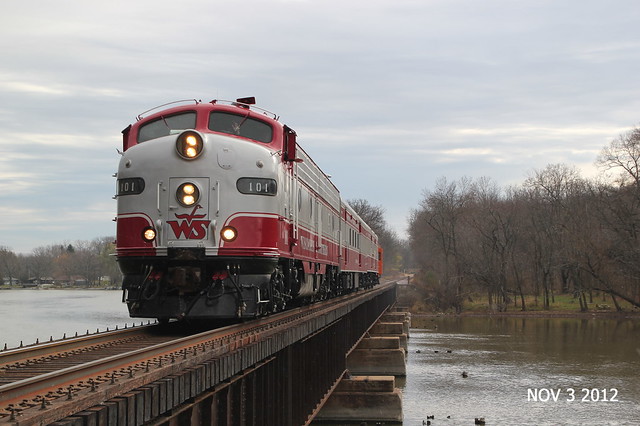
Wisconsin Southern E9A #101 seen hauling the Toys for Tots train cross the Rock River east of Edgerton, WI on November 3rd, 2012. photo- Brian Allen
WISCONSIN- Just a quick update out of the Badger State. I had earlier reported that Soo Line 2-8-2 Mikado #1003 was scheduled to haul a Toys for Tots holiday train over the Wisconsin & Southern last month.
However, shortly before the scheduled November 3rd departure, the #1003 was sidelined with an unspecified mechanical problem. Wisconsin & Southern E9A #101 handled the Toys for Tots train between Milton and Middletown, WI.
The #1003 was pulled from service two years ago in order to under to undergo her FRA-mandated 15 year boiler inspection. Due to rising costs, there were some concerns from the preservation community that the #1003 would never return to service again.
Colombus-based American Steam Railroad Preservation Association has reached an agreement with the Cleveland-based Midwest Railway Preservation Society to house the restoration of former St Louis-San Francisco 2-8-2 Mikado #1352 at the MRPS' former Baltimore & Ohio roundhouse in Cleveland.
The #1352 was built by ALCo in 1912 and operated on the Frisco for nearly 45 years before her 1956 retirement. The Frisco donated the #1352 to Kansas City where she was on display at Swoop Park, but soon fell victim to neglect and vandalism. A group of concerned preservationists eventually purchased the 1352 and moved her into storage in rural Illinois.
The MRPS is also home to another, slightly newer ALCo 2-8-2 Mikado- former Grand Trunk Western #4070. The #4070 was built in 1918 and most recently operated in 1990 on the nearby Cuyahoga Valley Scenic Railroad.
As the American economy continues to receive bad news amid Barack Obama's reelection and increasing concerns about the upcoming 'fiscal cliff', Canada has made it clear that it needs workers and is looking to the USA to help fill that gap [and I for one welcome our new Canadian overlords- NANESB!]
Much of western Canada is experiencing a shortage of skilled laborers- this is particularly true of the energy sector in oil-rich provinces like Alberta or Saskatchewan. Despite the fact that just under 30,000 Canadians made their way to Alberta from other provinces to find work in the last year, oil industry consultants believe they'll need more than 35,000 additional workers over the next decade for the oil sands alone. Moreover, companies will be losing a large number of worker due to attrition as statistics have shown much of the current workforce in the oil sands, exploration and refineries is middle-aged.
[...] the industry’s growth is far from certain.
“Labour shortage impacts could threaten investment, revenues and sustainability throughout the entire energy value chain,” said Peter Boag, president of the Canadian Petroleum Products Institute, which recently changed its name to Canadian Fuels Association.
The country’s energy sector industry directly employed 187,000 workers last year, and that’s set to grow exponentially.
“There will be no reprieve from current hiring challenges for oil and gas services as the sector will need to fill thousands of positions between now and 2015,” says HR Petroleum Council in a report. “Employee turnover is the sector’s greatest workforce concern as it escalates costs and exacerbates sector-wide labour and skill shortages.”
The oil sands are different in that they have to be extracted in a manner more reminiscent of mining for ore than drilling for oil. Although environmentalists opposed development of Alberta's oil sands, the oil has been naturally seeping into nearby bodies of water such as the Athabasca River for centuries. Although much less straightforward to extract, the mixture of sand, clay, water and bitumen locked in the ground are said to rival the conventional petroleum reserves of Saudi Arabia and Venezuela. Much of the oil sands activity is centered northeast of Edmonton around Fort McMurray, Alberta- a latter-day boomtown dubbed by some as 'Fort McMoney'.
Since 2010, about 35,000 U.S. workers a year have been issued work permits, according to Canadian immigration statistics. That's up 13% from earlier in the decade. And that figure is expected to grow as provinces continue to loosen requirements for temporary foreign workers.
Rudolf Kischer, a Vancouver-based immigration attorney, said his firm can hardly keep up with the processing of work permits for employers hiring U.S. help.
"We're the busiest we've ever been," he said.
Many of those workers are heading to where the labor market is hottest: Edmonton.
Edmonton has become a staging ground for oil companies that include Canada's Suncor Energy Inc., Shell Canada Ltd. and Chevron Canada Ltd. The energy sector has in turn boosted industries such as manufacturing, home building and retailing.
With a population of about 812,000, Edmonton looks a lot like many American cities. There are large strip malls anchored by U.S. retailers such as Costco and Home Depot, and ubiquitous coffee shops — except here Tim Horton's doughnut shops outnumber Starbucks 3 to 1.
The biggest difference: The unemployment rate here is 4.5%, and "We're Hiring" signs are posted in almost every window.
Jobs near Fort McMurray, a remote town six hours north, are the best-paid; a welder can make up $37 an hour. (At present Canadian and U.S. dollars are almost equivalent in value.) But laborers must stay in barracks-style camps, which energy companies have upgraded to woo them. The best ones offer private rooms with flat-screen TVs, gyms, prime dining and wireless Internet access.
Workers spend as long as a couple of months at a stretch laboring before returning to Edmonton "moneyed up," as the expression goes around here. Workers then pump those dollars into the local economy.
The province of Alberta boasts a median household income of $83,000 compared with $50,000 in the U.S.
Andrew Hoggard, a 35-year-old auto mechanic who moved to Edmonton from Michigan in March, can hardly keep up with his workload. He puts in 12-hour days at a local Chrysler dealership, including some Saturday shifts.
Still, he's not complaining. In eight months, he's made $70,000. Back in Holland, MI, where he worked on commission at Nissan dealership, he relied on his parents to help him pay rent when the work slowed.
In British Columbia, an unprecedented construction boom has left the province short on workers. However, in southern California, even before the current recession there have been thousands of skilled tradesmen who remain unemployed, underemployed or are working outside their field altogether. This led to officials in Riverside County, CA to coordinate with Canadian delegations and organizations like the British Columbia Construction Association to hold a job fair slated for early December in Indio, CA.
“Some have not found work for the past four years in their trade,” said Tom Freeman, commissioner with the Riverside County Economic Development Agency’s office of foreign trade, which has helped set up a Dec. 4 job fair in Indio to recruit workers willing to move north.
Economic development specialists and others in the Coachella Valley have been very involved in what is called the “workforce mobility program,” with initial meetings taking place in Palm Springs and Desert Hot Springs, Freeman said.
The British Columbia Construction Association, which represents some 2,000 companies, will have a delegation at the job fair, as it has at similar job fairs held in Ireland and Scotland, said Abigail Fulton, vice president and an attorney with the association based in Victoria, British Columbia.
“We actually do the immigration work at no charge,” said Fulton, who noted the association is not looking for laborers but rather skilled tradesmen familiar with large commercial and industrial-type projects.
Along with competitive or even higher wages than companies are paying in the U.S., Canadian recruiters are touting steady work, retention bonuses, free universal health care and quality schools.
A flier sent out by Riverside County, the British Columbia Construction Association and the Canada California Business Council lists heavy equipment operators, iron workers, pipe fitters, mechanics, and mechanical and electrical engineers as among trades that are needed.
Of course, Canadian companies and recruiters aren't just limiting their search to the USA. Similar trade shows like the one set to take place in Indio have already been set up in Ireland and Scotland. Canadian officials have also been courting Polish immigrants in the United Kingdom, attempting to coax them into making the move to Canada. While this may sound like an unusual or way-too-specific niche, as of 2001 there are an estimated 980,000 Canadians of Polish ancestry [including Wayne Gretzky, Geddy Lee and William Shatner- NANESB!] and the UK's Office for National Statistics estimated there were an estimated 515,000 Poles either temporarily or permanently residing in the United Kingdom as of 2010.
UK Federation of Poles chairman Włodek Mier-Jedrzejowicz said he had been contacted by Canadian officials who said they were particularly keen on Poles able to fluently speak English.
While there are no doubt some drawbacks for Americans working in Canada [ie- you'd be taxed four times- US federal taxes, Canadian federal taxes, the provincial tax of wherever you live and the state tax of the last state you resided in before leaving- NANESB!] the Canadian dollar and the US dollar are roughly on par, interest rates for savings is slightly higher in Canada and provinces like Saskatchewan and Alberta enjoy more economic freedom than all but a handful of US states according to a Canadian think tank. A recent report from the Fraser institute also stated that Canada is among the top five nations in the world for economic freedom while the USA has plummeted from second place to 18th.
I find it interesting that when I was growing up, I remember that American liberals wanted the nation to follow Canada's lead as far as healthcare, military spending and gun control went. However, now that Canada is drilling for oil, sending troops to Afghanistan and rolling back gun control laws the liberals here in the USA aren't as keen to have the country be more like Canada.
Canadian lawmakers are expected to pass a back-to-work bill that would get Canadian Pacific [NYSE: CP- TSX: CP] trains rolling by the weekend and order striking Canadian Teamsters back to work on Thursday.
The striking Canadian rail workers have been working without a contract since December 31st. At issue when the Teamsters Canada workers called a strike last week was a new contract and pension funding reductions of up to 40%. Canada's Conservative government has previously passed similar back-to-work legislation to end strikes at Canada Post and Air Canada [TSX: AC-A] in recent years.
Trains from Canada's second-largest railway ground to a halt on May 23rd, severely curtailing CP Rail's operations on the American side of the border as well as those of shippers and railways that interchange with CP Rail.
The Montreal, Maine & Atlantic, which utilizes trackage rights over CP Rail at the western end of the MM&A system near Montreal, has temporarily laid off 59 employees and re-routed some interchange traffic to the Vermont Railway via Newport, VT. Canadian Pacific is responsible for dispatching trackage in and around the St Jean, Quebec interchange. While an agreement to keep commuter trains in Montreal, Toronto and Vancouver operating during the strike had been reached shortly beforehand, the MM&A unsuccessfully sought a court injunction to allow the regional railroad to access Canadian National for interchange in Montreal.
Earlier this year, Canadian labor groups were handed a major setback when EMD's parent company Caterpillar [NYSE- CAT] decided to shutter their London, Ontario plant and shift production to Muncie, IN after a months-long labor dispute with workers at the plant represented by the Canadian Auto Workers.
BNSF freight train cresting the Cascade Range in Washington state. Photo- Mike Bjork
According to a recent report in Bloomberg, Warren Buffet's BNSF Railroad and parent company Berkshire Hathaway [NYSE: BRK-A] stand to gain more traffic and revenue after President Obama declined approval of the proposed KeystoneXL pipeline from Canadian firm TransCanada [NYSE: TRP/TSX: TRP] that would transport oil from Alberta' Abathasca Tar Sands to Gulf Coast refineries.
A BNSF spokeswoman stated that if the KeystoneXL Pipeline "doesn't happen, we're here to haul".
With modest expansion, railroads can handle all new oil produced in western Canada through 2030, according to an analysis of the Keystone proposal by the U.S. State Department.
The rail option, though costlier, would lessen the environmental impact, such as a loss of wetlands and agricultural productivity, compared to the pipeline, according to the State Department analysis. Greenhouse gas emissions, however, would be worse.
Investors such as John Stephenson, who helps manage $2.7 billion for First Asset Management Inc. in Toronto said he anticipated the project would move forward next year. Pipeline shipping costs remain lower than rail, and a lack of readily available tanker cars may create a bottleneck.
The availability of tank cars may create a temporary “hiccup” in transport capacity, according to Tony Hatch, an independent railroad analyst in New York. Rail cars are “a pretty hot commodity,” as a result of demand from oil producers in North Dakota, he said.
Rail car production is already at a three-year high as manufacturers such as Greenbrier Cos Inc. [NYSE: GBX] and American Railcar Industries Inc. [NASDAQ: ARII] expand to meet demand for sand used in oil and gas exploration, according to Steve Barger, an analyst at Keybanc Capital Markets Inc. in Cleveland, citing Railway Supply Institute statistics.
Oil and natural gas moving to refineries by train is hardly a novel concept. Between 1983 and 1997, the Southern Pacific Railroad ran a daily 70+ car train from the oil fields around Bakersfield, CA over the Tehachapi mountains to the refineries in Long Beach, CA. The train- sometimes known as the Oil Can- ceased its daily run after a pipeline over the mountains was completed in the late 1990s. Over in Big Sky Country, the Montana Rail Link runs a daily 126-mile gas train between Missoula and Thompson Falls, MT to bypass a section of Conoco-Phillips' [NYSE: COP] Yellowstone Pipeline after a section of the gasoline pipeline in the Flathead Indian Reservation was shut down following a 1993 spill.
However, both of the aforementioned measures described were primarily stopgaps and seemingly inadequate for the scale and distances involved with the Abathasca Oil Sands. With a dedicated pipeline, TransCanada wouldn't have to worry about the tank cars sitting idle in a rail yard somewhere, crew changes every 200 or so miles or moving empty tank cars back to the oil fields.
To the south of the Abathasca oil sands, both BNSF and Canadian Pacific have been working to improve capacity and track speed on some of their North Dakota lines in order to better serve the Bakken Oil Shale that straddles the US/Canada border. In addition to the traffic generated from the Bakken shale, it would also be worth pointing out that BNSF would've also benefited if the pipeline was approved, as it is virtually the only Class 1 carrier that runs through the projected KeystoneXL pipeline route and almost certainly would've been called upon to deliver much-needed equipment and supplies for the construction and maintenance of KeystoneXL.
Obama mentioned numerous times that Buffet's secretary pays a higher tax rate than her billionaire employer while in his repeated calls for higher taxes. Buffet's secretary was present for Tuesday night's State of the Union address, sitting with first lady Michelle Obama. However, that little bit of political theater could backfire now that it's been learned that Buffet's secrtary could make anywhere from $200,000 to $500,000 annually. It's entirely possible that a sympathetic Bloomberg could've temporarily spiked the article to avoid any bad publicity while one of Buffet's employees was going to be used as a class-warfare prop from the President during Tuesday's state of the Union.
OMG! ThEh st00pid! It burns! IT BUUUUUUUUUUUUUUUURNS!!!!!
It was a brief snippet, to be sure, and I thought that perhaps with the benefit of some context, the Congresswoman was merely saying that she was skeptical that the project would create 20,000 jobs [I ardently support the project but even I find that number a little optimistic- NANESB!]. So I found a longer snippet, and not only does the suburban Chicago democrat say exactly I thought she said, she goes on to promote the Obama Administration's massively failed Green Jobs agenda and blames Republicans for Obama's veto, even though most Republican Congressmen, Senators and governors support the project.
"Twenty thousand jobs is really not that many jobs and investing in green technologies will produce that and more. But I'll tell you what, you know it seems to me that the Republicans would rather have an issue than a pipeline" [emphasis mine- NANESB!]
The Obama Administration formally dismissed a bid by a Canadian company to construct a pipeline that would bring in oil from northern Alberta's tar sands to Texas for refining. Although the State Department and Obama Administration has left the door open for TransCanada [NYSE: TRP] to re-apply for a permit to build the KeystoneXL pipeline or alter the planned route, it's considered unlikely that the company will do so until after the 2012 Presidential election.
President Obama had until Feb 21st to make a decision regarding the proposed KeystoneXL pipeline, but [brace yourself- NANESB!]blamed Republicans for his decision claiming that the 'arbitrary' deadline made approving the project impossible, despite the fact that the project has been under review for environmental impact on both sides of the border since 2007. Initially, approval of the product was left up to the State Department owing to the fact that it crossed an international boundary into the USA. President Obama initially announced that he would punt the final decision on KeystoneXL until after the 2012 election [i.e. when either somebody else was in the White House or he didn't have to worry about re-election- NANESB!] but House Republicans included a stipulation in the payroll tax cut debate in December that Obama had to make a decision within 60 days on the pipeline.
At least one union, the Laborers International Union of North America (LiUNA), was furious with the Obama Administration's decision, citing that the project has already underwent more than 1100 days of environmental review and that the Presidents dismissal of TransCanada's project disproportionately hurt the construction industry, which has been experiencing persistently high unemployment for the last 3 years.
Instead of waiting around for Presidential approval that is less likely to be granted, Canada is looking to market the oil from the Abathasca Oil Sands in China. To that end, TransCanada's competitor Enbridge Energy [NYSE: ENB, EEP, EEQ], backed by China's quasi state-run Sinopec[NYSE- SHI] are working on building a pipeline dubbed the Western Gateway Pipeline that would link Alberta with the Pacific Coast where the oil would be shipped to Asia from there. Curiously, this route raises even more environmental concerns as the proposed western terminus of the Northern Gateway pipeline is Kitmat, BC. From the Pacific ocean, Kitmat is only accessible by a relatively narrow inlet that poses a number of weather and navigation hazards, and the province of British Columbia imposed an informal moratorium on tanker traffic off shipping lanes north of Vancouver Island.
Along with Beacon, Evergreen solar was de-listed from the NASDAQ recently. While Beacon Power still maintains a Tyngsboro, MA address, in a cost-cutting measure, Evergreen left the Commonwealth of Massachusetts for facilities in China despite Massachusetts awarding the company nearly $60 million in grants and tax incentives to set up shop in Devens, MA.
Keep in mind that the American taxpayer is more than $500 million in the hole for Solyndra alone, but with 11 other failing 'green energy' companies who were recipients of DOE loans and various government grants, that number can only go up.
Heavy-duty mining trucks loaded with oil sands for processing at Fort MacMurray, Alberta- photo Jeff McIntosh/Canadian Press
The Obama Administration postponed an important decision regarding the proposed KeystoneXL pipeline that would bring oil from Alberta's Athabasca oil sands to a refinery in Texas. Conveniently enough for the President, the delay means that a decision on the fate of the project won't be reached until after the 2012 Presidential election.
The State Department suggested that looking at new routes for the pipeline within the state of Nebraska would take until at least the first quarter of 2013, well beyond the November 6, 2012 U.S. election. The department had previously said it hoped to make a final decision by the end of this year.
Trans Canada Pipeline [NYSE: TRP/TSX: TRP] would build, operate and maintain the proposed pipeline, which would bypass a circuitous route through southern Manitoba to Steele City, NE. Another phase of the pipeline would be added between Cushing, OK and Port Arthur, TX on the Gulf Coast. Because the pipeline crosses an international border with the USA, the decision was reportedly left up to the State Department.
While Obama dithers, procrastinates and puts off any meaningful decision on the KeystoneXL pipeline until he feels its politically safe to do so, China's state run Sinopec [NYSE: SHI] has invested heavily in the Northern Gateway Pipeline project with Canadian oil and pipeline company Enbridge [NYSE: ENB]. The Northern Gateway would move oil from the Athabasca oil sands over the Rocky mountains to a maritime terminal in Kitmat, BC. Unlike KeystoneXL, the Northern Gateway pipeline takes an all-Canada routing; meaning that Canada could export oil to China or India without having to wait around for the dithering and red tape involved in State Department or White House approval from her neighbor to the south.
This week's decision smacks of him waiting until voters cannot punish him at the ballot box when he finally does vote against it. The fact that he opted for a contrived and politically safe delay that supposedly won't get resolved until after the 2012 campaign seems to indicate he's only interested in being a one-term president.
While interests in both the USA and Canada are awaiting a State Department decision on a proposed pipeline linking northern Alberta's oil sands with Texas, Chinese companies are proposing a pipeline of their own linking the vast reserves with the Pacific Ocean.
The oil sands of this Canadian province are so big that they will be able to serve both of the world's largest economies as production expands in the coming years. But that will mean building at least two pipelines, one south to the Texas Gulf Coast and another west toward the Pacific, and that in turn means fresh environmental battles on top of those already raging over the costly and energy-intensive method of extracting oil from sand.
Most believe that both will eventually be built. But if the U.S. doesn't approve its pipeline promptly, Canada might increasingly look to China, thinking America doesn't want a big stake share in what environmentalists call "dirty oil," which they say increases greenhouse gas emissions.
Alberta has the world's third largest oil reserves, more than 170 billion barrels. Daily production of 1.5 million barrels from the oil sands is expected to nearly triple to 3.7 million in 2025. Overall, Alberta has more oil than Russia or Iran. Only Saudi Arabia and Venezuela have more.
Alberta is one of the few places where oil companies can invest, as the majority of the world's oil reserves are controlled by national governments. Only 22 percent of the total world reserves are accessible to private sector investment, 52 percent of which is in Alberta's oil sands, according to the Canadian Association of Petroleum Producers.
At issue are environmental concerns over two proposed pipeline projects. The Northern Gateway Pipeline would pump oil from Edmonton, AB over the Rockies to a new maritime terminal in Kitimat, BC for export to China. China's state oil company, Sinopec [NYSE: SHI] reportedly has a stake in excess of US$ 5 billion in the plans drawn up by Alberta-based Enbridge [NYSE: ENB/TSX: ENB].
Map detailing already existing pipelines and proposed expansion
Meanwhile, running to the south is the Keystone XL project, much of which is already in place, but Phase 1 takes a circuitous zig-zag route through Manitoba before stretching south across the border to Steele City, NE. From there, the pipelines diverge with one heading east to Patoka, IL and the other heading south to Cushing, OK (See map above). The proposed extension (Phase 4) by pipeline owner TransCanada [NYSE: TRP/TSX: TRP] would bypass Phase 1 and take a more direct route from Alberta by cutting through eastern Montana, then western South Dakota and Nebraska. Phase three of the project would involve expanding the pipeline south from Oklahoma to the Houston area.
Natural oil sands seepage into Alberta's Athabaca River
So right off the bat, this KeystoneXL pipeline expansion would be providing Americans with jobs and an important energy source from a politically stable ally in the region. Sounds like a win-win- doesn't it?
'Green' energy advocates often (and rightly) cite our growing dependence on an energy source that primarily originates from a decreasingly stable parts of the world. Yet whether it's hydrofracking in the Marcellus Shale, offshore oil drilling in the Gulf of Mexico or ANWAR, the same 'Green' energy advocates suddenly deem those energy sources off-limits.
Since the proposed KeystoneXL pipeline expansion crosses the US/Canada border, the final say in the matter is ultimately left up to the State Department, which is expected to make its final decision after a multi-agency review later on this year [A word of caution- leaving the matter up to the State Department could be a means for the White House to avoid making an unpopular political decision ahead of 2012- NANESB!]
Here's the thing that really bothers me- should they successfully derail the KeystoneXL project, it's not as though the oil sands will continue to sit there untapped. There is still the matter of growing demand from China. From the American perspective, one of the few things we have in our favor at the moment is that there's perhaps even more local opposition to the Northern Gateway pipeline project then there is the KeystoneXL. There is also concerns about tankers navigating the 55-mile inlet known as the Douglas Channel in order to get between Kitimat and the Pacific Ocean.
Today's train of thought- perhaps unsurprisingly- brings us not only north of the border, but about as far north as one can get on the North American standard gauge railroad network (while Fairbanks, AK would be further north, railcars moving to and from Alaska actually have to travel by ship). Around a hundred years ago, it was determined that the Peace River region in northwestern Alberta was one of the few places remaining for settlers which could support agriculture under the dominion of Canada's land grants. The only problem was that there was no rail link to the rest of Canada, so a series of competing lines were awarded charters to build lines radiating north and west out of Edmonton. After WWI, many of these lines were struggling financially or incomplete and after a series of lease agreements with the province. Alberta would then continue to group these railroads under the Northern Alberta Railways umbrella and the line to Dawson Creek, BC would serve as the railhead to the Alaska Highway construction project following US entry into WWII. The NAR would see some postwar traffic, but it began to taper off when Pacific Great Eastern (BC Rail's predecessor) built a line into Dawson Creek from the south.
Already half owned by Canadian National, the NAR would cease to exist as a separate entity when CN purchased a controlling interest in NAR in 1981. In the late 1990s, much of the NAR lines were targeted for divestiture by the CN, only to have the separate entities (mostly operated by Rail America, Savage Rail Services and CANDO) be reacquired by 2007.
Here, railpictures.net contributor Tim Stevens caught CN SD40 #6001 leading a pair of battered GP40-2LWs as they cross a trestle in Peace River, AB with a slightly overpowered local bound for the Daishowa Paper mill west of town on August 29, 2008.
Also to the west of town is the junction where the line to Hines Creek, AB meanders west while the line to Hay River, NWT heads north. Hay River is terminus for the northernmost standard gauge line in Canada.
While our independence day is right around the corner, today marks Canada Day (formerly Confederation Day) for our neighbors up north. Sure- we may think of Canada as a safe haven for draft-dodging hippies back during the Vietnam era, but there's more to the Great White North than geriatric hippies and lengthy wait times to see a doctor under their healthcare system.
[Nose Art on WWII-era RCAF Lancaster]
Don't let the decades of Trudeau-esque nanny statism fool you, either- Canada's rugged individualism has been out there for all to see over the last few years [I could even make the case that it was there all along, just not noticed until fairly recently- NANESB!]. You want badass? How about driving 18 wheelers over frozen lakes? You want even morebadass? Try being the first one to drive heavy vehicles across the frozen waters in the wilderness: that sounds like ex-soldier, ex-Mountie John Denison ,who began supplying remote mining camps in the Northwest Territories at first with 'Cat trains'- a bulldozer pulling several sleds loaded down with supplies and lashed together- and then with a secondhand Army truck in the 1950s. Today there is a fairly well co-ordinated system overseeing operations of the seasonal ice roads in the Northwest Territories; that's not to say it's no longer dangerous, but imagine heading out into the wilderness in not much more than a secondhand two and a half ton truck. Denison was considered the original architect of the ice roads and was awarded the Order of Canada in 1998. John Denison passed away in Kelowna, BC in 2001 at the age of 84.
Not badass enough? Try one of the longest confirmed sniper kills on record! Then-Master corporal Rob Furlong of Princess Pat's Light Infantry set a world record in 2002 with the longest confirmed kill during Operation Anaconda in Afghanistan's Shah-i-Kot valley, when he dropped a machine gun toting Al Qaeda fighter from a distance of more than 2600 yards (or just over a mile and a half). Having said that, Furlong's record was recently surpassed by a British sniper- also in Afghanistan.
Keep in mind that Canada entered WWII two years ahead of the USA. James Doohan- the actor who played Scotty on Star Trek- was with the Canadian Army when they stormed Juno beach on D-Day. He was hit by gunfire and lost his finger that day but would survive. Later on in his acting career, cameramen would ty and avoid filming his hand that was missing the finger.
Let's not forget ice-hockey, hardly a pursuit for the faint of heart. Sure, it's been awhile since a Canadian team brought home the Stanley Cup, but Canada provides a good deal of the manpower for those championship teams. One possible upside of the 'Fairness Doctrine' being imposed on American broadcaster is that USA viewers could be treated to a 76 year old Don Cherry reducing Keith Olberman to a snivelling, incoherent shell of a human being with just one glance...well....I guess an even more incoherent snivelling shell of a human being during NBC'sFootball Night in America (a name NBC 'borrowed' from CBC's long-running Hockey Night in Canada). Hell, Cherry would probably make Olberman's awkward, gangly stepson Rachel Maddow hold his technicolor dream coat while he effortlessly sapped the MSNBC 'personality' of his will to live. And let us not forget the First Canadians (an Anglo Canadian neolingism for 'Native Americans')such as the Baker Twins- Shannon and Shauna- from the Stellat'en First Nations Reservation in Northwestern British Columbia. OK....to be honest, since I don't watch Smallville, I only found out about them like 20 minutes ago. Apparently Shannon's appearance on Smallville was supposed to be a one-time deal that got extended when the producers found out she had a real-life identical twin.
[Image: CMT]
There's also a good number of country musicians that hail from Canada. In the interest of full disclosure, I hardly ever listen to country music but have to acknowledge that a disproportionate number of attractive women seem to gravitate towards that medium as performers. Montreal-born and Medicine Hat, Alberta-raised Terri Clark (shown above) has been in the business for the last 15 years.
Let us not forget the iron horses that- just as in our history- played a pivotal role in the development and expansion of Canada. One could make the argument that Canada as a nation would not have survived were it not for the completion of the Canadian Pacific line between Ontario and the then-obscure pacific coast port of Vancouver. In fact, completion of the line was a condition for British Columbia's 1871 entry into the Confederation of Canada. Canadian Pacific's line was completed in November 1885, followed by Canadian Northern's transcontinental line (which would become Canadian National). Like their American counterparts, Canadians have also taken steps to preserve equipment and structures from that era- such as former Canadian National streamlined U-1-f 4-8-2 Mountain class built by the Montreal Locomotive works. #6060 (shown above) is such an example and is maintained by the Rocky Mountain Rail Society and frequently operated over the Alberta Prairie railroad in Stettler, AB (the Alberta Prairie has a smaller ex-US Army Steam engine of its own it will operate on a more regular basis).
This video from TLC also gives viewers an idea of what it's like to operate a train over the Canadian Rockies in more modern times (it starts about 40 seconds in):
So Happy Canada Day, our neighbors to the north! I'm not sure if you traditionally set off fireworks like we do on independence day, but raise a frosty pint of Alexander Keith's or Okanagan Spring to your underrated nation on this first of July!
Canadian National announced that it intends to file for abandonment with Transport Canada of it's Drumheller Subdivision, roughly 178 miles of trackage between Lyalta, AB (just east of Calgary) and Oyen, AB (just west of the Saskatchewan border), this week. Up until earlier this year, this was part of the CN's Calgary, AB-Saskatoon, SK line that snaked through eastern Alberta's badlands. Canadian National announced that they intended to discontinue through service and locals would only operate as far as Lyalta from the west or Oyen to the east. A consortium of online communities and shippers is lobbying to purchase the line if CN's abandonment is approved.
Also, one of the communities along the Drumheller Subdivision is home to an abandoned-but-intact 10-stall Canadian National roundhouse. The roundhouse in NHL Hall-of-Famer Lanny MacDonald's hometown of Hanna, AB dates back to 1913 and had additional stalls added in 1929. CN abandoned the structure in 1961 and it occasionally saw use as an auction house. Now the historic structure is in the running for a grant of up to C$250,000 for restoration. I encourage NENESB! readers to go over there and read a more detailed history of the Hanna Roundhouse courtesy of the Hanna Roundhouse Restoration project and if they're so inclined, go ahead and vote as well (registration is required- but you can vote more than once).
Of course, as soon as I heard about CN's pending abandonment of the Drumheller subdivision, I couldn't help but wonder how this beauty would look hauling visitors and railway enthusiasts through Alberta's badlands behind some vintage coaches- maybe even using the roundhouse at Hanna as a turning point.
The beauty in question shown here is former Canadian National 4-8-4 Mountain class #6060, built by the Montreal Locomotive works in 1944 and nicknamed Bullet-nosed Betty or Spirit of Alberta. She is kept in good running order by the Rocky Mountain Rail Society and will often see service hauling excursion trains over Alberta Prairie Railway's Stettler-Big Valley, AB line.
The RMRS and East Central Railway Society recently announced that they had secured funding to restore the previously abandoned tracks between Stettler and Donalda, AB- a distance of roughly 20 miles. This will effectively double the operating trackage for the Alberta Prairie and RMRS out of Stettler.
(Cal Murray/railroadforum.com)
Saskatchewan's Last Mountain Railway started up operations on the former Canadian National line between Davidson and Lumsden, SK- a total of 108km. The Last Mountain will also be leasing an additional 27km of trackage from CN between Lumsden and Regina, SK where the shortline will connect with both the Canadian National and Canadian Pacific railways. Power for the line is a pair of General Electric B23-7s. This would be at least the second shortline to start up operations in Saskatchewan this year- the Great Sandhills Railway began operating the former Canadian Pacific Empress subdivision in June 2009.
The Quebec, North Shore & Labrador Railway has placed four of their rebuilt SD40-3s up for sale. They are listed as being in running condition, although it has not been specified whether or not they're still on QNS&L property. The QNS&L is an isolated mining railway that serves various iron ore mines in northeastern Quebec and Labrador- they have no rail connections with the rest of the North American continent.