Showing posts with label Natural Gas. Show all posts

Sunday, August 24, 2014

Today's Train of Thought- Limited Commercial Interruption, August 24th, 2014


Today's Train of Thought takes us to the Land of 10,000 Lakes- specifically, the gritty commercial, industrial, agricultural and transportation hub that is the Twin Cities.

In this era where seemingly every shortline, regional or industrial switching outfit is affiliated with conglomerates such as Genesee & Wyoming, WATCO or Omnitrax, a shortline operator that doesn't fall under that umbrella is something of a rare find. This is especially true of big-city terminal, transfer or switching roads such as the Minnesota Commercial. Back before there were more than six Class One rail carriers in the United States, the burdensome task of dragging cars from one classification yard to another or switching local industries along the way often fell to entities that jointly owned by the rail carriers serving a given area.

A few such examples exist today- Chicago has the Belt Railway of Chicago, St Louis has the Terminal Railroad Association of St Louis and since 1987, the Twin Cities has had the 150-mile Minnesota Commercial. Going by the MNNR abbreviation, the Minnesota Commercial was the successor to the Minnesota Transfer Railway which was at one time jointly owned by robber barons and fallen flags alike- the Northern Pacific; Chicago, Burlington & Quincy; Milwaukee Road; Chicago & North Western; Rock Island; Soo Line; Chicago & Great Western; Minneapolis & St Louis and Great Northern. By 1970, more than half of these railways would find themselves part of the Chicago & North Western or the newly-formed Burlington Northern. Most of the MNNR's trackage is within Hennepin county and includes numerous spurs, branches and yard tracks. By 1987, when the Minnesota Transfer was reorganized as the Minnesota Commercial Railway, the Rock Island had dissolved and the greatly-truncated Milwaukee Road had been taken over by the Soo Line.

Since the late 1990s, ownership of the MNNR has been more or less divided up between the four remaining Class 1 rail carriers that serve the Twin Cities- BNSF, Canadian National, Canadian Pacific and Union Pacific. The MNNR interchanges with all four of those plus regional Twin Cities and Western in St Paul. The Minnesota Commercial also has something of a following among rail enthusiasts for its tendency to utilize oddball power, such as ALCos, MLWs or rebuilt GEs or EMDs. To this day, a pair of locals serving an industrial park on the north end of the MNNR reportedly utilize a pair of former Green Bay & Western ALCo RS27s.

More recently, the MNNR has moved towards adding older four and six-axle GE roadswitchers onto their roster- including the Santa Fe-rebuilt U36C, reclassified as the SF30C [other examples can be found in Brazil and Mexico- NANESB!]. And like nearby shortlines such as the Wisconsin Northern or St Croix Valley, traffic has heated up in recent years thanks to the oil and gas industry's appetite for frac sand from the upper Mississippi River valley.

Here, Minnesota Commercial SF30C #50 is seen with an MNNR MLW M630 and another 6-axle GE as it charges through the Westminster area of St Paul, MN with more than 100 gondolas of wet sand in tow on the BNSF Midway Sub on May 9th, 2012. According to photographer Brian Kays, the unit sand train also required two B23-7s as mid-train helpers as the Texas bound sand train scaled the line out of the Mississippi River Valley.

Monday, February 24, 2014

Ukrainian President Yanukovych Flees Kiev as Demonstrators Overrun Presidential Compound, Topple Lenin Statues


As anti-government Maidan protestors gained increasing control over parts of the Ukrainian capital of Kiev, President Yanukovych fled his presidential compound to the majority-Russian Crimean port of Sevastopol on Friday.

While Russia denounced the ousters of Kremlin-allied Yanukovych as 'Kalashnikov-toting people in black masks', Ukraine's parliament voted to strip Yanukovych of office and issue a warrant for his arrest in the death of dozens of Maidan protestors in clashes with police last week.

Parliament Speaker Oleksandr Turchinov was named the interim president of the Ukraine while former Prime Minister Yulia Tymoshenko was released from prison and flown to Kiev to address the victorious pro-Western Maidan demonstrators.
Tymoshenko, 53, was freed from prison Saturday after two-and-a-half years, most of them spent in a detention hospital.

Dressed in black, she later emerged at Kiev's Independence Square in a wheel chair. Cheers erupted.

Tearfully, she hailed the sea of protesters, who listened and occasionally waved.

"Today, Ukraine has finished with this terrible dictator," she said, referring to ousted President Viktor Yanukovych.

She then passed on a not-so-subtle message.

"There'll be no Ukraine but the Ukraine you want," she said. "And I'm the guarantor of that Ukraine."

The polarizing former Prime Minister has a complicated relationship with Yanukovych

Both have dominated the nation's politics for years. Both have a rivalry that dates years.

Her international popularity soared a decade ago as a result of her ardent speeches that helped overturn Yanukovych's presidential win in 2004. She's considered a hero of the country's 2004 Orange Revolution, a wave of peaceful protests that swept her and Viktor Yushchenko into power as Prime Minister and President, respectively.

The same revolution successfully overturned what many believed was a largely false presidential win by Yanukovych.

But the promise of the revolution soon turned sour. The two feuded publicly, prompting Yushchenko to fire her a few months into her term.

In 2007, Tymoshenko was back as Prime Minister. But she was dogged by accusations of irregularities and overlooking the nation's economic problems.

Her tense working relation with Yushchenko did not help their case. Analysts say it was one of the reasons she lost to Yanukovych in the 2010 presidential elections.

After Yanukovych won that election, Tymoshenko, was forced out of office and into the courtroom. In 2011, she was on trial over a costly natural gas agreement that she signed with Russia while she was Prime Minister.

In October of that year, a Ukrainian court found her guilty of abuse of authority for signing overpriced gas contracts with Russia and sentenced her to seven years in prison.

The prosecutor said the gas deals inflicted damage to the country amounting to more than 1.5 billion hryvnias (almost $190 million at the exchange rate at the time). In addition to the sentence, the court ruled she must repay the money.

Amnesty International slammed the verdict as "politically motivated" and called for the release of Tymoshenko, who was Prime Minister from January to September 2005, and December 2007 to March 2010.

The case against her was widely considered politically motivated, and the United States and other Western nations called her "a political prisoner."

Both Tymoshenko and Yankukovych have been accused of being oligarchs who have consolidated their power and used the presidential office for personal gain. On Saturday, Maidan demonstrators made their way to Yanukovych's hastily-abandoned presidential mansion. According to watchdog website opendemocracy.net, Yanukovych's presidential salary as the equivalent of US $25,000 per year- yet Yanukovych's mansion in Mezhyhirya is worth an estimated US $75 million and features a private zoo, antique car collection and life-size mock galleon and marina.


Meanwhile, the nationalist Svoboda Party used the collapse of the government to start tearing down statues built to honor Vladmir Lenin that date back to the Cold War- some statues in the eastern and central part of the Ukraine were never torn down with the collapse of the USSR either due to the high Russian population or lingering nostalgia for the old Soviet union by die-hard communists.

Meanwhile, Luxembourg-based steelmaker Arcelor-Mittal [NYSE- MT] announced that they would be removing a Lenin statue and temporarily relocating foreign workers on the grounds of their facility in the Ukraine.

The next round of presidential elections were scheduled to take place in February 2014, but with the ousting of Yanukovych the parliament has now moved election day up to May 25th, 2014.

Russia has said they do not recognize the interim government and there are concerns that the turmoil in the Ukraine will provide Russia with the pretext to change previously negotiated prices for natural gas imported from Russia. Although the Ukraine has sought to diversify its imports of natural gas- as well as exploit their own shale reserves- due to previous disputes with Russia- by early 2014 Energy and Coal minister Eduard Stavytsky said that the Ukraine was importing natural gas almost exclusively from Russia due to a clear price advantage.

Tuesday, January 21, 2014

New York Governor Cuomo- Conservatives Have "No Place in New York"

It's not surprising that Governor Andy Cuomo feels this way- it is a little surprising that Cuomo would be this brash and up-front about his disdain for some of his fellow New Yorkers in an election year.


In an interview with Syracuse PBS affiliate on Friday, Cuomo stated that conservatives have "no place in the state of New York, because that's not who New Yorkers are".

The Republican Party candidates are running against the SAFE Act — it was voted for by moderate Republicans who run the Senate! Their problem is not me and the Democrats; their problem is themselves. Who are they? Are they these extreme conservatives who are right-to-life, pro-assault-weapon, anti-gay? Is that who they are? Because if that’s who they are and they’re the extreme conservatives, they have no place in the state of New York, because that’s not who New Yorkers are.

If they’re moderate Republicans like in the Senate right now, who control the Senate — moderate Republicans have a place in their state.

Shortly after the remarks were made public, Cuomo backtracked and his supporters claimed that his remarks were merely 'taken out of context', instead. Some supporters highlighted Cuomo's qualifier of 'extreme' and pointed out the Governor's praise of 'Moderate' Republicans who have more or less rubber-stamped some or all of Cuomo's agenda. Cuomo attempted to walk back his statements by saying that New Yorkers prefer moderate politicians of either party running for office only a few weeks after avowed socialist and Sandinista supporter Bill DeBlasio was sworn in as mayor of New York City.

By 'anti-gay', Cuomo is apparently referring to anybody who held similar views on same-sex marriage as Pope Francis or President Obama prior to his 2012 re-election campaign. Meanwhile, the NY SAFE Act, a hastily written and almost confiscatory gun law rushed through a closed-door session of the New York state assembly in the immediate aftermath of the December 2012 Newtown, CT school shootings has proven extremely unpopular upstate. Opponents point out the law does nothing to deter crime and makes criminals out of law-abiding citizens who own previously legal firearms while prompting manufacturers and businesses to move out of state because of the increased restrictions.

Another issue that has residents upstate irate at the son of Democratic former governor Mario Cuomo is fracking. New York's Southern Tier sits atop the Marcellus Shale natural gas formation- in fact, the formation is named after the village of Marcellus outside of Syracuse. However, while there has been drilling activity in Pennsylvania, Ohio and West Virginia, Cuomo has dragged his feet on the issue since his 2010 election. Although drilling for natural gas could give the Empire State's economy a shot in the arm- particularly the economically hard-hit Southern Tier- hardline environmentalists and celebrity activists such as Yoko Ono or actor Mark Ruffalo seem to have the ear of Gov Cuomo's office, regaling his staff with liberally embellished horror stories of artificial earthquakes and tap water bursting into flames due to fracking. As the celebrities, environmentalists and wealthy Manhattan progressives do there utmost to ensure that no drilling takes place in New York, upstate counties atop the Marcellus Shale have unemployment rates of around 8%. To his credit, Cuomo floated a compromise where drilling would be confined mostly to the Southern Tier counties of Broome, Chemung, Tioga, Steuben and Chenango but that was quickly overruled by environmentalists. While the Governor and state officials have made no official decision on fracking, observers believe Cuomo and other Democrats are waiting for a more politically opportune time after the 2014 election to make an unpopular decision.

Meanwhile, as landowners in the Southern Tier have been hit with a double whammy of an economy that's been in decline since the 1970s and some of the highest property taxes in the USA, Governor Cuomo has been fundraising in Hollywood- for his re-election bid as governor of New York.

Between the push for same-sex marriage, gun control and abortion while obstructing a surefire means of reviving the Southern Tier's long suffering economy for political expediency, Cuomo's actions as governor have made it abundantly clear that he believes conservatives (or even moderates who disagree with him) have no place in New York. his statements in Friday's PBS interview simply made it official.

[Hat tip- Lonely Conservative; The Mental Recession

Thursday, August 29, 2013

Amid Talk of Privatization, Mexico's State Owned Oil Company Will Start Oil Exploration in the USA


Mexico's state-run oil monopoly, Pemex, confirmed this week their plans to set up a new company to explore for oil and natural gas in the USA and in US territorial waters. Pemex's newly appointed CEO, Emilio Lozoya, said that the unconventional move would help the Mexican oil giant obtain further access to Mexico's domestic supply by introducing it new techniques for offshore drilling and hydraulic fracturing.

The proposal, outlined by Chief Executive Emilio Lozoya in an interview, would push Pemex into complicated drilling techniques where it has no experience. It is a bold move abroad for the inward-looking company, which is the world's fifth-largest crude producer but has never faced competition nor ventured far beyond its borders.

"Pemex will be starting a new company that will work on the shale-gas and shale-oil fields in the U.S. and in the deep-water side of the U.S.," said Mr. Lozoya, a 38-year-old former investment banker tapped last year by Mexican President Enrique Peña Nieto to run the oil giant. "The geology is similar and we can benefit from numerous areas of collaboration with international oil companies."

Potential candidates for Pemex's US energy exploration venture would include Texas' Eagle Ford Shale or New Mexico's Permian Basin- both of which are fairly close to the Mexican border and share a similar topography to northern Mexico.

The announcement comes less than two weeks after Mexican president Enrique Peña Nieto postponed a sweeping bill that would overhaul Pemex and allow foreign investment in the state-run monolith, although Nieto made it a point of stopping short of privatization. The 27th article of Mexico's 1917 Constitution states that all natural resources are deemed property of the state. While Nieto or Mexico's congress are unlikely to revise that part of Mexico's constitution, Pemex could offer foreign companies profit-sharing on various projects as an incentive for foreign investment. However, privatization of Pemex could be viewed as a third rail of Mexican politics.

Pemex was formed in 1938 when then-President Lazaro Cardenas expropriated the assets of all foreign oil and privately-held Mexican companies operating in Mexico. Since expropriation, Mexico has become the sixth largest oil producer in the world. Pemex also has a pension and healthcare system that is independent from the rest of Mexico.

However, in recent years Pemex has been plagued by a number of problems including declining output, theft and sabotage by organized crime, obsolete facilities, deadly accidents, little to no safeguards against pollution and overly generous salaries and benefits to redundant bureaucrats. The entity has traditionally invested in a bloated and heavily entrenched workforce instead of constructing new refineries or modernizing facilities. As recently as 2011, gasoline imports to Mexico were at an all-time high as Pemex sought to expand existing refineries instead of building new ones. Despite high revenues thanks to increased oil costs in recent years, Mexico's federal government traditionally collects between 60% and 70% in taxes and revenues from the oil giant.

Although any degree of privatization of Pemex seems unlikely for now, other state-run oil companies in Latin America have managed to partially privatize while the government remains the majority shareholder. In the mid 1990s, Brazil opened up their oil and natural gas deposits to foreign competition, meaning that the former oil monopoly PetroBras [NYSE- PBR; PBRA] would have to submit competitive bids to the government for subsequent leases while allowing PetroBras to form joint ventures with foreign companies. In 2007, Colombia's EcoPetrol [NYSE- EC] was also partially privatized and shares of the company began selling on the stock exchanges in both Bogota and New York.

Nor would Pemex be the first state-run assets in Mexico that were privatized. In the late 1990s, Mexico opened up their national rail network to privatization- Carols Slim's Grupo Mexico [BMV- GMEXICOB] began operation of FerroMex while Kansas City Southern [NYSE- KSU] entered into a joint venture with Grupo Tranportacion Maratimo Mexicano SAB [BVM- TMMA] to form Transportacion Ferroviaria Mexicana until the KCS bought out TMM's share in 2005. By 1998, Mexico's government had started to privatize their airport system, with publicly traded groups like Grupo Aeroportuario del Centro Norte, S.A.B. de C.V [NYSE- OMAB], Grupo Aeroportuario del Pacifico S.A.B. de CV [NYSE- PAC] and Grupo Aeroportuario del Sureste, SAB de CV [NYSE- ACR] being awarded concessions to operate the airports throughout the country including those in Monterrey, Cancun and Guadalajara.

Tuesday, July 30, 2013

Saudi Prince- US Shale Oil Could Undermine Kingdom, OPEC Nations


A Saudi prince and business investor has warned that the kingdom and other OPEC members that their economies were under a growing threat from the 'fracking revolution' in the USA that has shaken up the energy landscape in recent years.
Prince Alwaleed bin Talal, the country’s best-known global investor, said the business model of Middle East oil exporters risks unravelling rich industrial states find ways of cutting demand. “Our country is facing a threat with the continuation of its near-complete reliance on oil: 92% of the budget for this year depends on oil,” he said in a letter to Saudi oil minister Ali Al-Naimi.

Opec admits that new output from hydraulic “fracking” could chip away its dominant position in the market but the group is more worried about recession in Europe and a hard landing in China.

Prince Alwaleed said oil demand from OECD rich states is in “continuous decline”, and the Saudis will not be able to ratchet up their output from 12.5m to 15m barrels per day (bpd) to cover growing budget costs. “It is necessary to diversify sources of revenue, establish a clear vision, and start implementing it immediately,” he said.

A report last month by Leonardo Maugeri at Harvard University said US shale oil output could triple to 5m bpd by 2017, turning America into the world’s top producer once again.

If shale does deliver on its promise and keeps prices low for decades, it will be a mortal threat to OPEC states that rely on oil revenue to cover social spending and placate fast-growing populations.
Prince Alwaleed was ranked by Forbes magazine as the world's 6th richest man at one point and is most infamous for his comments urging that the United States "should re-examine its policies in the Middle East and adopt a more balanced stance toward the Palestinian cause" just weeks after the September 11th, 2001 terrorist attacks. Then-mayor Rudy Giuliani and other New York officials rejected a $10 million donation from Alwaleed after his remarks.

A trio of Dakota, Missouri Valley & Western units approach the Canadian Pacific interchange in Flaxton, ND as a recently-constructed oil pump works in the foreground in November 2012. Steven M Welch photo.
Hydraulic fracture drilling- also known as hydrofracking or fracking- uses a mix of water and chemically treated sand or 'mud' that's injected into the ground to get to otherwise inaccessible deposits of oil or natural gas. The 'Shale revolution'- as some have called it- has led to the formation of oil boomtowns in North Dakota and breathed new life into Rust Belt towns in Pennsylvania and Ohio. This in turn has led to increased manufacturing for components, mining for 'frac sand' and rail activity moving the supplies into the oilfields and the oil out and to refineries.

Drilling for natural gas in Pennsylvania's Marcellus Shale has become particularly contentious recently, with environmentalists and movie stars weighing in on the purported dangers of fracking to groundwater supplies [although some wells were contaminated decades before fracking began in the area- NANESB!]. A 2012 movie titled Promised Land starring Matt Damon as an energy company representative who has a change of heart after being sent to a struggling Pennsylvania town to secure leases for wells was financed in part by the United Arab Emirates- another OPEC member.

The shale revolution isn't just limited to the United States or Canada, either. Earlier this year, there was a massive oil discovery in Australia's outback while fracking for both natural gas and oil began in Argentina in April. Energy companies believe that Poland may contain central Europe's largest reserves of natural gas, and development of that could reduce Europe's dependence on the Russian energy giant Gazprom. Meanwhile, data from the British Geological Survey indicates that the UK's own shale gas reserves are nearly twice the size of original estimates.

Thursday, June 27, 2013

White House Makes War on Coal Official

Front end loader at work at the Jellico Branch National Coal loadout in Turley, TN in June 2009. BA Harrison photo
Well- at least Obama is following through on one of his campaign promises from 2008-


In a speech at Georgetown University this week, President Obama outlined plans to bypass congress and implement strict new emissions regulations on new and existing power plants throughout the USA. The proposals include shutting down the remaining coal plants in the USA through regulatory fiat and freeing up an estimated $8 billion in guaranteed loans to startup green-energy firms [such as Solyndra, Spectra-Watt or Evergreen solar- all of whom filed for bankruptcy or shipped production offshore- NANESB!].

The speech was basically a big middle finger to coal country and energy-producing states like Texas, North Dakota or Oklahoma. Senator Joe Manchin (D- WV) said that the President's proposals were essentially a declaration of war on the American economy in an interview after Obama's Georgetown address.

Similar proposals- such as a cap and trade system- couldn't make it through a House and Senate controlled by the Democrats in Obama's first term, which was why the President announced his intention to bypass congress with these new regulations.

The speech comes less than a year after the media and supporters of President Obama laughably denied that President Obama was even waging a War on Coal or that GOP candidate Mitt Romney would be more harmful than Obama for the coal industry. However, now that Obama has secured a second term, White House officials can openly declare "a war on coal is exactly what's needed" without having to worry about any immediate electoral consequences.

In recent years, the coal industry has been besieged by competition from oil and natural gas while simultaneously being targeted from the left by well funded and politically connected environmental groups. Although coal is also used in the steelmaking and cement making processes, roughly 40% of the electricity generated in the USA comes from coal-fired power plants. Metallurgic coal is also exported to China, South Korea and Europe for steelmaking there, proposed coal export terminals have been facing increased political opposition in the Pacific Northwest. In the traditionally coal-centered economies of western Pennsylvania, West Virginia and eastern Ohio, natural gas drilling in the Marcellus and Utica shales [along with the EPA's previous regulatory burden- NANESB!] has brought more pressure on the coal industry there.

While the Administration's focus on crippling the coal industry may have seemed to benefit the oil and natural gas industries at first blush, Obama also weighed in on the Keystone XL pipeline during his Georgetown speech, saying that the project wouldn't be approved if he determined that it increased carbon emissions. Backers of the pipeline cite a State Department finding from earlier this year transporting the oil sands from Canada by pipeline would emit less greenhouse gases than shipping it by rail.

Unlike President Obama's vaunted 'green jobs', hiring has been brisk around the oilfields in North Dakota and western Texas in recent years and parts of western and central Pennsylvania have seen economic growth due to exploration and drilling activities around the Marcellus shale.

Friday, May 31, 2013

Pennsylvania Democrat Caught Using Multiple Aliases Online to Harass Constituents Who Support Natural Gas Drilling

A state representative from southwestern Pennsylvania has apologized for harassing constituents who had expressed support for natural gas drilling using online comments under a number of fake names on various websites.

The apology came hours after state representative Jesse White (D-Washington) denied using such tactics when he was questioned by a reporter from Pittsburgh TV station KDKA. In fact, White initially called the accusations a personal attack against him by "the propaganda wing of the natural gas industry" when a KDKA camera crew caught up with him.


Janice Gibbs- a Washington County grandmother who supported natural gas drilling- began posting her pro-drilling views online under the moniker Proud American. Almost immediately after posting her comments, White apparently revealed her identity and accused her of being a paid operative of natural gas companies [despite the fact that Gibbs has no lease on her land- NANESB!] . Other commenters called Gibbs "dumber than a box of rocks", an "uneducated yinzer" and "an embarrassment to the community"- she suspected that Rep White was behind a number of those comments himself, but didn't have any proof until somebody began posting anti-fracking comments under her name on the natural gas industry's Energy In Depth website.

The organization traced the comments from "Janice Gibbs" and "Janet Gibson" to a computer using Rep White's IP address. The domain name for an anti-fracking website called 'GasRoots PA' that routinely lauds White and refers to fracking supporters as 'whores' was also registered under White's name. White refused to comment when he was confronted with both facts by a KDKA reporter.

But while White stonewalled, Gibbs freely spoke.

“I kind of feel violated,” Gibbs said. “Yep, I feel violated that an elected official would go this far.”

White told Sheehan he has no connection to an anti-drilling website called GasRootsPA.com, which chastises drilling supporters as “whores” and regularly praises White.

However, when Sheehan searched the domain name he found that it also was registered in White’s name.

Within an hour after the interview, GasRootsPA was re-registered under another name — Tony Stewart — another fictitious person.

But, the intrigue goes even deeper.

In the past two years, Internet sites have been littered with postings from people named Victoria Adams, Frank Reynolds, Cindy McPherson and others attacking pro-drilling advocates.

Sheehan couldn’t find any evidence that these people actually exist, but their language is strikingly similar to White’s own Facebook postings where he is fond of calling opponents “trolls.”

Cindy McPherson calls pro-gas supporters: “nameless trolls.” Victoria Adams calls another a “gas industry troll” and Frank Reynolds calls yet another an “energy industry troll.”

Farmer Don Roessler gets royalties from Marcellus Shale drilling. He suspects White — using the handle “Prouder American” — has told people to boycott his crops and has called him names too.

“He’s gone on insulting me, insulting my intelligence,” Roessler said.
Roessler and Gibbs aren't the only constituents who were reportedly harassed online by White. A pro-dilling township supervisor in Cecil, PA named Elizabeth Cowden said that somebody has been posting comments online using a similar name to make it appear as though she was calling herself a liar. Far from being a political opponent of White, Cowden said that she had donated regularly to White in the past but had stopped in the two years.

Two years ago, a Washington County jury also ruled that White's online comments- which were made under his own name- libeled and defamed Robinson Township Committee member named Raymond Bish- a fellow Democrat. White is also an attorney and fellow lawyer Charles Kurowski said the attacks on Bish were despicable and unprovoked.

The Marcellus Shale formation stretches form upstate New York to southwestern Virginia and contains massive reserves of natural gas that remain largely untapped. A process known as hydraulic fracture drilling- or hydrofracking- has been used to drill for gas in Pennsylvania and West Virginia. However, the natural gas industry faces well-financed and well-publicized opposition from environmentalists and New York City-based entertainers opposed to the fracking process, claiming it will irreversibly foul local groundwater- despite hydrofracking having been used elsewhere without such dire effects.

Most of the drilling in the Marcellus Shale is taking place in Pennsylvania so far, while New York State has placed an ongoing moratorium on hydrofracking.

Saturday, March 30, 2013

Natural Gas Begins Flowing To Israel From Offshore Tamar Gas Field


Natural gas from a drilling platform some 90km off the coast of Haifa has started flowing to a processing facility along the Israeli coastal town of Ashdod this weekend.
Israel's Energy Ministry says gas from the offshore Tamar field began flowing for the first time Saturday and would reach a processing facility on Israel's coast by Sunday afternoon.
Long considered empty of natural resources in an otherwise oil-rich part of the world, two massive offshore natural gas fields were discovered off of the Mediterranean coast starting in 2009. The Tamar field, which is being developed by Houston-based Nobel Energy [NYSE- NBL] along with a number of Israeli-based companies, holds an estimated 9 trillion cubic feet of natural gas. Discovered in 2010, the much larger Leviathan Field is said to contain nearly 18 trillion cubic feet of natural gas. In addition to Nobel energy, Australia's Woodside Petroleum [ASX- WPL] is reportedly in negotiations for a 30% stake in developing the Leviathan Field.

The finds could not only help Israel become energy independent over the next several decades, but could make Israel a net exporter of energy once full scale production begins.

The Leviathan field is adjacent to another gas field called the Aphrodite gas field that's been claimed by Cyprus and is also being developed by Nobel energy. During the recent banking crisis, there was talk of the Cypriots approaching the Russians and securing a bailout by collateralizing a percentage of the offshore natural gas deposits. There has also been talk of Israel and Cyprus jointly marketing natural gas to European markets.

Saturday, January 19, 2013

Standoff Between Algerian Army and Al Qaeda Terrorists At Natural Gas Facility Comes to Bloody Conclusion

Algerian Military truck seen on the road to Ain Aminas. Anis Belghoul- AP Photo

A standoff between the Algerian Army and Al Qaeda terrorists who took foreign hostages at a natural gas field in eastern Algeria came to a violent end when Algerian Special Operations Forces stormed the facility on Saturday.
Algerian special forces stormed a natural gas complex in the Sahara desert on Saturday to end a standoff with an Al Qaeda-linked terror group that left at least 23 hostages dead and killed all 32 militants involved, the Algerian government said.

The siege at Ain Amenas transfixed the world after radical Islamists stormed the complex, which contained hundreds of plant workers from all over the world, then held them hostage surrounded by the Algerian military and its attack helicopters for four tense days that were punctuated with gun battles and dramatic tales of escape.

Algeria's response to the crisis was typical of its history in confronting terrorists, favoring military action over negotiation, which caused an international outcry from countries worried about their citizens. Algerian military forces twice assaulted the two areas where the hostages were being held with minimal apparent mediation -- first on Thursday, then on Saturday.

"To avoid a bloody turn of events in response to the extreme danger of the situation, the army's special forces launched an intervention with efficiency and professionalism to neutralize the terrorist groups that were first trying to flee with the hostages and then blow up the gas facilities," Algeria's Interior Ministry said in a statement about the standoff.

In the final assault, the remaining band of militants killed the hostages before 11 of them were in turn cut down by the special forces, Algeria's state news agency said. The military launched its Saturday assault to prevent a fire started by the extremists from engulfing the complex and blowing it up, the report added.

A total of 685 Algerian and 107 foreigner workers were freed over the course of the four-day standoff, the ministry statement said, adding that the group of militants that attacked the remote Saharan natural gas complex consisted of 32 men of various nationalities, including three Algerians and explosives experts.

The military also said it confiscated heavy machine guns, rocket launchers, missiles and grenades attached to suicide belts.

The facility at Ain Aminas is run by Sonatrach, the Algerian state oil company- along with BP [NYSE: BP] and Norway's Statoil [NYSE: STO]. Sonatrach officials said the entire refinery had been mined with explosives, and that the process of clearing it out is currently under way.

Algerian officials believe the raid on the Ain Amenas facility and subsequent seige was done with inside help.
At least some of up to 70 Islamist guerrillas who stormed in before dawn on Wednesday launched their operation hours earlier, barreling over smugglers tracks across the Libyan border just after midnight, an Algerian security official told Reuters, citing evidence from mobile phones traced to the militants.

The ease with which they entered the fortified housing compound and nearby natural gas plant also left Algerians in little doubt the gunmen had allies among people at the site.

"They had local cooperation, I'm sure, maybe from drivers or security guards, who helped the terrorists get into the base," said Anis Rahmani, editor of Algeria's Ennahar newspaper and a writer on security issues who said he was briefed by officials.
Officials from Algeria's Interior Ministry said troops had moved in to prevent the terrorists from moving the captured hostages across the border to more lawless areas of Libya or Mali. An Algerian hostage said that some of the foreign hostages were forced to wear explosive vests or belts and that the Algerian hostages were more loosely guarded by the attackers. At least one American and one Briton were confirmed killed in the seige while another American and five Norweigans are unaccounted for.

Algeria has taken a hard line against terrorists and Islamic militants since a prolonged civil war in the 1990s between the military and jihadists killed an estimated 100,000 people.

Monday, January 7, 2013

New York State Report Deems Hydrofracking Safe, Matt Damon Hardest Hit

Natural gas well in Wilcox, PA

An unreleased document from New York State's Department of Enviromental Conservation leaked to the press indicates that the state has reached the conclusion that hydrofracking can be done safely.
The document, first reported by the New York Times and Gannett News Service and published online Thursday by New York State public radio, references sections of DEC's draft environmental review that deal with health impacts from shale gas drilling and high-volume hydraulic fracturing, or fracking. The report concludes that adverse health impacts will be prevented if DEC's guidelines are followed.

The eight-page document references sections of DEC's 1,500-page environmental impact study of shale gas development. A final version of that study, which is expected to be released in February, will include revisions based on public comment and a health impact review now under way by the state Health Department and three outside experts, DEC has said.

Cuomo has said he'll lift the state's ban on fracking if it's shown to be safe. The state has had a moratorium in effect since July 2008, when DEC began its review of the impacts of fracking.

The document appears to have been written for inclusion in the larger environmental impact study. It describes potential health risks associated with fracking and shale gas development such as exposure to chemicals, contamination of drinking water sources, air pollution, and contact with radioactive elements brought up from deep underground.

DEC Commissioner Joe Martens in September rejected calls for a separate health study by outside experts. Instead, he said the Health Department and a panel of outside experts would review what DEC had already done.
The Marcellus shale formation extends from the southern tier region of New York State to southwestern Virginia and contains trillions of cubic feet in natural gas. Using a method known as hydraulic fracturing or simply fracking, drilling began five years ago in Pennsylvania and West Virginia. Hydrofracking uses pressurized water, sand and a number of chemicals injected to the ground to drill through the shale and reach the natural gas trapped underground.

Some activists have expressed concern that fracking will contaminate drinking water or even cause earthquakes around the drilling areas. The Department of Environmental Conservation's report reportedly hasn't discouraged activists from protesting fracking from gathering in Albany this week.

Meanwhile, Matt Damon's United Arab Emirates-backed anti-fracking movie Promised Land fared poorly at the box office in its opening weekend nationwide.
The film, which Matt Damon co-wrote and stars in, took just 10th place at the weekend box office, with $4.3 million in ticket sales, according to The Los Angeles Times.

The top weekend spot, with $23 million, went to the slasher flick “Texas Chainsaw 3D.”

“Promised Land,” which cost $15 million to make and was directed by indie pioneer Gus Van Sant, delves into fears about water pollution from fracking
Damon denied the film had an anti-fracking message and that the writers and cast simply wanted to 'start a discussion' on the subject of fracking [which in liberal-speak usually means you're supposed to sit and not question anything they say- NANESB]

Sunday, December 2, 2012

Quickie Iron Horse Roundup- Conrail Freight Derails, Spills Chemicals in New Jersey; Canadian National Begins Testing LNG-Fueled Locomotives

AP Photo

CONRAIL- Officials from the NTSB are investigating the Friday morning derailment of a Conrail Shared Assets freight train in Paulsboro, NJ that sent several tank cars tumbling into Mantua Creek [a video of the bridge in action before the derailment can be viewed here- NANESB!].

The Conrail freight was pulling 84 cars and heading southbound along a branchline when the derailment occurred Friday morning. At least one of the cars ruptured, sending a cloud of vinyl chloride into the air and forcing the evacuation of hundreds of residents nearby- 70 people were also hospitalized with respiratory problems.

Conrail and investigators from the National Transportation Safety Board are focusing on the 139 year old bridge- a movable 'A Frame' type span. The bridge was manually operated and had a bridge tender on site until the last decade or so. There was reportedly a minor derailment along the same bridge in 2009 and Conrail was investigating problems with trackside signals near the bridge in the week or so before Friday's derailment.

The swing bridge opens and shuts to accommodate boat traffic along the river and crews were reporting that the signals leading up to the bridge would remain yellow instead of turning green.
The veteran two-person crew operating the CSX train Friday was familiar with the route and had run it the three previous nights. They had started their shift at 3 a.m. in Camden and were surprised to get a yellow signal when they approached the bridge at about 7 a.m. They used a keypad device, similar to a garage door opener, to try to get a green light, to no avail. The pair then stopped the train for several minutes, examined the tracks, and got permission from a dispatcher to proceed, Hersman said.

The two locomotives and five tanker cars made it across before the crew looked back to see the bridge “collapse” and a pileup of cars in the creek. The one that ruptured had been struck by another tanker, she said.

Recordings of various data so far support the crew’s account, investigators said. However, authorities are not yet sure whether the bridge deck actually collapsed or shifted.
Officials are also considering tidal surges from the passing of Super storm Sandy may have factored into the derailment, undermining the 1873-built bridge. However, NTSB investigators can't do a thorough on site examination until the remaining chemicals are cleaned up.

Bracketing a Liquified Natural Gas tank car, rebuilt SD40-2s #5262 and #5258 are seen in handout photo from Canadian National Railways. CN is experimenting with rebuilding locomotives to run on LNG

CANADIAN NATIONAL- Canadian National Railways [NYSE- CNI; TSX- CNR] has begun testing a pair or LNG-powered locomotives to determine the feasibility of using natural gas instead of diesel fuel.

The conversion kits was supplied by Energy Conversions, Inc of Tacoma, WA and Calgary-based natural gas producer Encana [NYSE- ECA; TSX- ECA] will be providing the fuelling and the maintenance. Officials with Canadian National and Energy Conversions say that the move could cut carbon dioxide emissions by 30%. While Alberta is a leading energy producer thanks to crude oil and the oil sands, the province also sits on top of considerable natural gas deposits. However, the current glut has driven natural gas prices down- although this would put CN at an advantage should the prices persist as it expands the LNG-powered locomotive program.

Canadian National's LNG project is similar to an earlier natural-gas powered locomotive project from Energy Conversions. Between 1991 and 1996, the Burlington Northern Railroad ran coal trains between Wyoming's Powder River Basin and the midwest with a duo of SD40-2s bracketing an LNG tanker/tender modified by Energy conversions. Although the Burlington Northern program stopped around the same time as the merger with Santa Fe to form BNSF, Energy Conversions would do similar work for the Napa Valley Wine Train, the state railways of Thailand and Brazil's Companhia Vale do Rio Doce's [NYSE- VALE, BOVESPA- VALE3 & VALE5] rail operations.

The locomotives used for CN's LNG pilot program are a pair of 1975-built SD40-2Ws that are now sporting flared radiators- like the SD40-2s Burlington Northern used 20 years ago. Both locomotives and the LNG tanker/tender will be assigned to the 480km Canadian National line between Edmonton and the Athabasca oil sands hub of Ft McMurray, AB. Built in the 1920s, the line was originally part of the Northen Alberta Railway until NAR was taken over by CN in 1981. By 1994, CN ceased operations and the line was acquired by Rail Link's Lakeland & Waterways- who were brought into the Rail America fold by 1999. In the summer of 2000, Rail America halted operations on the Ft. McMurray line and within a few months, Canadian shortline operator CANDO contracting acquired the line outright from CN, only to have CN repurchase the line at the end of 2007.

Presently, the Canadian National hauls construction materiel, pipe and heavy machinery up to Ft McMurray and brings oil sands extraction byproducts like petroleum coke and sulphur south.

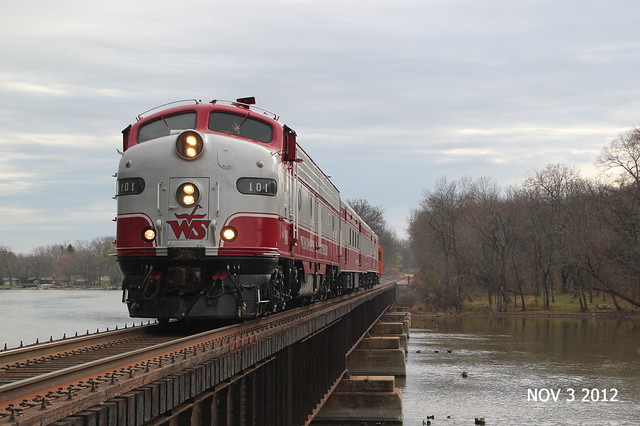
Wisconsin Southern E9A #101 seen hauling the Toys for Tots train cross the Rock River east of Edgerton, WI on November 3rd, 2012. photo- Brian Allen
WISCONSIN- Just a quick update out of the Badger State. I had earlier reported that Soo Line 2-8-2 Mikado #1003 was scheduled to haul a Toys for Tots holiday train over the Wisconsin & Southern last month.

However, shortly before the scheduled November 3rd departure, the #1003 was sidelined with an unspecified mechanical problem. Wisconsin & Southern E9A #101 handled the Toys for Tots train between Milton and Middletown, WI.

The #1003 was pulled from service two years ago in order to under to undergo her FRA-mandated 15 year boiler inspection. Due to rising costs, there were some concerns from the preservation community that the #1003 would never return to service again.

OHIO- Two Ohio-based preservation groups have announced plans to begin restoration of a 100 year old ALCo steam engine to service.

Colombus-based American Steam Railroad Preservation Association has reached an agreement with the Cleveland-based Midwest Railway Preservation Society to house the restoration of former St Louis-San Francisco 2-8-2 Mikado #1352 at the MRPS' former Baltimore & Ohio roundhouse in Cleveland.

The #1352 was built by ALCo in 1912 and operated on the Frisco for nearly 45 years before her 1956 retirement. The Frisco donated the #1352 to Kansas City where she was on display at Swoop Park, but soon fell victim to neglect and vandalism. A group of concerned preservationists eventually purchased the 1352 and moved her into storage in rural Illinois.

The MRPS is also home to another, slightly newer ALCo 2-8-2 Mikado- former Grand Trunk Western #4070. The #4070 was built in 1918 and most recently operated in 1990 on the nearby Cuyahoga Valley Scenic Railroad.

Friday, November 30, 2012

Canada Actively Seeking American Workers Left Jobless by 'Obama Recovery'

Jeff McIntosh photo- Canadian Press

As the American economy continues to receive bad news amid Barack Obama's reelection and increasing concerns about the upcoming 'fiscal cliff', Canada has made it clear that it needs workers and is looking to the USA to help fill that gap [and I for one welcome our new Canadian overlords- NANESB!]

Much of western Canada is experiencing a shortage of skilled laborers- this is particularly true of the energy sector in oil-rich provinces like Alberta or Saskatchewan. Despite the fact that just under 30,000 Canadians made their way to Alberta from other provinces to find work in the last year, oil industry consultants believe they'll need more than 35,000 additional workers over the next decade for the oil sands alone. Moreover, companies will be losing a large number of worker due to attrition as statistics have shown much of the current workforce in the oil sands, exploration and refineries is middle-aged.
[...] the industry’s growth is far from certain.

“Labour shortage impacts could threaten investment, revenues and sustainability throughout the entire energy value chain,” said Peter Boag, president of the Canadian Petroleum Products Institute, which recently changed its name to Canadian Fuels Association.

The country’s energy sector industry directly employed 187,000 workers last year, and that’s set to grow exponentially.

“There will be no reprieve from current hiring challenges for oil and gas services as the sector will need to fill thousands of positions between now and 2015,” says HR Petroleum Council in a report. “Employee turnover is the sector’s greatest workforce concern as it escalates costs and exacerbates sector-wide labour and skill shortages.”
The oil sands are different in that they have to be extracted in a manner more reminiscent of mining for ore than drilling for oil. Although environmentalists opposed development of Alberta's oil sands, the oil has been naturally seeping into nearby bodies of water such as the Athabasca River for centuries. Although much less straightforward to extract, the mixture of sand, clay, water and bitumen locked in the ground are said to rival the conventional petroleum reserves of Saudi Arabia and Venezuela. Much of the oil sands activity is centered northeast of Edmonton around Fort McMurray, Alberta- a latter-day boomtown dubbed by some as 'Fort McMoney'.

As Canada continues to tap the vast energy reserves out west, employers and recruiters are looking beyond their own borders to help offset the shortfall of skilled workers- including the USA.
Since 2010, about 35,000 U.S. workers a year have been issued work permits, according to Canadian immigration statistics. That's up 13% from earlier in the decade. And that figure is expected to grow as provinces continue to loosen requirements for temporary foreign workers.

Rudolf Kischer, a Vancouver-based immigration attorney, said his firm can hardly keep up with the processing of work permits for employers hiring U.S. help.

"We're the busiest we've ever been," he said.

Many of those workers are heading to where the labor market is hottest: Edmonton.

Edmonton has become a staging ground for oil companies that include Canada's Suncor Energy Inc., Shell Canada Ltd. and Chevron Canada Ltd. The energy sector has in turn boosted industries such as manufacturing, home building and retailing.

With a population of about 812,000, Edmonton looks a lot like many American cities. There are large strip malls anchored by U.S. retailers such as Costco and Home Depot, and ubiquitous coffee shops — except here Tim Horton's doughnut shops outnumber Starbucks 3 to 1.

The biggest difference: The unemployment rate here is 4.5%, and "We're Hiring" signs are posted in almost every window.

Jobs near Fort McMurray, a remote town six hours north, are the best-paid; a welder can make up $37 an hour. (At present Canadian and U.S. dollars are almost equivalent in value.) But laborers must stay in barracks-style camps, which energy companies have upgraded to woo them. The best ones offer private rooms with flat-screen TVs, gyms, prime dining and wireless Internet access.

Workers spend as long as a couple of months at a stretch laboring before returning to Edmonton "moneyed up," as the expression goes around here. Workers then pump those dollars into the local economy.

The province of Alberta boasts a median household income of $83,000 compared with $50,000 in the U.S.

Andrew Hoggard, a 35-year-old auto mechanic who moved to Edmonton from Michigan in March, can hardly keep up with his workload. He puts in 12-hour days at a local Chrysler dealership, including some Saturday shifts.

Still, he's not complaining. In eight months, he's made $70,000. Back in Holland, MI, where he worked on commission at Nissan dealership, he relied on his parents to help him pay rent when the work slowed.
In British Columbia, an unprecedented construction boom has left the province short on workers. However, in southern California, even before the current recession there have been thousands of skilled tradesmen who remain unemployed, underemployed or are working outside their field altogether. This led to officials in Riverside County, CA to coordinate with Canadian delegations and organizations like the British Columbia Construction Association to hold a job fair slated for early December in Indio, CA.
“Some have not found work for the past four years in their trade,” said Tom Freeman, commissioner with the Riverside County Economic Development Agency’s office of foreign trade, which has helped set up a Dec. 4 job fair in Indio to recruit workers willing to move north.

Economic development specialists and others in the Coachella Valley have been very involved in what is called the “workforce mobility program,” with initial meetings taking place in Palm Springs and Desert Hot Springs, Freeman said.

The British Columbia Construction Association, which represents some 2,000 companies, will have a delegation at the job fair, as it has at similar job fairs held in Ireland and Scotland, said Abigail Fulton, vice president and an attorney with the association based in Victoria, British Columbia.

“We actually do the immigration work at no charge,” said Fulton, who noted the association is not looking for laborers but rather skilled tradesmen familiar with large commercial and industrial-type projects.

Along with competitive or even higher wages than companies are paying in the U.S., Canadian recruiters are touting steady work, retention bonuses, free universal health care and quality schools.

A flier sent out by Riverside County, the British Columbia Construction Association and the Canada California Business Council lists heavy equipment operators, iron workers, pipe fitters, mechanics, and mechanical and electrical engineers as among trades that are needed.
Of course, Canadian companies and recruiters aren't just limiting their search to the USA. Similar trade shows like the one set to take place in Indio have already been set up in Ireland and Scotland. Canadian officials have also been courting Polish immigrants in the United Kingdom, attempting to coax them into making the move to Canada. While this may sound like an unusual or way-too-specific niche, as of 2001 there are an estimated 980,000 Canadians of Polish ancestry [including Wayne Gretzky, Geddy Lee and William Shatner- NANESB!] and the UK's Office for National Statistics estimated there were an estimated 515,000 Poles either temporarily or permanently residing in the United Kingdom as of 2010.

UK Federation of Poles chairman Włodek Mier-Jedrzejowicz said he had been contacted by Canadian officials who said they were particularly keen on Poles able to fluently speak English.

While there are no doubt some drawbacks for Americans working in Canada [ie- you'd be taxed four times- US federal taxes, Canadian federal taxes, the provincial tax of wherever you live and the state tax of the last state you resided in before leaving- NANESB!] the Canadian dollar and the US dollar are roughly on par, interest rates for savings is slightly higher in Canada and provinces like Saskatchewan and Alberta enjoy more economic freedom than all but a handful of US states according to a Canadian think tank. A recent report from the Fraser institute also stated that Canada is among the top five nations in the world for economic freedom while the USA has plummeted from second place to 18th.

I find it interesting that when I was growing up, I remember that American liberals wanted the nation to follow Canada's lead as far as healthcare, military spending and gun control went. However, now that Canada is drilling for oil, sending troops to Afghanistan and rolling back gun control laws the liberals here in the USA aren't as keen to have the country be more like Canada.

Tuesday, October 2, 2012

Anti-Fracking Movie Starring Matt Damon Bankrolled in Part by OPEC-Member United Arab Emirates


A new drama starring Matt Damon as a smooth-talking natural gas company official who attempts to purchase drilling rights from local residents in a rural Pennsylvania town is already generating buzz, but it has nothing to do with what takes place on-screen.

The movie Promised Land supposedly dramatizes the dangers involved in the drilling process known as hydrofracking- a local environmentalist seeks to thwart Damon and his company's attempts to drill in the area. To hardly any one's surprise, the local schoolteacher and environmentalist who raises the alarm regarding hydrofracking is portrayed in a positive manner while I suspect Damon's gas company official will be portrayed as manipulative and unethical- at least until his change of heart where he falls in love with a local woman.

Pretty standard Hollywood 'We-Liberals-and-Environmentalists-know-whats-best-for-you-rubes-in-flyover-country' boilerplate so far, right? With its December release, there's even Oscar talk for Promised Land all while bringing the ongoing debate over fracking front and center.

Only it was recently discovered that the film has received considerable financial backing from the United Arab Emirates- a member of OPEC and among the top 10 oil producing nations in the world.
The film was produced “in association with” Image Media Abu Dhabi, a subsidiary of Abu Dhabi Media, as first reported by the Heritage Foundation. Abu Dhabi Media is wholly owned by the government of the United Arab Emirates, a small but extremely wealthy federation of absolute monarchies along the southern coast of the Persian Gulf.

Very obviously, the UAE has an interest in slowing down the expansion of hydraulic fracking that has created an energy boom in the United States.
This would not be the first American film that would've received financial backing from Image Media Abu Dubai- other titles include The Help, Contagion and The Crazies among others.

Locations for filming Promised Land include the city of Pittsburgh as well as Westmoreland and Armstrong counties in Western Pennsylvania. A group of Armstrong county residents, upset at what they claim were the filmmakers using false pretenses to film in the area, started up a Facebook page called Armstrong County Promised Land Pride. Visitors to the page are greeted with the following succinct message: "They filmed this movie in our backyard. They said it would be fair to drilling. It's not. We're pissed."

Fracking opponents claim that the process injects massive quantities of hazardous chemicals into the groundwater and that hydrofracking can cause tap water to burst into flame and caused last year's magnitude 5.8 earthquake in Mineral, VA that was felt up and down the East Coast- even though the nearest natural gas well was hundreds of miles away.

The movie is loosely based on events in Dimock, PA where a handful of local residents had claimed drilling from nearby wells had contaminated their groundwater. However, after analysis by Pennsylvania's environmental agency and the EPA, the water was deemed safe to drink by the EPA this summer.

The real-life events in Dimock have reportedly prompted a hasty re-write of the Promised Land script. Of course this is where Hollywood decided to double down on the stupid in typical Hollywood fashion.
according to sources close to the movie, they’ve come up with a solution — suggest that anti-fracking fraudsters are really secret agents employed by the fossil-fuel industry to discredit the environmental movement.

In the revised script, Damon exposes Krasinski as a fraud — only to realize that Krasinski’s character is working deep undercover for the oil industry to smear fracking opponents.

Hollywood is worried about declining theater audiences; it’s blaming the Internet and the recession. But the real problem might be closer to home.

Damon and Krasinski said they were making a movie that “defines us as a country” but then shoehorned ideology into a script — and when real-world events became a problem, they shoehorned in more ideology.
You see, instead of the noble well-intentioned environmentalist perhaps having some kind of a 'Mea Culpa' moment and the dire environmental consequences Kasinski's charachter warned about not taking place, in west coast liberal screenwriter-land, the anti-fracking advocates being wrong are purely the fault of the oil company who are disseminating misinformation to discredit opponents.

Instead of some ancillary plot where the cash-strapped townsfolk can now afford to save up for their kids' college education or put an elderly relative in a decent rest home- all while drinking and bathing with tapwater that doesn't burst into flames- the alarmist and false narrative spun by the environmentalists and celebrity anti-frackers has to be placed at the feet of the energy companies. I believe that is called 'chutzpah' in some parts of the world.

Monday, September 3, 2012

Iron Horse Update for August 2012- Heritage Units Gather for Massive Norfolk Southern 'Family Portrait' in North Carolina; Rails to Trails- and then Back to Rails; New Genesee & Wyoming Line in Alabama


NORFOLK SOUTHERN- There was more to the 30th anniversary celebration of Norfolk Southern than the 21st Century Steam program, as it turned out.

Although it had initially planned a total of 18 'heritage' units- new locomotives painted in the colors of various Norfolk Southern predecesors- the total was bumped up to 20 earlier this summer with the belated additon of the Penn Central and Monongehela as part of the heritage fleet.

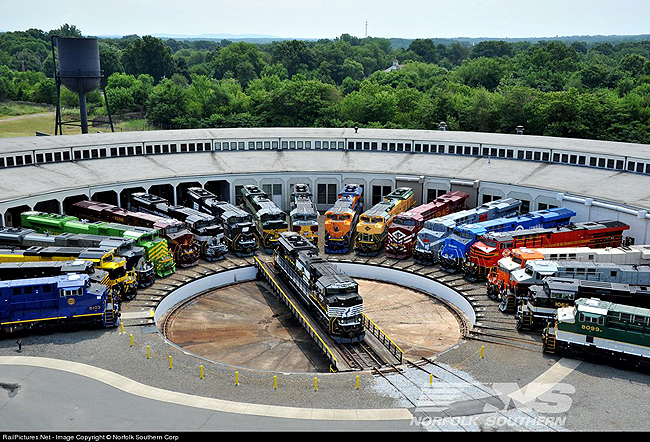
While just about all of the heritage units were placed in revenue service after arriving from GE's Erie, PA plant of Progress Rail's EMD facility in Muncie, IN, in late June, all 20 units were sent to the North Carolina Transportation Museum at Spencer, NC for a one-of-a-kind 'family portrait' at the Museum's massive roundhouse.

In the above official Norfolk Southern image, the heritage units on display include Norfolk & Western ES44AC #8103, Nickel Plate ES44AC #8100, Virginian SD70ACe #1069, Wabash SD70ACe #1070, Illinois Terminal SD70ACe #1072, Pennsylvania #8102, New York Central #1066, Penn Central SD70ACe #1073,  Erie SD70ACe #1068, Delaware Lackawana & Western SD70ACe #1074, Central Railroad of New Jersey SD70ACe #1071, Reading SD70ACe #1067, Lehigh Valley ES44AC #8104, Monongehela ES44AC #8025, Conrail ES44AC #8098, Norfolk Southern ES44AC #8114, Interstate ES44AC #8105, Wabash SD70ACe #1070, Savannah & Atlanta SD70ACe #1065 and Southern ES44AC #8098.

Norfolk Southern had also made it a point to have some of the heritage units accompany the steam-powered employee specials earlier in the summer with 'Nickel Plate' GE #8100 accompanying Nickel Plate #765 in Pennsylvania and 'Savannah & Atlanta' EMD #1065 accompanying the Southern #630 on trips through Tennessee and Virginia. Reportedly the Wabash #1070 will accompany the Fort Wayne Historical Society's big Nickel Plate Berkshire to St Louis this month for additional employee specials.

Although Union Pacific and Pan Am have both paid tribute to predecessor roads with specially painted locomotives, the size and scope of Norfolk Southern's heritage program is unprecedented. About half the roads honored in the NS Heritage program are due to the carrier's 1999 joint takeover of Consolidated Rail Corp- better known as Conrail- with CSX. Conrail was hastily formed from the remnants of the Penn Central, Erie Lackawana, Central Railroad of New Jersey, Reading and Lehigh Valley in 1976. Conrail also acquired a controlling interest in southwestern Pennsylvania coal hauler Monongahela in 1993.

A pair of Wheeling & Lake Erie SD40-2s dropping ballast in the yard adjacent to the MarkWest Liberty Mid-stream processing plant in Westland, PA on Aug 2nd, 2012. To access the facilities, the Wheeling & Lake Erie had to re-lay track over a 4½ stretch of former Montour Railroad track that was abandoned nearly 30 years ago and converted into a hiking trail. Jason Capra photo
WHEELING & LAKE ERIE- A portion of a rural branchline in the southwestern corner of Pennsylvania that was abandoned and torn up in 1984 is once again seeing trains thanks to the ongoing natural gas bonanza from the Marcellus Shale.

A subsidiary of the Pittsburgh & Lake Erie, the Montour Railroad was down to 23 miles in the early 1980s when their last major shipper- the Westland Coal Mine- announced they were closing down in 1984. In the early 1990s, the Montour Trail Council was formed to convert much of the remaining Mountour Railroad right-of-way into a hiking trail in the Pittsburgh area.

In 2005, a natural gas well was drilled in rural Washington County, PA using a relatively new technology called hydrofracking where sand, water and certain chemicals are used to drill through layers of shale for natural gas. Although geologists had long believed there were abundant natural gas reserves in the Marcellus Shale outcropping- which stretches from Upstate New York to eastern Tennessee- accessing it in an economic manner was problematic until the hydrofracking process had been proven successful.

Although Denver-based MarkWest energy [NYSE: MWE] had completed a massive cryogenic processing plant in Westland, the natural gas byproducts were loaded up in tractor trailers that had to negotiate at least 8 miles of relatively narrow, 2-lane roads before reaching interstate 79 in nearby Cannonsburg, PA. But in 2011, MarkWest Liberty announced their plans to re-open a portion of the former Montour Railroad which would give the cryogenic facility access to the Wheeling and Lake Erie railroad's line between Mingo Jct, OH and the former Norfolk & Western Rook Yard in Pittsburgh as well as interchange with CSX, Norfolk Southern and multiple Genesee & Wyoming properties.

The first train to operate over the newly-opened line was a short ballast train in June powered by two W&LE SD40-2s. In August, MarkWest Liberty began shipping byproducts by rail out of the Westland yard for the first time.
Currently, the rail loading facility has the capability of loading 12 tankers, but plans are to expand the number of loading racks so that up to 24 tankers can be loaded per trip.

The gas is piped to the rail loading facility from the processing plant in pure product lines, mostly propane or butane. The butane will be transported to petrochemical refineries while most of the propane is shipped to the East Coast for home heating use. There also will be shipments of isobutane and natural gasoline, McHale said. The natural gasoline is expected to be shipped to Canada for processing. All of the byproducts markets are subject to negotiated contracts with the producers and, in Washington County, MarkWest processes natural gas exclusively for Range Resources.

While the train is currently making one trip a day with 50 tankers, eventually that will become four trips a day for a total of 200 tankers. Each rail tanker takes four trucks off the road.
As for the rails-to-trails portion, there is still a trail involved. Contractors for MarkWest Liberty also completed a parallel portion of the Montour Trail along the line, with the fence separating the hiking trail from the railroad line.


A pair of Columbus & Chatahoochee SD40-2s lead two more Genesee & Wyoming units southbound with a mixed freight along Brickyard Rd in Girard, AL on July 1st during the innagural run of the C&C.
Frank Orona photo
GENESEE & WYOMING- Shortly before the Genesee & Wyoming's [NYSE- GWR] purchase of competing shortline holding company Rail America [NYSE- RA] was announced, GWR started up operations on yet another Southeastern shortline.

Operations for the 26 mile Columbus and Chatahoochee began on July 1, 2012 on a former Norfolk Southern branch between Girard and Mahart, AL. The deal also includes trackage rights on Norfolk Southern between Girard, AL and Columbus, GA to reach the Norfolk Southern Yard and sister GWR road Georgia Southeastern.

Power for the line is a pair of SD40-2s in GWR's trademanrk orange and black. At its startup, the line is also borrowing power from sister railroads Chattooga and Chickamagua and The Bay Line in the form of 3 GP38s. The Columbus & Chatahoochee is the ninth GWR railroad to start up operations in the region- a number of the other lines include formerly independent shortlines and regionals such as the Georgia Central, Altanta & St Andrews Bay, Georgia Southwestern, Chatahoochee Industrial or Meridian & Bigbee.

Tuesday, July 24, 2012

Borderline Psychosis Update- Drug Tunnel Discovered in AZ; Cartels Finding Slick New Way to Skirt Border Patrol? Car Bomb in Tamaulipas Kills Two

ARIZONA- Investigators in Arizona keeping a warehouse in the southwestern border town of San Luis under surveillance had discovered this month a recently completed drug tunnel connecting it with San Luis Rio Colorado on the Mexican side of the border.
Engineered with 4-by-6 beams, plywood walls, ceilings and floors, and a lighting and ventilation system, the fully operational tunnel was used to smuggle methamphetamine and possibly other drugs, the DEA said.

"From what I've heard and in my experience, this is probably the most sophisticated tunnel that they've probably found in Arizona," said Doug Coleman, special agent in charge of the DEA's Phoenix field office.

"It's really a piece of work," he said. "It looks like it was designed to be on a pulley system where you could just download the drugs in San Luis (Rio Colorado, Sonora) and use a pull cart to pull them all the way through and then pop them up on this side."

Coleman said he does not believe the tunnel was in operation for more than a week, based on the "pristine" condition of the shaft and the fact that drums filled with dirt removed from the tunnel were on pallets still inside the building. "I think it was very new," he said.
According to the DEA and Arizona Department of Public Safety, on July 6th, an Arizona State Trooper pulled over a Ford F-150 on US Route 95 in the Yuma, AZ area. A search of the vehicle turned up nearly 40 pounds of methamphetamine wrapped up in packaging in the bed of the truck.

After contacting the DEA, a search warrant was obtained for the warehouse in San Luis where the tunnel was discovered. The tunnel reportedly led to a recently-constructed ice distribution warehouse on the Mexican side of the border.

MEXICO- Police in the outskirts of Mexico City have arrested a number of men who were accused in attacking and robbing more than 90 youths from a church group who were on a camping retreat at an ecological preserve at the base of the Popocatepetl volcano. Even in nation that has grown increasingly jaded over brazen acts of murder committed in broad daylight, the crime shocked Mexico's general public.
Police arrested 17 men Wednesday on suspicion of attacking youths and raping five women and girls who were on a church camping trip outside Mexico City, a brutal assault that shocked much of the country.

The attorney general for the State of Mexico, Alfredo Castillo, said 11 of the gang members were identified by some of the victims. In interrogation videos played for reporters, three of the suspects confessed that they sexually abused the women and girls because fellow attackers told them to.

Two of the suspects were local police officers and another had served in the military, Castillo said, speaking two days after authorities announced the arrest of a man who was described as not directly involved in the assault on the camp-out but who allegedly provided information to the assailants.
The attacks, robberies, assaults and rapes took place over a period of several hours on Friday the 13th in the park which straddles the border of the states of Mexico and Puebla. At least 7 girls in the church group were sexually assaulted before their assailants left in stolen vehicles.

According to Mexico's state prosecutor, 12 of the 17 men in custody were identified by the victims as taking part in the assaults and robberies. Reportedly, none of the men in custody have any ties to the major organized crime organizations that have been locked in an ongoing bloody turf-wars since 2006.

DISTRITO FEDERAL- Authorities in Mexico's capitol city say they have arrested one of three Federal fugitive policemen who are wanted in the connection with a shootout where they killed three colleagues at Mexico City's international airport in late June. Mexican authorities say they've captured one of three rogue federal police officers who allegedly took part in a June 25 shootout that killed three of their colleagues at Mexico City's international airport.
Federal Police regional security chief Luis Cardenas Palomino says suspect Bogard Felipe Lugo de Leon was caught at a Mexico City apartment after police received a tip.

Cardenas Palomino says Lugo de Leon confirmed that one of the two officers who opened fire on their colleagues was about to be handcuffed for purportedly trafficking drugs through the terminal.

He says the bust was not pre-planned, but occurred when one of the rogue officers was caught in the act.
However, many in the Mexican press have questioned the official version of events leading up to the June 25th deadly shootout at Benito Juarez International Airport.
Mexican media have begun to question the official account, asking whether the gunfight could have been the result of a falling-out among co-conspirators. If it was an operation to capture traffickers in the act, some said, why did it take 20 minutes for additional police officers to appear after the shooting began? Why were only three police officers sent to arrest two armed fellow officers in a crowded airport?

“Tricks, lies, inventions!” the columnist Manuel J. Jauregui wrote in the Reforma newspaper Wednesday, adding that the operation was an embarrassment and that federal authorities were scrambling to get their stories straight. “They don’t even know who were the good guys and who were the bad guys,” Jauregui wrote.
Two other Federal Police officers are wanted for their role in the airport terminal shooting.

TAMAULLIPAS- Two police officers were killed and another 7 people were wounded when a powerful car bomb was detonated outside of the home of the top police official in Tamaulipas earlier this month.
Tamaulipas state Interior Secretary Morelos Canseco said Public Safety Secretary Rafael Lomeli wasn't injured in the blast, but that three neighbors were injured by glass fragments from shattered windows.

Canseco said the bomb was detonated with a cellphone soon after Lomeli arrived at his home. He said the car bomb showed an increased sophistication, both in the detonator and explosives used. It apparently exploded in a car parked just outside a security barrier on a street on which the official's home is located.
The bomb went off just outside a security checkpoint in the capital city of Tamaulipas. No organization has claimed responsibility for the bomb. Two years ago, a car bomb killed three police officers in Ciudad Juarez across the border from El Paso, TX.

TEXAS- Drug traffickers may be taking advantage of a boom in natural gas drilling in the Lone Star state to help move their product and circumvent Border Patrol checkpoints around the Eagle Ford shale in South Texas.

Map courtesey of Houston Chronicle
Drug traffickers have discovered that private roads sturdy enough to accomodate tractor-trailer and heavy duty pickup traffic serving drilling sites for companies like Exxon Mobil [NYSE- XOM], Halcon Resources [NYSE- HK] or Apache [NYSE- APA] can accomodate their vehicles and payload of contraband. Moreover, many of these private roads also bypass fixed Border Patrol checkpoints in South Texas.
Hefty roads running through once-remote ranchlands now enable loaded-down tractor-trailers and pickups to avoid Border Patrol highway checkpoints that have long been the last line of defense for stopping all traffic headed farther into the United States.

Traffickers are seeking to use the southwest-most stretches of the massive Eagle Ford shale formation, which stretches from Mexico all the way to East Texas, to their advantage by trying to corrupt truck drivers, contractors and gate personnel. Authorities also speculate that they are trying to make "cloned" copies of legitimate trucks and use contractor-like vehicles to avoid standing out among fleets of oil-field service vehicles working for energy companies. In some cases, vehicles have been stolen and believed to have been used by smugglers.

"They are using those roads to transport drugs, guns, ammo, you name it," said Albert DeLeon, chief deputy of the Dimmit County sheriff's office.

"Our biggest concern is how law enforcement is going to attack the threat. We cannot move Border Patrol checkpoints into those positions," said Tony Garcia, director for the South Texas HIDTA [High Intensity Drug Trafficking Area- NANESB!]. "It is pretty much up to your imagination what they could be moving through there. ... It is a bit of a dicey situation for us to deal with. We are putting our heads together."

For energy companies, the roads are critical to moving heavy drilling and related equipment in and out of the ranchlands where the work is done.

"Once they get past the checkpoints, they are pretty much free," said Javier Pena, head of the Drug Enforcement Administration's Houston division, which includes San Antonio and reaches to the Mexican border.

"It is very much on our radar," Pena said of smugglers. "We have been gearing up for it."

He declined to discuss the use of sensors, cameras or other tactics to monitor possible narcotics routes. Authorities also suspect that gate guards, drivers or other workers might succumb to bribes.

On a weekday morning in early March, 18,665 pounds of marijuana were caught being smuggled aboard two trucks, one a flatbed, the other a tanker truck driving through the Briscoe Ranch on a road that circumvents a Border Patrol checkpoint.

They were on a private road leased to energy companies and carrying what looked like supplies typically used in oil field operations but were instead loaded with marijuana. The two trucks yielded the most pot ever caught in one day by the Border Patrol's Del Rio Sector.

One of the truck drivers, who was not an employee of the energy industry, later admitted to agents that he was to be paid $7,500 to deliver the load, according to an affidavit at the federal courthouse in Del Rio.

Other big South Texas catches came in July last year when Border Patrol agents stopped a bogus oil field truck carrying 1,373 pounds of marijuana, and in June when they found 3,529 pounds of the drug stashed in a truck driven by an energy company worker.
In some boder areas in the USA, the Border Patrol sets up additional checkpoints along highways further away from the Mexican border where they can stop and inspect passing vehicles. On some maps, the private roads bypass some of these checkpoints where the contraband can continue on to the interstate highway system and metropolitan areas like Dallas or Houston.