Random musings on sports, geopolitics, current events, pin-ups and the railroad industry from a rank amateur blogger.
Showing posts with label SD40-2. Show all posts
Friday, August 1, 2014
Todays' Train of Thought- Annoying Orange, August 1st, 2014
Today's Train of thought takes us to the Peach State and highlights what is sure to be a source of consternation for commuters in Georgia's second largest city and home to the US Army's Ft Benning.
The 26-mile Columbus and Chattahoochee is one of the newer railways in the Genesee & Wyoming family of shortlines and actually the second one to operating in the western Georgia city of Columbus. The line operates between Phenix City and Mahrt, AL was formed in 2012 but has trackage rights over a stretch of the former Central of Georgia line between Columbus, GA and Birmingham, AL to reach the Norfolk Southern yard in downtown Columbus.
To get the that NS yard, Columbus and Chattahoochee trains have to traverse the Chattahoochee River, which forms much of the boundary between Georgia and Alabama. Once across the river, trains for both the NS and Columbus & Chattahoochee have to traverse several blocks of street-running trackage on 9th street, sometimes snarling up traffic at rush hour in the heart of this city of more than 200,000.
Here, railpictures.net contributor Casey Thomason caught Columbus & Chattahoochee SD40-2 #3348 leading a consist on its way back to the NS yard after picking up loads from the paper mill in Mahrt, crossing the river and trundling down the middle of 9th street on September 7, 2012- just two months after the Columbus and Chattahoochee was formed.
According to the photographer, this was a relatively short train that only took up 2-3 blocks. Longer trains on the Norfolk Southern from Birmingham have to slow down for yard limits while westbound trains only gradually pick up speed, creating a rolling roadblock that leaves soldiers and civilians alike scrambling to fins an alternate route.
Friday, July 4, 2014
Today's Train Of Thought- Faded Glory, July 4th, 2014
Today's Train of Thought takes us to South Dakota and features a one-of-a-kind throwback that has withstood more than two decades of service on the harsh conditions of the Great Plains.
Dakota, Minnesota & Eastern SD40-2 SD40-2 #6359 started out life in 1974 as Milwaukee Road #193 and served the troubled class 1 until the Soo Line took over a little more than a decade later. By the early 1990s, a small fleet of secondhand SD40-2s were sold to Cedar Holdings' fairly new startup, the Dakota, Minnesota and Eastern. The line operated hundreds of miles of secondhand former Chicago & Northwestern trackage across the state of South Dakota as well as parts of Wyoming, Nebraska and southern Minnesota. Although generating traffic was seldom a problem- the western end of the line generated aggregates, wheat, cement, Bentonite Clay and more recently, ethanol- the condition of the track and bridges between Pierre and Rapid City, SD restricted the DM&E to 10 MPH running. Still, in 2002 Cedar Holdings was ambitious enough to purchase the Washington Group's I&M Rail Link [parent company of the Montana Rail Link- NANESB!- a cluster of former Soo Line- nee Milwaukee Road- mainlines through the Midwest that linked the Twin Cities with Kansas City, MO and Chicago via Sabula, IA. The new railway was a sister company called the Iowa, Chicago & Eastern
Meanwhile, the DM&E was working on a project that would give them access to Wyoming's Powder River Basin and open up that state's coal fields to competition from a third rail carrier- breaking Union Pacific and BNSF's duopoly on the region. However, a number of obstacles had to be overcome before that could become a reality- such as the extremely slow track between Rapid City and Pierre and noise mitigation near the renowned Mayo Clinic in Rochester, MN.
As estimates for work on a completed line between Wyoming's coal fields and the Mississippi River at Winona, MN continued to skyrocket Canadian Pacific decided they should be the ones to step in and undertake such an endeavor, and purchased Cedar Holding's rail properties outright in 2008. Besides the proposed Powder River expansion, CP Rail got their former Milwaukee Road lines to Chicago, the Twin Cities, Kansas City and branchlines to Mason City and Sheldon, IA.
However, with the hostile takeover of CP Rail by the Pershing Square hedge fund in 2011 and the slumping demand for coal thanks in part to the onerous regulatory burdens placed on them by an EPA determined to kill off the coal industry, CPR lost their appetite for the Powder River expansion and by extension, much of the original DM&E trackage. By late 2012, much of the 600+ miles of Marshall, MN was placed for sale. In early 2013, CPR announced they had reached a deal with the Genesee & Wyoming family of shortlines to sell off the trackage between Marshall, MN and Colony, WY via Pierre and Rapid City, SD to form a new railway called the Rapid City, Pierre & Eastern. Reportedly included in the transaction is a number of former DM&E SD40-2s to be used as power for the Genesee & Wyoming startup.
During CP's tenure at the helm of running the DM&E, it was often difficult to tell whether or not they had in fact taken over. Most of the trains still regularly sported former DM&E or ICE power and to makes things a little more confusing the Dakota, Minnesota & EAstern purchased a number of secondhand SD40-2s from Canadian Pacific- many of which were still painted CPR red but stenciled for the DM&E at the time of the Canadian Pacific takeover.
Moreover, the DM&E had a habit of naming some of their units after the towns the main line went through- SD40-2s were dubbed 'City of Wall' or 'City of New Ulm'. However, DM&E #6359 was a little different- in 1991, she was painted with a special mural of Mount Rushmore to celebrate the 50th anniversary of the national monument and dubbed the Mount Rushmore.
Despite the number of changes that have taken place over the DM&E in the last 20+ years, DM&E #6589 still sports the Mount Rushmore mural on her long hood. While it may not be included in the batch that CPR sent to the Genesee & Wyoming line, the #6359 still gets around plenty, making its way as far east as CSX's massive Selkirk yard outside of Albany, NY in the past few years as run-through power on unit ethanol trains.
Here, railpictures.net contributor Michael Polk caught the Mt Rushmore leading two other DM&E SD40-2s on an empty grain train on a branchline near Onida, SD on July 3rd, 2013. The final destination are the elevators just outside the town of Onida. This quintessential granger scene seems largely unchanged from the last 20 or so years, despite the presence of CPR red among the cornstalks.
Thursday, June 5, 2014
Today's Train of Thought- Taken To the Woodshed, June 5th, 2014

Today's Train of Thought takes us to the Buckeye State and features the regional Wheeling & Lake Erie, one of the few remaining independent regionals in the USA.
The current incarnation of the W&LE takes its name from the original Wheeling and Lake Erie which was completed in 1877 as a link between the coal fields around Wheeling, WV and the ports and steel mills along the shores of Lake Erie. After WWII, the (original) W&LE merged with the Nickel Plate, which in turn became part of the Norfolk and Western in 1964. In the early 1980s, the Norfolk & Western and Southern merged to form the Norfolk Southern.
In 1990, the Norfolk Southern divested themselves of a portions of the original W&LE line between Brewster, OH and Pittsburgh- this new iteration of the W&LE was also able to secure trackage rights over CSX's ex-Baltimore & Ohio Sand Patch line through the Alleghenies between the Pittsburgh area and Cumberland, MD- an agreement the B&O had with the original W&LE that pre-dated the formation of CSX.
By most accounts, the early 1990s were pretty lean years for the W&LE but by 1994 the company restructured its debt and acquired the Akron and Barberton Belt Railway. While some of the traffic- such as iron ore, coal, aggregates and chemicals- has been in the same since the 1990 incarnation of the W&LE, traffic has picked up thanks to increased drilling in the Marcellus and Utica Shale.
Here, Richard W Thompson caught Wheeling and Lake Erie SD40-2 #6348 with a stone train backing past a bright crimson shed in Bellevue, OH in August 2010. Besides being home to a number of limestone quarries, Bellevue is also home to the Mad River and Nickel Plate Railroad Museum and where rail and real-estate tycoon Henry Flagler first ventured into starting his own business in the 1850s before going on to start the Florida East Coast railroad.
Besides being used for aggregates, limestone is also used for drilling pads throughout the Utica and Marcellus Shale.
Tuesday, April 8, 2014
Today's Train of Though- Dogwood Bumstead, April 8, 2014
Today's Train of Thought takes us to the heart of Dixie at the start of springtime. In many places throughout the south, many of the railroads and highways are lined with blossoming trees as the winter months recede [although I suspect many trees will be 'late bloomers'- if the bloom at all- due to this year's cold snap in the Deep South- NANESB!].
One pretty common tree is the dogwood, which goes by the latin name Cornus Florida. Besides the white blossoms in springtime, the wood for these trees have been known to be used for anything from cutting boards to golf clubs to walking canes- but probably not railroad ties.
Here, railpictures.net contributor Frank Orona caught CSX SD40-2 #8199 and C40-8 #7530 trundling past a stand of trackside dogwood trees in bloom on March 17, 2009 at Calera, AL with symbol freight M721, the Calera turn assigned between Birmingham and Calera. Immediately behind the two units is a lengthy cut of hopper cars carrying lime from Calera- the town is also home to the Heart of Dixie Railroad Museum.
Thursday, March 27, 2014
Today's Train of Thought- When the Moon Hits Your Eye Like A Big Fish Fry, March 27th, 2014
Once upon a time, when travel by rail was still prevalent, the thousands of railway stations along various lines throughout the USA had actually served their intended purpose. But as the number of intercity passenger trains declined due to the advent of jet travel and the interstate highway system, railroads began to tear them down, sell them off or at least use the structures for other purposes like storage or maintenance-of-way. Some big city passenger stations- such as Los Angeles Union Station or Washington DC's Union Station still serve their intended purpose while the passenger stations in Buffalo or Detroit are oversized decaying relics neglected for decades.
For some of the small towns along the rails, the fate of their depots are actually far more varied. Some towns depots still serve as active passenger stations for Amtrak or other passenger rail lines to this day, while others are still standing as derelict hulks, businesses, private homes or municipal offices- even if the rails that once served it have been ripped out years ago. For instance, along some of the former Boston & Maine, Central Vermont or Boston & Albany rail lines in western New England are former depots that serve as restaurants, beauty salons, breweries, bank branches or even a workshop that makes components for AR-15 rifles.
It's no different in the upper Midwest, either. Today's train of thought takes us to the former Milwaukee Road line through North Prairie, WI. Here, railpictures.net contributor Eric Shicotte caught Wisconsin Southern SD40-2 #4011 trundling past the former Milwaukee Road depot off of Main Street with Horicon, WI to Janesville, WI symbol freight T-004 in March 2013. As you can tell from the signage in the foreground, this old Milwaukee Road structure is now home to Tenerelli's Italian Restaurant [no reviews on Yelp, but on Google+ it rates 4.5 stars- NANESB!]. And as that other bit of signage indicates, not only does Tenerelli's offer Italian fare, but it also takes part in that time-honored Midwestern tradition of the Friday night fish fry.
Friday, March 14, 2014
Today's Train of Thought- Shuffle Off to Buffalo the Hoosier State; March 14 2014
Today's Train of Thought takes us to Indiana and an impressive engineering feat for a part of the country many people assume is as flat as a pancake.
Back in the 1980s, the Illinois Central Gulf embarked on a divestment spree, getting rid of hundreds of miles of track in the Midwest and deep south to focus on their key Chicago-New Orleans route. One of these railroads got its start in 1986 is the Indiana railroad, which recently celebrated its 27th year of operation. The INRD took over operations of the 155 mile former Illinois Central line between Newton, IL to Indianapolis in 1986- which includes a number of trestles and even a tunnel southwest of Indianapolis. While other IC spinoffs from that same timeframe have folded or been absorbed by other Class I carriers, the INRD has been steadily expanding in recent years- purchasing brand new EMD SD90MACs and expanding their reach to Chicago and Louisville, KY via acquisitions and trackage rights.
Here railpictures.net contributor Pat Lynch caught Indiana Railroad SD40-2 #4001 leading symbol freight SAHW [Senate Avenue in Indianapolis to HiaWatha Yard in Jasonville, IN- NANESB!] trundling across the 970 foot Shuffle Creek Trestle along Lake Lemon in Unionville, IN on January 25th, 2011. Trailing the #4001 is another INRD SD40-2 and a Helm Leasing SD60 while nearby is the only tunnel on the Indiana Railroad- the 500 foot Unionville Tunnel.
As impressive as the Shuffle Creek Trestle is, it's not even the longest trestle on the INRD- that honor is reserved for the 2300 ft Richland Creek Trestle- known to some as the Tulip Testle. Both structures were completed in 1906.
Saturday, November 23, 2013
Today's Train of Thought- Reading (and Northern) Rainbow, November 23rd 2013
Today's Train of Thought takes us to Anthracite Country in eastern Pennsylvania and features the regional Reading & Northern. Since its modest beginnings in 1983 as a 13 mile former Conrail branchline outside of Reading, PA, the railroad has been able to weather the ups-and-downs of railroading in the northeastern USA better than most, growing to its current size of more than 300 miles.
Besides anthracite coal, customers for the Reading & Northern include the Yuengling Brewery and Kimberly Clark Paper. Up until recently, the Canadian Pacific utilized trackage rights over R&N's former Lehigh Valley line between Scranton and Leighton, PA to reach Philadelphia under an agreement with the Delaware & Hudson as part of the 1976 formation with Conrail. The line through the Lehigh River Gorge is also home to the Jim Thorpe, PA based Lehigh Gorge Scenic Railway which operate popular excursions out of the former Central Railroad of New Jersey depot in Jim Thorpe. Power for these excursions can be anything from a 1980s built SD50 to the R&N's striking blue 1928-built 4-6-2 Baldwin.
However, the Reading & Northern remains primarily a freight-hauling outfit that traverses the same scenic terrain as the Lehigh Gorge Scenic railway as well as other, less frequently traveled lines.
Here, railpictures.net photographer Chris Starnes caught Reading & Northern SD40-2 #3058 in charge of freight MCQA [Mount Carmel to TamaQuA, PA- NANESB!] heading eastbound through fall foliage at Barnesville, PA in October 2012. Today's train is waiting for a track crew just up the line to finish up before continuing east to Tamaqua- the pair of SD40s started out life on the Union Pacific and are painted in colors reminiscent of the original Reading Railroad.
Sunday, September 8, 2013
Today's Train of Though- Enter Sandman, September 9th, 2013
Today's Train of Thought takes us to the Bluegrass state and provides us a glimpse of the late RJ Corman's impeccably-run Central Kentucky Lines.
Sand vacuumed up from the bed of the Ohio River is loaded into a fleet of RJ Corman's impeccably maintained fleet of red gondola cars by Louisville, KY based Nugent sand for the relatively short 80 mile trip to Nugent Sand's Lexington, KY facility.
The short trip, which was profiled in a 2011 Lexington Herald-Leader article about RJ Corman's railroad enterprises, takes an estimated 17,400 trucks of the road between Louisville and Lexington each year. Since 2005- just two years after RJ Corman's Central Kentucky Lines took over operations of the former Louisville & Nashville line between Lexington and Louisville- anywhere from 400,000 to 600,000 tons of sand have been moved over the line with each car carrying roughly 125 tons.
Here, railpictures.net contributor JL Scott caught RJ Corman Lines SD40T-2 #5409 and SD40-2 #3944 roaring eastbound through Shelbyville, KY with a Lexington-bound sand train on May 22nd, 2011. The #5409 started out life as Denver, Rio Grande & Western #5409 while the #3944 began as a Missouri Pacific unit.
Sunday, July 21, 2013
Today's Train of Thought- Roving Badgers, July 21st, 2013
Today's Train of Thought takes us to the heart of Dixie and highlights some visitors who are out of place.
With the 2001 acquisition of the Wisconsin Central by Canadian National, remnants of the Wisconsin Central fleet began showing up further afield almost immediately. Part of this had to do with CN repaying horsepower hours owed to CSX and Norfolk Southern- while newer CN units were assigned to the former WC, for awhile, your best bet of finding a unit still painted in Wisconsin Central colors was actually further afield in Pennsylvania or Florida.
One such train that regularly drew WC power far from home was CSX unit molten sulfur trains between Chicago and Florida. Sulfur- which can be used in making steel, acid or fertilizer- is typically melted so it can be shipped with relative ease.
Here, railpictures.net contributor William H Davis Jr caught Wisconsin Central SD40-2 #6005 leading unit molten sulfur train K841-24 through New Castle, AL with another WC SD40-2 as well as a Santa Fe painted BNSF C40-8W and CSX EMD trailing on a sunny April 2004 day. The lead unit started out life as Algoma Central #187 in the late 1970s, which the WC obtained from their 1995 takeover of Canadian regional Algoma Central.
Tuesday, June 11, 2013
Today's Train of Thought- It's Miller Time! June 11, 2013
Today's Train(s) of Thought takes us to a once dormant corner of western Massachusetts. Although the Hampden County town of Palmer, MA has rightfully earned itself a reputation as a train-watcher's haven, Millers Falls in Franklin county deserves an honorable mention for hosting not one, but two resurgent railroads.
Best known for the Millers Falls Tool company, this Western Massachusetts village of about 1100 is situated at the confluence of the Millers and Connecticut River as well as Massachusetts Route 63 and the Mohawk Trail (Route 2- sometimes known locally as the French King highway). The village is also located at the crossing of what was once the Central Vermont Railroad and Boston & Maine's Fitchburg Division. The railroads that served Millers Falls, MA went into a precipitous decline starting in the late 1960s. The B&M started off the 1970s by entering bankruptcy in March 1970 and the CV's line between the Vermont-Quebec border and New London, CT had always been something of a backwater in the Canadian National system.
Along with the Maine Central and Delaware & Hudson, the somewhat resurgent Boston & Maine was brought into the Guilford fold in the early 1980s, ushering in a period marked by declining traffic, reduced salaries, deferred maintenance, layoffs, shop closures and labor strife. By 1988, Guilford abandoned any plans of operating a unified system stretching from Washington DC to northeastern Maine by declaring the Delaware & Hudson bankrupt. While the D&H would continue running with the New York, Susquehanna & Western as their designated operator for a few years, Canadian Pacific purchased the line outright in 1991. For better or worse, this left the Boston & Maine and Maine Central in the Guilford fold.
Around the same time the D&H was purchased by CP Rail, rumblings began on a possible privatization of the Canadian National Railway and its subsidiaries. Although the Central Vermont had operated as a subsidiary of the Canadian National since 1923, a newly privatized CN began looking to sell off marginal lines [even before privatization, they sold off their former Grand Trunk Eastern line between Sherbroke, Quebec to Portland, ME to Pennsylvania-based Emons Industries in 1989- NANESB!]. So one of the lines that ran through this western New England burgh was basically a wholly owned subsidiary of the Canadian government. To hardly anyone's surprise, the candidates for divestment included the Central Vermont, and they soon found a buyer in San Antonio-based RailTex in 1995. The line's name was changed to the New England Central and new(er) blue and yellow GP38-2s became the mainstay of the NECR fleet.
Meanwhile, Guilford's fortunes were seemingly tied to Maine's paper industry. At the time, Conrail provided the fastest route in and out of New England on their former Boston & Albany mainline between Beacon Hill yard in Boston and the massive former Penn Central yard in Selkirk, NY. If they used Guilford at all, shippers typically preferred the absolute minimum- this typically involved handing off trains to Guilford at Worcester, MA so they could continue to Ayer, MA and points northeast. This meant the underutilized Fitchburg division languished further- although coal trains from western Pennsylvania and general freight was handed off to Guilford by CP Rail at Mechanicsville, NY. While not in direct competition with each other, it seemed as though the Guilford's fortunes faded as New England Central's rose.
In 1998- Guilford's management made a curious move that wouldn't generate much attention until nearly a decade later. They purchased the rights to the name of the defunct Pan Am Airlines. By 2006, Guilford Transportation was re-branded as Pan Am Railways.
Interestingly, this wasn't simply a matter of slapping a new logo on the locomotives and rolling stock and hope that nobody noticed how badly the railroad had sucked for the last 20 years. Earnest efforts were made to retain current shippers and attract new ones or ones that had stopped using them.
By 2008, Pan Am had entered into an agreement with Norfolk Southern to upgrade trackage on the Fitchburg Division between Mechanicsville, NY and Ayer, MA- giving NS access to Boston area shippers. While unit coal trains from Western Pennsylvania continued running to the power plants in Mt Tom, MA and Bow, NH, Pan Am sought to expand upon that.
For instance, First Light Power began experimenting with blending coal from Colombia at the former Northeastern Utilities power plant in Mt Tom. The coal would be shipped from Colombia's Atlantic coast to Rhode Island, where it was then loaded into a dedicated unit train for the Providence & Worcester. From there it would travel between its two namesake cities. Once at Worcester, it would continue to the northwest to the Guilford/Pan Am interchange at Gardner, MA and on to Mt Tom (via Millers Falls and the East Deerfield yard) from there.
In the above image, NERail Photos contributor Bill Wehmeyer caught a Pan Am train at Miller's Falls, MA having something of an identity crisis. Here, Providence & Worcester B23-7 #2201 is seen leading a P&W GP38-2 with unit coal train PWMT [Providence & Worcester interchange at Gardner, MA to the Mount Tom power plant]- heading eastbound on June 15, 2012. The train utilizes P&W power for the duration of its run to the power plant.
Norfolk Southern's investment seems to be paying off for both parties- in addition to traffic destined for the Canadian Pacific at Mechanicsville and the unit coal trains originating on the Norfolk Southern or Providence & Worcester, the Fitchburg division of the Pan Am is also hosting unit grain trains, unit clay slurry trains from the Vermont Railway and dedicated unit trains of crude oil from North Dakota's Bakken Shale that is handed off to them by the CSX in Rotterdam Jct, NY on a weekly basis. Shippers that once preferred to avoid Guilford or the rails altogether are rediscovering Pan Am, with paper and forestry products moving out of Maine via the old B&M Fitchburg division instead of the former Boston & Albany (now CSX) line. In fact, traffic has increased so sharply on the Pan Am that the line finds itself short on locomotives at the moment- in addition to trying to wring every possible mile out of their secondhand GP35s and GP40s or run-through power from CSX, Union Pacific, BNSF and Norfolk Southern, Pan Am has also been borrowing SD40-2s from Helm Leasing and Norfolk Southern to try and fill in the gap.
New England Central- which had operated under the Rail America umbrella since 2000- has been no slouch, either. Hauling seemingly everything from construction debris to America's Cup yachts, New England Central began handling unit ethanol trains in conjunction with the Canadian Pacific, Vermont Railway and Providence & Worcester starting in 2010. The former Central Vermont line also accommodates Amtrak's Washington DC-St Albans, VT Vermonter. Despite sustaining heavy damage during the 2011 Tropical Storm Irene, the NECR was nearing completion on a massive upgrade of their line between Northfield, MA and St Albans, VT that is expected to benefit the NECR, Amtrak and to a lesser extent, Pan Am [which still uses the line to haul salt, plate steel and LPG as far north as White River Jct, VT- NANESB].
Perhaps the most significant development for the NECR has been the sale of parent company Rail America to Genesee & Wyoming holdings at the end of 2012. Within weeks, NECR locomotives were among those in the former Rail America network being repainted in G&W's trademark orange and black.
Above, raiplictures.net contributor Gary Senecal caught northbound NECR SD40-2 #6281 leading train #611 as it made its way north across the Millers River trestle just outside of the center of town while a passing storm makes its way east off in the distance on May 8th, 2010. Its not uncommon for NECR trains to perform interchange work with Pan Am at Millers Falls instead of at White River Jct, VT on the Connecticut River line
Despite being a New England Central train, the motive power gives no indication that this is a train belonging to any Rail America railroad- #6281's Conrail markings are very much intact while Florida East Coast SD40-2 #722 still retains its Union Pacific Armour Yellow and grey. By 2011, the former FEC SD40-2s and a couple of blue FEC GP40-2s were re-lettered for NECR, although as of March 2013, #6281 still retained the Conrail logo.
Best known for the Millers Falls Tool company, this Western Massachusetts village of about 1100 is situated at the confluence of the Millers and Connecticut River as well as Massachusetts Route 63 and the Mohawk Trail (Route 2- sometimes known locally as the French King highway). The village is also located at the crossing of what was once the Central Vermont Railroad and Boston & Maine's Fitchburg Division. The railroads that served Millers Falls, MA went into a precipitous decline starting in the late 1960s. The B&M started off the 1970s by entering bankruptcy in March 1970 and the CV's line between the Vermont-Quebec border and New London, CT had always been something of a backwater in the Canadian National system.
Along with the Maine Central and Delaware & Hudson, the somewhat resurgent Boston & Maine was brought into the Guilford fold in the early 1980s, ushering in a period marked by declining traffic, reduced salaries, deferred maintenance, layoffs, shop closures and labor strife. By 1988, Guilford abandoned any plans of operating a unified system stretching from Washington DC to northeastern Maine by declaring the Delaware & Hudson bankrupt. While the D&H would continue running with the New York, Susquehanna & Western as their designated operator for a few years, Canadian Pacific purchased the line outright in 1991. For better or worse, this left the Boston & Maine and Maine Central in the Guilford fold.
Around the same time the D&H was purchased by CP Rail, rumblings began on a possible privatization of the Canadian National Railway and its subsidiaries. Although the Central Vermont had operated as a subsidiary of the Canadian National since 1923, a newly privatized CN began looking to sell off marginal lines [even before privatization, they sold off their former Grand Trunk Eastern line between Sherbroke, Quebec to Portland, ME to Pennsylvania-based Emons Industries in 1989- NANESB!]. So one of the lines that ran through this western New England burgh was basically a wholly owned subsidiary of the Canadian government. To hardly anyone's surprise, the candidates for divestment included the Central Vermont, and they soon found a buyer in San Antonio-based RailTex in 1995. The line's name was changed to the New England Central and new(er) blue and yellow GP38-2s became the mainstay of the NECR fleet.
Meanwhile, Guilford's fortunes were seemingly tied to Maine's paper industry. At the time, Conrail provided the fastest route in and out of New England on their former Boston & Albany mainline between Beacon Hill yard in Boston and the massive former Penn Central yard in Selkirk, NY. If they used Guilford at all, shippers typically preferred the absolute minimum- this typically involved handing off trains to Guilford at Worcester, MA so they could continue to Ayer, MA and points northeast. This meant the underutilized Fitchburg division languished further- although coal trains from western Pennsylvania and general freight was handed off to Guilford by CP Rail at Mechanicsville, NY. While not in direct competition with each other, it seemed as though the Guilford's fortunes faded as New England Central's rose.
In 1998- Guilford's management made a curious move that wouldn't generate much attention until nearly a decade later. They purchased the rights to the name of the defunct Pan Am Airlines. By 2006, Guilford Transportation was re-branded as Pan Am Railways.
Interestingly, this wasn't simply a matter of slapping a new logo on the locomotives and rolling stock and hope that nobody noticed how badly the railroad had sucked for the last 20 years. Earnest efforts were made to retain current shippers and attract new ones or ones that had stopped using them.
By 2008, Pan Am had entered into an agreement with Norfolk Southern to upgrade trackage on the Fitchburg Division between Mechanicsville, NY and Ayer, MA- giving NS access to Boston area shippers. While unit coal trains from Western Pennsylvania continued running to the power plants in Mt Tom, MA and Bow, NH, Pan Am sought to expand upon that.
For instance, First Light Power began experimenting with blending coal from Colombia at the former Northeastern Utilities power plant in Mt Tom. The coal would be shipped from Colombia's Atlantic coast to Rhode Island, where it was then loaded into a dedicated unit train for the Providence & Worcester. From there it would travel between its two namesake cities. Once at Worcester, it would continue to the northwest to the Guilford/Pan Am interchange at Gardner, MA and on to Mt Tom (via Millers Falls and the East Deerfield yard) from there.
In the above image, NERail Photos contributor Bill Wehmeyer caught a Pan Am train at Miller's Falls, MA having something of an identity crisis. Here, Providence & Worcester B23-7 #2201 is seen leading a P&W GP38-2 with unit coal train PWMT [Providence & Worcester interchange at Gardner, MA to the Mount Tom power plant]- heading eastbound on June 15, 2012. The train utilizes P&W power for the duration of its run to the power plant.
Norfolk Southern's investment seems to be paying off for both parties- in addition to traffic destined for the Canadian Pacific at Mechanicsville and the unit coal trains originating on the Norfolk Southern or Providence & Worcester, the Fitchburg division of the Pan Am is also hosting unit grain trains, unit clay slurry trains from the Vermont Railway and dedicated unit trains of crude oil from North Dakota's Bakken Shale that is handed off to them by the CSX in Rotterdam Jct, NY on a weekly basis. Shippers that once preferred to avoid Guilford or the rails altogether are rediscovering Pan Am, with paper and forestry products moving out of Maine via the old B&M Fitchburg division instead of the former Boston & Albany (now CSX) line. In fact, traffic has increased so sharply on the Pan Am that the line finds itself short on locomotives at the moment- in addition to trying to wring every possible mile out of their secondhand GP35s and GP40s or run-through power from CSX, Union Pacific, BNSF and Norfolk Southern, Pan Am has also been borrowing SD40-2s from Helm Leasing and Norfolk Southern to try and fill in the gap.
New England Central- which had operated under the Rail America umbrella since 2000- has been no slouch, either. Hauling seemingly everything from construction debris to America's Cup yachts, New England Central began handling unit ethanol trains in conjunction with the Canadian Pacific, Vermont Railway and Providence & Worcester starting in 2010. The former Central Vermont line also accommodates Amtrak's Washington DC-St Albans, VT Vermonter. Despite sustaining heavy damage during the 2011 Tropical Storm Irene, the NECR was nearing completion on a massive upgrade of their line between Northfield, MA and St Albans, VT that is expected to benefit the NECR, Amtrak and to a lesser extent, Pan Am [which still uses the line to haul salt, plate steel and LPG as far north as White River Jct, VT- NANESB].
Perhaps the most significant development for the NECR has been the sale of parent company Rail America to Genesee & Wyoming holdings at the end of 2012. Within weeks, NECR locomotives were among those in the former Rail America network being repainted in G&W's trademark orange and black.
Above, raiplictures.net contributor Gary Senecal caught northbound NECR SD40-2 #6281 leading train #611 as it made its way north across the Millers River trestle just outside of the center of town while a passing storm makes its way east off in the distance on May 8th, 2010. Its not uncommon for NECR trains to perform interchange work with Pan Am at Millers Falls instead of at White River Jct, VT on the Connecticut River line
Despite being a New England Central train, the motive power gives no indication that this is a train belonging to any Rail America railroad- #6281's Conrail markings are very much intact while Florida East Coast SD40-2 #722 still retains its Union Pacific Armour Yellow and grey. By 2011, the former FEC SD40-2s and a couple of blue FEC GP40-2s were re-lettered for NECR, although as of March 2013, #6281 still retained the Conrail logo.
Saturday, June 8, 2013
Because One Wasn't Enough- Second Iron Horse Roundup for May 2012
East Erie Commercial GE 85-tonner bringing brand-new VLI (Valor Logistica Integrada) BB40-9Ws from General Electric's Erie plant to the CSX interchange in April 2012. The units are destined for one of VALE mining's railroads in Brazil.
BurghMan photo
GENERAL ELECTRIC- General Electric announced plans to cut as many as 950 jobs at their Erie, PA plant in April. Production will be shifted to GE's new facility in Ft Worth, TX.
The reductions are slated to start in six months pending a 60-day period of talks with union leaders, said Lorenzo Simonelli, head of GE's transportation unit. The new plant in Fort Worth, also the headquarters for Warren Buffett's Burlington Northern Santa Fe railroad, is about 20 percent more efficient than the Erie plant, which is more than 100 years old.Although the move would put GE closer to major customers such as Union Pacific, BNSF and Kansas City Southern, critics point out that GE is moving from a union facility in Pennsylvania to a right-to-work state where labor costs are lower. In 2011, the National Labor Relations Board issued an injunction that blocked Boeing from shifting production of their 787 Dreamliner from Washington state to South Carolina- a move similar to what General electric CEO Jeffery Immelt is doing by shifting GE production from Pennsylvania to Texas. However, its worth pointing out that Immelt was appointed to President Obama's short-lived 'Jobs Council' in early 2011.
The Fairfield, Conn.-based company is the world's largest builder of locomotives.
Simonelli said production of Evolution-series locomotives will be increased in Fort Worth, along with wheels for mining equipment, as output in Erie is reduced. About 10 percent of the work now handled at the Pennsylvania site will be moved to Mexico and third-party manufacturers, he said.
About 200 of the Erie job cuts, more than 20 percent, are linked to declining coal demand, Simonelli said. GE's railroad customers have parked about 3,000 locomotives as utilities that once relied on coal carried by trains to produce electricity began switching to cheaper natural gas from shale formations.
Freshly repainted Massachusetts Central GP38-2 #1750 is seen at Mid America Car in Kansas City, MO on May 25th. The #1750 and #1751 are awaiting relettering before heading east to Massachusetts. Matt Mauner Photo.MASSACHUSETTS CENTRAL- The Mass Central is expected to take delivery of a pair of repainted GP38-2s. The units were repainted into a McGuinness style 1960s-era Boston & Maine inspired paint scheme.
Currently the Mass Central operates freight service on 26 miles of a former Boston & Albany branch between Palmer, MA and South Barre, MA. The railway began operations in the mid 1970s after purchasing the current line from Penn Central and motive power includes a GP9, a former Milwaukee Road GP20 and an extremely rare 1947-built ex-Southern NW5 that's been with the Mass Central from the beginning.
Interestingly, while the Boston & Maine did roster GP38s at one point, they were painted a more basic blue and white paint scheme with the notable exception of B&M #200, which was painted red, white and blue colors in 1975 for America's bicentennial.
Former McCloud River ALCo 2-6-2 is seen with a photo freight on the Oregon Coast Scenic railroad on May 4th. The line was severed from the rest of the country by a December 2007 storm. Thomas R Schultz photoOREGON- The Oregon Coast Scenic railroad reached an agreement in 2012 with the Port of Tillamook Bay to operate excursions between Tillamook, OR and the Salmonberry River Canyon- some 46 miles.
After performing repairs and maintenance on a section of the line that has been out of service for more than five years, the Oregon Coast Scenic ran a test train from Garibaldi, OR to the mouth of the Salmonberry River and current end of the line in April.
The excursion also measured how long the trip would take, Thompson explained, and was an opportunity to shoot photos and video of a train on the track for future promotional footage.The 95-mile Port of Tillamook Bay Railroad between Hillsboro and Tillamook, OR was knocked out of service by numerous washouts and landslides during a December 2007 storm, causing an estimated $50 million in damage. Using a fleet of former Southern Pacific and Burlington Northern SD9s, the POTB hauled lumber and forestry products between the Hillsboro and Tillamook. Since then, the POTB and Oregon Coast Scenic have been isolated from the rest of the nation's rail network.
“The last time a steam engine passed through Salmonberry was 1953 – 60 years ago,” Thompson said.
A total of 55 people made the trip, most of them OCSR volunteers and their families and friends. A family with young children that had been ogling the train when it stopped at Wheeler were invited to join the tour. Thompson conducted trip, riding the caboose at the end of the train and manually checking road crossings for traffic.
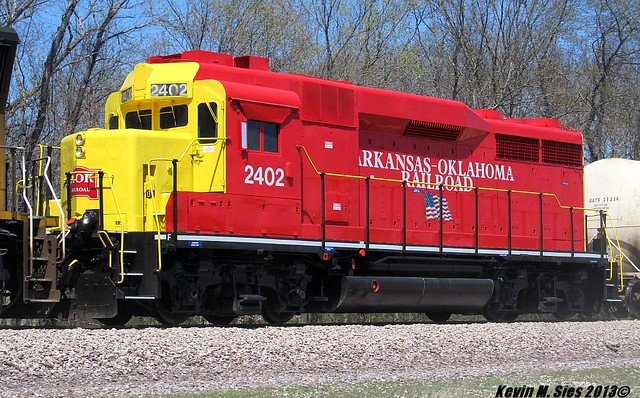
Freshly repainted GP30M #2402 seen in transit on the Union Pacific on the Union Pacific outside of Livingston, IL on April 19th. Kevin Sies photoARKANSAS-OKLAHOMA RAILROAD- The Arkansas-Oklahoma railroad has acquired a quartet of former BNSF GP30M's from Larry's Truck and Electric of MacDonald, OH. In addition to the four GP30M's, the A-OK has also acquired a former Idaho Northern & Pacific (ex Wheeling & Lake Erie, nee Southern) ALCo-trucked GP35. The EMD's are expected to replace five former Conrail B23-7s that have been on the railroad since 2005.
The A-OK runs between McAlester and Howe, OK and leases a 36 mile former Union Pacific branch between Shawnee and Oklahoma City. Commodities handled include coal, frac sand, wheat, plastic, corn, acid, aggregates, lumber and feed. The 118 mile former Rock Island line between Shawnee and McAlester had been dormant for several years due to an unstable bridge over the North Canadian River. The AOK has been working to restore service between McAlester and Shawnee, and progress was made at the end of 2012 when the AOK successfully reopened the bridge over the North Canadian River.
Florida East Coast SD40-2 #714 is seen with Jacksonville-bound intermodal freight #226 as it crosses the San Sebastian River in St Augustine, FL on March 10th.FLORIDA EAST COAST- The Florida East Coast has begun repainting units in a red and yellow scheme reminiscent of the line's early diesels. This would not be the first time the FEC has painted a unit in what has been referred to as Flagler or Champion colors- more than a decade ago, GP40 #2000 was painted in similar colors as a one off.
Bob Pickering photo
FEC's motive power fleet consists of GP40s in a dark blue and white scheme, SD70M-2s painted in colors closely copying the Alaska Railroad (blue and gold) or Rail America (red white and blue) and former Union Pacific SD40-2s that have been operating in UP's Armour Yellow for years. So far, the colors have been applied to the former UP SD40-2s.
The move is likely an effort to boost the railroad's corporate image ahead of an anticipated increase of intermodal traffic that is expected to coincide with the widening of the Panama Canal. The massive project is expected to be completed in 2014 or 2015 and the FEC has been working with the Port of Miami and Port Everglades to include on dock rail facilities as part of their expansion plans.
The Florida East Coast was acquired by Fortress Investment Group [NYSE: FIG] in 2007- they also owned a stake in Rail America until their 2012 sale to Genesee & Wyoming. Although the FEC was largely operated independently of other Rail America properties, some of the new SD70M-2s were delivered in Rail America colors (while still lettered for FEC) and Rail America subsidiary New England Central received GP40s and SD40-2s from Florida East Coast beginning in 2009 before they were relettered for the NECR in 2011.
Painted in Delaware & Hudson-inspired colors, Saratoga & North Creek B39-8 #8524 is seen trundling through the golf course at Stony Creek, NY with the railroad's first revenue freight train on February 11th. John Sesonske photoSARATOGA & NORTH CREEK- It was a short, one car train- reminiscent of a bygone era for shortlines in the Northeast- but Iowa Pacific is hoping this could be just the beginning.
A lone boxcar carrying garnet bracketed by a Saratoga & North Creek B39-8 and Delaware & Hudson painted bay window caboose left North River, NY on Feb 11th in what was the first freight movement over the former Delaware & Hudson branch in more than 25 years.
“We’re open for business,” Iowa Pacific President Ed Ellis said Wednesday. “We’ve broken the ice here. We’re thrilled that Barton is working with us. We’re hopeful this means we’ll be moving a lot more different things moving forward.”The dormant line was purchased by Warren County in the 1990s and the Upper Hudson Railroad operated excursions over a portion of the line until 2010. In 2011, Iowa Pacific was awarded the contract to operate the entire 57 mile line and began operating passenger excursions between North Creek and the Canadian Pacific interchange in Saratoga, NY in July 2011. The line also directly interchanges with Amtrak's Ethan Allen and Adirondack passenger service as well.
Lumber, logs and rock tailings from an old mine in Tahawus are other possibilities.
In Corinth, officials are optimistic that freight service will lure new industry to the former International Paper Co. site.
“This is what we’ve been waiting for, not just passenger service,” Supervisor Richard Lucia said.
A rail spur goes to the former International Paper property, whose large old buildings have been razed. In addition to rail service, however, the location has ample water, a waste treatment plant, landfill and a new million-dollar electric substation.
“I still feel this is the best heavy industrial site in eastern New York,” said Jack Kelley, director of economic development for Prime Companies, an Albany-based realty firm. “Freight service makes it even more desirable for someone to move in.”
Most recently, an Italian solar panel manufacturer expressed interest, but plans never moved forward.
Kelley said he believes anything from wood products to natural gas power generation make sense for the site, or perhaps an intermodal facility similar to one in Mechanicville where products could be unloaded for transport by truck to their final destination.
“There aren’t an awful lot of places in this area where trains can sit while they’re loaded and unloaded,” Kelley said.
Barton’s facility in North River is at the south end of a recently reopened 30-mile stretch of track from North Creek north to Tahawus. Barton’s garnet abrasives are used around the world for waterjet cutting, coatings removal and other special uses such as surface preparation.
At the north end of that line, in Tahawus, NL Industries owns a former ilmenite mine that was used to make titanium during World War II. The line sat idle for many years until Iowa Pacific readied it for re-use last year, despite objections from environmental groups.
A portion of track runs through Adirondack Forest Preserve.
Ellis said a large market exists for waste rock to be used in road building and similar large-scale construction jobs. NL Industries has hired a firm to find potential buyers, he said.
“I believe there will be stone moved in 2014,” he said, adding that freight revenue should account for about half the railway’s revenue within two years.
Thursday, November 29, 2012
Today's Train of Thought- Classic Brick Work, November 29, 2012
In keeping with the recent autumnal theme, Today's Train Of Thought takes us to the Volunteer State.
EMD's SD40-2 unquestionably turned out to be a popular locomotive- just under 4,000 were produced for North American and export markets between 1972 and 1989. Many of the ones that ended up on the Norfolk Southern fleet were a little different, however. The two railways that would merge in the 1980s to form the Norfolk Southern- the Norfolk & Western and Southern Railway- were holdouts in an operating method known as long hood forward.
Since the arrival of the first GP7s on the Southern, the two lines had a tendency to operate the diesels long hood forward- basically with the engine, generator and radiators at the front of the locomotive while the cab and control stands were actually closer to the train. While it might appear at times that the train was running in reverse, the control stands were actually bi-directional. Up until around the time of the merger, the Norfolk Western and Southern ordered locomotives from both EMD and GE that featured a high hood towards the 'front'. That gave the locomotives- regardless of the model or manufacturer- a very blocky appearence, leading some to dub the high hood units as 'bricks'.
Although the Norfolk Southern acquired a number of new locomotives as well as a significant portion of Conrail's engine fleet, none of those were suited for long-hood forward running like the former Southern and Norfolk & Western diesels were [it was never a common practice on Conrail or any of the predecessor railroads, either- NANESB!].
A number of the high-hood 'bricks' have since been retired, scrapped, stored or sold off. Although a number of railroads purchasing former N&W or Southern high hood units have opted to rebuild them so they'd have a lower nose on the short hood for increased visibility, lines like the Georgia Central or Guilford/Pan-Am simply kept the high hood locomotives they acquired from Norfolk Southern the way they were.
Still, even on the rails originally belonging to Norfolk & Western and Southern, the long hood forward practice is becoming increasingly rare, let alone the locomotives manufactured for the Southern or N&W.
Here, railpictures.net contributor Chris Starnes caught 38 year old Norfolk Southern SD40-2 #3232 on the point of Knoxville to Clinton, TN local freight T12 operating short hood forward on a sunny fall day in October 2011 [video of the #3232 in action can be found here]. The venerable 6-axle, 3000 HP beast was built for Southern in September of 1973 and while she could be found almost anywhere on Norfolk Southern's vast system, the photographer caught her on 'home' rails in Knoxville, TN as the leaves above the tracks are changing into various shades of yellow and orange.
It's worth pointing out that while the #3232 has toiled away for one or two owners in nearly four decades of largely uninterrupted service, Knoxville is home to an even older Southern alumni- 1890-built 2-8-0 steam locomotive #154- that sees action a few times a year on the Three Rivers Ranbler excursion train.
Friday, November 16, 2012
Today's Train of Though- Climate Change, November 16th 2012
Today's train of thought takes us trackside to a pond Down East to highlight the change of seasons. What some people refer to as 'climate change', many in the Northeast simply refer to as 'fall', although the lead locomotive depicted above has come a long way since hauling fast freight and minerals through under the blazing sun of California's Mojave desert.
Here, railpictures.net contributor Dan Nelson caught Pan Am/Maine Central SD40-2M #617 roaring past a pond in Auburn, ME with symbol freight NMSE [Northern Maine Jct/Hermon, ME to the CSX Yard at SElkirk, NY] on October 9th, 2010.
The first two units are sporting a classy red and silver that was actually the colors of California's Trona Railway. The lead unit started out life as in May 1974 as Santa Fe SD45-2 #5710 before being rebuilt to SD40-2 standards in the 1990s and purchased by California shortline Trona Railway, where it wore the number 3003. The 30 mile line hauls soda ash, borax, coal and potash in the Mojave Desert, connecting with the Union Pacific.
In 2004, after a little over a decade in service on the Trona, the #3003 and its brethern had been sold to Helm Leasing as the line purchased a handful of former Southern Pacific and Union Pacific SD40T-2 Tunnel Motors. The red and silver units criss-crossed the country as a rent-a-wreck in service on the BNSF, Norfolk Southern, CSX, Union Pacific and shorlines or regionals like the Aberdeen, Carolina & Western or Pan Am.
By late 2009, the unit was one of dozens of six-axle 'rent-a-wrecks' purchased by Pan Am in anticipation of faster track speeds and more frequent trains on the Mechanicsville NY to Ayer, MA 'Patriot Corridor' [although in this instance, she's depicted hustling finished paper products and kaolin empties back to the CSX interchange- NANESB!]. Sister units 616 and 618- also rebuilt from former Santa Fe SD45-2s- arrived in New England around the same time wearing Trona's distincitve colors. Hauling forestry products through Maine at or near fall's peak foliage season much be quite a change of pace from dragging minerals through the blistering heat of the Mojave Desert- even before being rebuilt and sold to the Trona, #617 was no stranger to the harsh desert climate that Santa Fe's Transcontiental main line passed through.
By the spring of 2012, the Trona paint scheme was gone from #617 as she was repainted into Pan Am's solid blue scheme and had Pan Am lettering and the globe logo applied at the Providence & Worcerster shops in Worcester, MA.
Interestingly, none of of the tunnel motors soldiering on for the Trona wear the railroad's silver and red scheme- the locomotives are still painted in Southern Pacific or Union Pacific colors while as of this summer, Pan Am #618 was reportedly still in Trona colors.
Here, railpictures.net contributor Dan Nelson caught Pan Am/Maine Central SD40-2M #617 roaring past a pond in Auburn, ME with symbol freight NMSE [Northern Maine Jct/Hermon, ME to the CSX Yard at SElkirk, NY] on October 9th, 2010.
The first two units are sporting a classy red and silver that was actually the colors of California's Trona Railway. The lead unit started out life as in May 1974 as Santa Fe SD45-2 #5710 before being rebuilt to SD40-2 standards in the 1990s and purchased by California shortline Trona Railway, where it wore the number 3003. The 30 mile line hauls soda ash, borax, coal and potash in the Mojave Desert, connecting with the Union Pacific.
In 2004, after a little over a decade in service on the Trona, the #3003 and its brethern had been sold to Helm Leasing as the line purchased a handful of former Southern Pacific and Union Pacific SD40T-2 Tunnel Motors. The red and silver units criss-crossed the country as a rent-a-wreck in service on the BNSF, Norfolk Southern, CSX, Union Pacific and shorlines or regionals like the Aberdeen, Carolina & Western or Pan Am.
By late 2009, the unit was one of dozens of six-axle 'rent-a-wrecks' purchased by Pan Am in anticipation of faster track speeds and more frequent trains on the Mechanicsville NY to Ayer, MA 'Patriot Corridor' [although in this instance, she's depicted hustling finished paper products and kaolin empties back to the CSX interchange- NANESB!]. Sister units 616 and 618- also rebuilt from former Santa Fe SD45-2s- arrived in New England around the same time wearing Trona's distincitve colors. Hauling forestry products through Maine at or near fall's peak foliage season much be quite a change of pace from dragging minerals through the blistering heat of the Mojave Desert- even before being rebuilt and sold to the Trona, #617 was no stranger to the harsh desert climate that Santa Fe's Transcontiental main line passed through.
By the spring of 2012, the Trona paint scheme was gone from #617 as she was repainted into Pan Am's solid blue scheme and had Pan Am lettering and the globe logo applied at the Providence & Worcerster shops in Worcester, MA.
Interestingly, none of of the tunnel motors soldiering on for the Trona wear the railroad's silver and red scheme- the locomotives are still painted in Southern Pacific or Union Pacific colors while as of this summer, Pan Am #618 was reportedly still in Trona colors.
Saturday, October 27, 2012
Today's Train of Thought- Marquette Down on the Calendar, October 27, 2012
It doesn't seem that long ago that New England was the place to be for fall- especially if you were a sports fan. The days get shorter, the hills start to explode with reds, oranges and yellows and you could hardly turn on the radio or TV without listening to a Boston team winning.
It wasn't that long ago one could expect to tune in to the Red Sox vie for another American League pennant, the Patriots embark on their quest for another title, Boston College raise hell in the ACC with Matt Ryan at QB and the Bruins and Celtics season get underway- all in one weekend. But the only constant is change, and like the leaves lazily drifting to the ground an increasing number of these teams have made themselves in non-factors in the month of October.
Now, that mojo seems to have made it's way west to the Wolverine State. Granted they haven't gotten off to the best of starts in the World Series, but not only have the Detroit Tigers won the American League pennant, they also can lay claim to the first triple crown winner in baseball in more than 45 years as well as the defending AL MVP and Cy Young winner- starting pitcher Justin Verlander. Be it the Wolverines or Spartans, either one of Michigan's Big 12 college football teams have more wins than all three FBS schools in New England combined (the MAC teams are another story, tho').
Sometimes the icing on the cake is the bucolic scenery in the fall- whether in the Midwest of northeastern corner of the country. And if some active rail lines happen to cut their way through that bucolic landscape, then all the better.
And this is exactly the case with western Michigan's Marquette Rail. Here, railpictures.net contributor familymansystem caught Marquette Rail SD40-2 #3001 leading a pair of Union Pacific-painted leasers up the hill and under a wooden bridge at Newyago, MI with Grand Rapids-bound symbol freight Z-151. The wet weather and fallen leaves on the tracks made the rails especially slick on October 11, 2012 and the crew has decided to double up the hill- a process where the crew splits the train into two portions before heading up the hill with one half, placing it in a siding before retrieving the second half and continuing after reattaching the two portions.
Not surprisingly given the composition and bright colors [no easy feat on an overcast day- NANESB!], familmansystem's image has been selected for a People's Choice award by railpictures.net users.
Interestingly, the #3001 is the only such unit to wear such bright livery for the Marquette- the other units are primarily leasers, some of which had the Marquette Rail logo hastily applied. This will also likely be the only unit to wear this distinct scheme. Marquette Rail has the distincion of going from becoming an independent shortline to a Rail America subsidiary to a part of the Genessee and Wyoming system in a few months time. The GWI acquisition of Rail America systems means that there will be plenty more orange along the Marquette Rail in the future.
Saturday, August 25, 2012
Today's Train of Thought- Deep in the Heart of Texas, August 25, 2012
Today's train of thought features what could easily be one of America's most overlooked Class 1 railroads. Despite boasting more than 3200 miles of track, the Kansas City Southern operates mostly in the MidSouth, parts of Texas and some of the Midwest. Of course- that's not including some of KCS's subsidiaries that have been acquired in the past decade such as the Texas Mexican Railroad or their more than 2600 mile Mexican subsidiary- KCS de Mexico.
Traffic along the original KCS route between Kansas City and Shreveport, LA [with lines branching off to New Orleans, Fort Worth and the Texas Gulf coast at Port Arthur- NANESB!] includes coal, aggregates, plastics, wheat, auto parts, chemicals, corn and intermodal traffic. The 1990s saw the KCS expand considerably with the acquisition of former Illinois Central lines between Shreveport and Meridian, MS (formerly Midsouth Rail) and Kansas City and St Louis (formerly the Gateway Eastern).
Fort Worth is about as far west as the KCS goes- at least on the American side of the border. And it is just to the north of here that railpictures.net contributor Chris Starnes caught this duo of SD40-2s heading north on BNSF trackage rights at Justin, TX on a stormy July 2008 afternoon. The lead unit- SD40-2 #3061- is in the slightly newer Kansas City Southern grey with yellow trim paint scheme while the trailing SD40 is in the older all-white version with red letters. The train still has a few miles to go before reaching home rails at Wylie, TX.
With the recent expansion, KCS has purchased newer motive power from GE that's in the company's eye-catching orange black and yellow 'Southern Belle' livery reminiscent of the KCS early streamliners.
Wednesday, March 14, 2012
Today's Train of Thought- First Light, March 14, 2012

Today's Train of Thought takes us to a frigid and snowy Hawkeye State to a line that's changed hands no less than three times since 1996.
In 1985, the Illinois Central Gulf spun off a series of lines throughout the Midwest and Deep South that they deemed redundant. Many of these lines exist today as regionals like the Indiana Railroad or Paducah & Louisville. Around that same time, the ICG's former Illinois Central Chicago to Omaha, NE line went to the newly-formed Chicago Central & Pacific. In addition to the main line across northern Iowa, the CC&P also had a branch to Sioux City, IA and the Cedar River line, which went north from Waterloo, IA to Albert Lea, MN and south from Waterloo to Cedar Rapids, IA.
The CC&P lasted a little more than 11 years when the Illinois Central made the somewhat unusual move of reacquiring the railway lock, stock and barrel in 1996- about two years before the Canadian National would acquire the IC.
Here, railpictures.net contributor R Scott Marsh catches Canadian National local freight L575 with Illinois Central SD40-2 #6201 leading and Elgin, Joliet & Eastern SD38-2 #678 trailing along with a Canadian National GE trailing. The train is seen just outside of St Ansgar, IA with a lengthy cut of grain cars for a customer on the Osage sub north of Waterloo at daybreak on Jan 30th, 2012.
Saturday, February 18, 2012
Today's Train of Thought- Joint (Line) Endeavor, February 18

Today's Train of Thought takes us to the foot of the Rockies on Colorado's Joint Line. Construction on the Rio Grande line south of Denver started in 1870- the line was origianlly supposed to go as far south at El Paso, TX where it would link up with a sister railroad in Mexico and on to the Pacific coast from there. While towns such as Pueblo and Colorado Springs sprung up along the Rio Grande line south of Denver, they reached a huge imapsse at Raton Pass near the New Mexico-Colorado state line.
However, the topography wasn't what proved to be so costly for Rio Grande. By 1878, the Rio Grande and archrival Atchison, Topeka & Santa Fe became embroiled in what was known as the Railroad Wars over the both the southern route and construction of newer routes to tap the mineral-rich boomtowns of the Rockies. In February 1878, the Santa Fe hired a number of local gunfighters and the financially strapped Rio Grande was forced to cede Raton Pass and points south without even firing a shot.
The following year, a silver strike up in Leadville, CO sparked the renewal of the Railroad Wars between Santa Fe and Rio Grande. This time, the silver veins in Leadville were the prize and Santa Fe hired infamous Old West gunslingers like Bat Masterson and Doc Holliday to try and secure the pivotal route through the Royal Gorge. However, Rio Grande had secured the support of local sheriffs and an injuction from the fourth judicial circuit court and the Royal Gorge route went to Rio Grande by 1880.
The history of the Joint Line between Pueblo and Denver was far less acrimonious and provided both the Santa Fe an outlet to Denver from it's transcontinental route while giving the Rio Grande access to other class 1 railroads such as Missouri Pacific, Rock Island, Colorado & Southern.
Besides being a pivotal bridge route, the line gained increasing importance with increased mining of low-sulphur coal from the Powder River Basin in Wyoming and unit coal trains to power plants throughout Texas and the Midwest.
Since the 1990s mergers that put Rio Grande under Union Pacific control and saw Burlington Northern combine with the Santa Fe, BNSF still handles the local freight on most parts of the Joint Line.
Here, railpictures.net contributor Joe Blackwell caught rebuilt BNSF SD40-2R #1572 leading the southbound Pike's Peak local at Larkspur, CO. The lead unti actually started out life as a Santa Fe SD45-2, but was recently rebuilt, renumbered and repainted by BNSF. The new paint scheme stands out in stark contrast to the crisp white landscape and blue skies on this sunny February 2012 day.
Monday, January 9, 2012
Today's Train of Though- A Grande Finale; January 9, 2012

Today's train of though showcases the end of an era for the Main Line Through the Rockies in the cold, lonely high desert of Utah.
Nearly a decade after Denver, Rio Grande & Western merged with Southern Pacific, businessman Phil Anschultz sold the combined system to Union Pacific in 1996. And just like Union Pacific's acquisitions of the Missouri Pacific, Missouri-Kansas-Texas and Western Pacific railroads in the 1980s, it was seemingly inevitable that these new acquisitions would disappear under a coat of armour yellow paint.
However, a number of 3,000 HP SD40T-2 Tunnel Motors from the Rio Grande would remain in service into the early 2000s, still in unmodified DRG&W black and orange. The majority of these locomotives were assigned to helper and local service in the aptly named railroad and mining town of Helper, UT.
With their numbers declining as the decade progressed, the units- along with other older locomotives from the Union Pacific fleet- were assigned to the 'Dirt Train', a dedicated unit train that hauls gondola cars full of contaminated soil to a disposal site in E. Carbon, UT.
By 2006, all that remained of the SD40T-2 Tunnel Motors that began service in Rio Grande's black and orange was DRG&W #5371. She would spend the next two years alternating service between locals around Salt Lake City and the dirt train.
Here, railpictures.net contributor James Belmont catches the #5371 and a trio of armour yellow SD40-2s trailing as they head east through Wellington, UT on Feb 29th, 2008 while making their way to the East Carbon disposal site with another trainload of contaminated dirt [likely from the decommissioned Hunter's Point Naval Shipyard in San Francisco, CA- but that's just speculation on my part- NANESB!].
According to Mr Belmont, this was the last run of the #5371 in regular service. The Rio Grande unit was sent to Cheyenne, WY for storage shortly after this picture was taken. By September 2008, the #5371 was stricken from Union Pacific's roster.
By 2009, the Union Pacific Railroad donated the #5371 to the Utah State Railroad Museum in Ogden, UT [Housed in Ogden's Union Station along with the John M Browning Firearms Museum, upping the 'must visit' factor for me by about another 1000 points- NANESB!].
Today, the 5731 keeps company with other displayed locomotives such as Union Pacific DD40AX #6916 (largest diesel locomotive built by EMD) and 4-8-4 #833 (a sister to Union Pacific's still-active #844.
Sunday, November 27, 2011
Today's Train of Though- WAAY Out There, November 27, 2011

Today's train of thought takes us to the Southeastern corner of the Granite State on the former Boston & Maine line between Billerica, MA and Rigby Yard in Portland, ME. While not part of the Norfolk Southern/Pan Am Patriot Corridor, the line has seen a marked increase in traffic over the last decade. While aggregates from Ossippe, NH bound for Boston's Big Dig as well as improved connections with CSX, Canadian Pacific and Norfolk Southern with Pan Am west of Ayer, MA no doubt accommodated an increase in freight traffic between Maine and the rest of the nation, the most high profile trains using this stretch of the Pan Am are the 5-daily Amtrak Downeaster trains departing out of Boston's North Station.
The 116-mile trip between Boston and Portland, ME consistently enjoys the highest ridership rates on the Amtrak system and is expected to undergo a 30 mile expansion east to Brunswick, ME in the near future.
With all that said, it is still freight that pays the freight on the former B&M Eastern Line. Pan-Am and Amtrak have begrudgingly learned to coexist over the last 10 years, and both railroads are better off for it.
Here, railpictures.net contributor Stephen Arata caught Pan Am symbol freight WAAY [WAterville, ME to AYer, MA] slowing down as it rounds a curve in Newfields, NH under a canopy of New England fall color on November 5, 2011. SD40-2 #609 and two other Pan-Am units are grinding to a halt as the freight train awaits the passage of one of the Downeaster Amtrak trains.
Monday, November 14, 2011
Today's Train of Thought- A Leisurely Run for the Border, Nov 14th 2011

When one thinks of parts of this country that have an abundance of fall colors, one doesn't usually think of Iowa. But the northeast corner of the Hawkeye state features rolling hills and valleys as well as forests along the Mississippi River. And it's through this somewhat un-Iowa-like landscape that the former Milwaukee Road line between Minneapolis-St Paul and Kansas City traverses. There's a line to Chicago that branches off across the Mississippi river at Sabula, IA. Over the last 25 years, the line has seen no fewer than five different owners (Milwaukee Road; Soo Line; I&M Rail Link; Dakota, Minnesota & Eastern and Canadian Pacific) with the most recent change of ownership coming in 2008 when DM&E parent company Cedar American Holdings sold the combined DM&E/IC&E system to Canadian Pacific.
For the most part, CP doesn't seem to be in any particular rush to assert its corporate identity over its latest acquisition. While the blue and yellow EMDs of the IC&E and DM&E have occasionally been showing up on CP Rail's system as far east as the D&H in northern New York state, trains over this recently acquired part of the Canadian Pacific are for the most part powered by second generation standard-cab EMDs from both the IC&E/DM&E fleet as well as similar lease units.
Here, on a clear, gorgeous autumn afternoon in October 2010, railpictures.net contributor FJ Grizel caught a mixed freight decelerating after crossing the mighty Mississippi from Savanna, IL into Sabula, IA. The lead unit- SD40-2 #6367- is no stranger to these parts having started out life as Milwaukee Road #206 and having been dubbed 'City of New Ulm' by the DM&E.
Subscribe to:
Posts (Atom)