Showing posts with label Soo Line. Show all posts

Friday, August 9, 2013

Iron Horse Roundup For July/August 2013

AFP Photo
MONTREAL, MAINE & ATLANTIC- In the wake of last month's deadly runaway train wreck that devastated the southern Quebec town of Lac Megantic, Hermon, ME-based Montreal, Maine & Atlantic filed for Chapter 11 bankruptcy in federal bankruptcy court in Bangor, ME.
The MM&A has also petitioned Canadian civil courts for relief under that country's Companies’ Creditors Arrangement Act. The company appears to have set aside nearly $786,000 as “indemnification and/or contribution in connection with wrongful death litigation and other claims,” according to a listing of the company’s 20 largest creditors.

MMA still owes $27.5 million of a $35 million loan it received from the Federal Rail Administration in 2005, according to Gardner’s affidavit. The railroad also has a $6 million line of credit with the Wheeling & Lake Erie Railway Co. issued in June 2009. That company has sought to protect its security interest, the affidavit said.
Other creditors include JD Irving subsidiary New Brunswick Southern, a subsidiary of San Antonio, TX-based Valero energy [NYSE- VLO], Minneapolis, MN-based Flex Leasing LLC and the Canadian Pacific railroad [NYSE- CP; TSX- CP].

Although a federal bankruptcy judge ruled that the MM&A could continue to operate under Chapter 11 reorganization, the line through Lac Megantic is still closed, effectively severing the Montreal, Maine & Atlantic in two. At the end of July, Maine state officials had entered into talks with four other unnamed railways to continue service in anticipation of the MM&A shutting down.

The MM&A laid off 79 workers in the wake of the Lac Megantic disaster. Meanwhile, Canadian officials have raised the death toll in Lac Megantic to 47 during the July 6th derailment.

Xoan Soler- La Voz de Galicia

SPAIN- The driver of a train that derailed and killed 78 passengers in northwestern Spain has been provisionally charged with multiple counts of negligent homicide, although he wasn't required to post bond or sent to jail because he wasn't considered a flight risk.
Garzon was questioned for almost two hours at the court in Santiago de Compostela, the northwestern town near where the accident occurred.

Garzon was driving the train carrying 218 passenger in eight cars that hurtled far over the 80-kph (50-mph) speed limit into a high-risk curve on Wednesday evening, tumbling off the tracks and slamming into a concrete wall, with some of the cars catching fire.

The Spanish rail agency has said the brakes should have been applied four kilometers (2.5 miles) before the train hit the curve

However, a local resident who rushed to the scene of the accident said in an interview broadcast Sunday that minutes after the crash Garzon had told him he had been going fast and couldn’t brake.

The resident, Evaristo Iglesias, said he and another person accompanied the blood-soaked Garzon to flat ground where other injured people were being laid out, waiting for emergency services to arrive.

“He told us that he wanted to die,” Iglesias told Antena 3 television. “He said he had needed to brake but couldn’t,” Iglesias said. He added that Garzon said “he had been going fast.”

In its report about the accident, Antena 3 television showed a photograph of Iglesias in a pink shirt and cap helping to carry the driver after the train accident. The station also aired television footage of Iglesias working beside the wrecked train to help other survivors.

Garzon was reportedly on the phone with an agent at the next station to determine which track his train was to come in on. While in the USA, train crews are now prohibited from talking on the phone while operating the train, Spain's state-run RENFE uses what's referred to as 'tren-tierra' or train to land lines to communicate between stations and crew. Shortly before the accident, the train passed from an area where computers control most of the train's functions to one where the driver has to brake and accelerate accordingly. It's believed that Garzon may have missed this transition point while he was on the phone.

ARGENTINA- Transportation officials in Argentina's capital of Buenos Aires have released in-cab CCTV footage of engineers reading, napping or playing on their phones while the train is in motion.
In one clip, the driver is seen stepping up to the camera in his train cabin, attempting to obscure the lens so his activities cannot be seen. Other drivers are more overtly distracted, with some taking a nap, reading a book or playing on their mobile phone.

Argentina's Interior and Transport Minister Florencio Randazzo has since vowed to lead a crackdown on dangerous train drivers.

He plans to ban phone calls and unauthorised people in the cab

Mr Randazzo has introduced daily medical checks on all drivers to gauge their fitness to drive and to reduce the risk of them falling asleep at the controls.

Under the new system, all those caught distracted on camera will either be disciplined or fired.
The release of the footage comes more than a year after a commuter train plowed into a terminal in Buenos Aires, killing 49 and injuring hundreds.

FRANCE- Investigators in France believe a faulty switch system was to blame in a deadly derailment that killed six passengers at a station south of Paris last month.

After leaving the tracks, the train crashed into the station at Bretigny-sur-Orge.

A passenger speaking on France's BFM television said the train was going at a normal speed and was not meant to stop at Bretigny-sur-Orge.

He described children unattended in the chaotic aftermath, and swarms of emergency workers at the scene.

Two train cars, numbers 3 and 4, initially derailed, then knocked the other cars off the track, SNCF chief Guillaume Pepy said.

"Some cars simply derailed, others are leaning, others fell over," he said


A spokesman for the French state-run railway- SNCF- said the train was carrying an estimated 350 passengers when it derailed at 5:15 PM local time at Gare Bretigny sur Orge. The official death toll from the accident was 7 with more than 20 injured.


CALIFORNIA- Governor Jerry Brown has ordered a 60-day 'cooling down' period between San Francisco's Bay Area Rapid Transit and workers threatening to strike over an expired contract with the transit agency.

Last month, a 4-day strike had left Bay Area commuters scrambling for alternate transportation. It was the first strike for BART since 1997.

Prior to Brown's announcement, both the Service Employees International Union and Amalgamated Transit Union were hoping the looming deadline of Sunday, Aug 11th would be sufficient to pressure BART management to agree to a renewed contract on the union's terms. Prior to Brown's intervention, the unions had threatened to resume their strike after this weekend.

The two month delay would take away some leverage from unions representing BART employees as it would allow the agency time to recruit replacement workers from out of retirement. An odd clause in the contract originally signed in 1979 would have prevented BART from hiring replacement drivers until the workers actually went on strike, and even then the replacement workers would only after completing a 15 week training course.

Reuters/Denis Balibouse

SWITZERLAND- Transportation officials in Switzerland are investigating the cause of a head-on collision between two passenger trains in the western part of the country. The crash killed the driver of one of the trains and injured at least 35 passengers.

The two Swiss Federal Railways regional passenger trains collided with one another head-on at Granges-Marnand in the Vaud Canton outside of Lucerne on July 29th. Although some press outlets have speculated that one of the trains left the Granges-Marnand station too early and collided with an incoming train, officials have yet to determine the exact cause of the crash and are moving both wrecked train sets to another location to closer examine the wreckage.


SOO Line SD60 #6053 leads an SD60M over county highway G38 outside of Washington, IA with a northbound Kansas City-St Paul manifest freight train on June 2012. Eric Rasmussen photo.

CANADIAN PACIFIC- In a surprise move, the Canadian Pacific Railroad announced that they are seeking bids for more than 40 former Soo Line SD60s and SD60Ms. The solicitation comes as the CPR is more than halfway through an extensive rebuild of their SD60 fleet. Some of the units are being stored at CP's St Luc yard in Montreal. All of the overhauled units have been rebuilt to Tier 0+ EPA compliance and feature AESS Locomotive Automatic Engine Start/Stop and Positive Traction Control in compliance with an upcoming PTC mandate expected to take effect starting in 2015- several more are supposed to undergo rebuilding at Montreal's CADRAIL facility.

The Soo Line ordered the SD60s from EMD in 1987 and with CP Rail's takeover, the burly 3800 HP six axle EMDs could be found anywhere from the Canadian Rockies to upstate New York although they were (and still are) outnumbered by CP Rail's far more prolific fleet of SD40-2s.

Canadian Pacific has also started putting up their fleet of former Milwaukee Road GP40s for sale- Respondek Rail Corp and United States Sugar Corp have already purchased a pair.

With the arrival of rebuilt GP20C-ECO and SD32C-ECO from Caterpillar [NYSE- CAT] subsidiary Progress Rail, Canadian Pacific returned their only two Gensets to National Railway Equipment in Illinois in July. The two Gensets- #2100 and #2101- were largely paid for by a province of Ontario 'green energy' intiative.

Sunday, March 31, 2013

Iron Horse Update for March 2013


In a scene that won't be repeated anytime soon, Delaware & Hudson painted GP38-2 #7304 is seen rolling along the former Pennsy RR High Line through Philadelphia, PA with a mixed bag of CP and leased SD40s in charge of Train 158-04 in August 2011. Lee King photo


CANADIAN PACIFIC/DELAWARE & HUDSON- The Canadian Pacific railroad announced their pullout from the Philadelphia area effective March 4th. The move comes as something of a surprise as the CP Rail [NYSE- CP] had been seeing increased traffic in the form of dedicated unit crude oil trains between the Bakken formation in North Dakota and refineries in the Northeast- including in the Philadelphia area. In fact, the Carlyle group plans on investing more than $200 Million in a Sunoco [NYSE- SXL] refinery along the Schuykill River.

The Canadian Pacific actually owns no right-of-way around Philadelphia. Instead, the CPR reached the city of Brotherly Love thanks to trackage rights date back to the 1976 formation of Conrail after the bankruptcies of the Penn Central, Lehigh Valley, Reading, Central New Jersey and Erie Lackawana. The Delaware & Hudson was allowed trackage rights into Philadelphia (as well as Newark, NJ Buffalo, NY and Chessie System/CSX's Potomac Yard in Alexandria, VA) to prevent Conrail from monopolizing freight rail service. The trackage rights were included in CP Rail's 1991 purchase of the Delaware & Hudson, but since Conrail's 1996 sale of the former Lehigh Valley mainline between Scranton and Packerton, PA and the 1999 breakup of Conrail itself, the Canadian Pacific has had to negotiate trackage rights over multiple railroads just to reach Philadelphia proper. While CPR still utilizes trackage rights over Norfolk Southern's Southern Tier line to reach Buffalo, the D&H's Potomac Yard service was cut back to Harrisburg, PA in 1989 [while the New York, Susquehanna & Western was the designated operator- NANESB] and the Newark service was cut back to Allentown, PA in 2012.

Canadian Pacific's ceding Philadelphia to CSX and Norfolk Southern reflects a broader trend of cutting back on trackage deemed unprofitable or redundant since the 2011 takeover of the Calgary-based Class 1 carrier by private equity firm Pershing Square Capital. In December 2012, the CPR announced they were seeking buyers for more than 600 miles of former Dakota, Minnesota & Eastern trackage in South Dakota, Wyoming, Minnesota and Nebraska.

CANADIAN PACIFIC/SOO LINE- Fourteen cars of a 94-car southbound Canadian Pacific freight train derailed in Western Minnesota on March 28th. The derailment took place near Parkers Prairie, MN and three of the cars had spilled oil onto the ground. Initial estimates claimed that as much as 30,000 gallons had leaked from one of the ruptured cars, but that figure was later revised downward to less than 15,000 gallons.

No injuries were reported in the derailment, although the cold weather hampered cleanup by giving the oil a thicker, tar-like consistency. The line was reopened within a matter of hours.


SWEDEN- A woman in the Swedish capital was hospitalized and is facing charges of suspicion of reckless endangerment after allegedly stealing an empty commuter train from a depot in Stockholm and crashing it into a house back in January.
Tomas Hedenius, a spokesman for train operator Arriva, said the woman, born in 1990, stole the four-car train at a depot outside Stockholm.

She then drove it about 1.6 kilometres to the end station on the railway line, where it jumped off the tracks, careered for about 25 metres and crashed into a three-story building.

“There were three families inside the apartment building, but no one was injured. At least not physically,” Hedenius said.

The motives of the woman, who worked for a company contracted to carry out cleaning for the train operator, were not immediately clear.

“We have only heard good things about her. We’re investigating how this could happen, and why she did what she did,” Hedenius said.
It is unclear how the woman got the keys to the train, but the Arriva spokesman said that operating the commuter trainsets is pretty straightforward once in the cab.

HOUSATONIC RAILROAD- The Housatonic Railroad suffered its second derailment since November earlier this month. Shortly after midnight on March 15 four cars jumped the rails and tipped over near the entrance of a paper mill in Lee, MA with two high-sided gondola cars spilling construction debris along the banks of the Housatonic River.

Crews spent the weekend cleaning up the derailment and re-opening the line, although a Housatonic spokesman said that the two gondola cars would likely be scrapped on site.

Texas-New Mexico SD9043MAC #113 seen leading a short mixed freight at Hobbs, NM. The 104-mile Iowa Pacific subsidiary is enjoying a revival of oil drilling in the Permian Basin, which straddles the Texas and New Mexico border. JR Leal photo

TEXAS-NEW MEXICO- After spending approximately $25 million dollars on improvements to the right-of-way, Iowa Pacific's Texas-New Mexico Railroad began handling their first unit train of crude oil at the end of January. Ultimately bound for refineries along the Texas Gulf coast, the crude is loaded along the TNMR in Winkler County, TX. Some of the improvements also include a joint Union Pacific/Texas-New Mexico unloading facility for frac sand at the interchange in Monohans, TX that Iowa Pacific chipped in more than $1.5 million towards.

When Iowa Pacific Holdings first acquired the Texas-New Mexico and disconnected sister line West Texas & Lubbock in 2002, there were reportedly only 12 oil rigs operating throughout the Permian Basin. More recent estimates now put the number at 450.

The Texas-New Mexico operates with a motley hodgepodge of motive power, including new SD9043MACs as well as B39-8s from sister railroad San Luis & Rio Grande as well as former Arizona & Eastern GP20s and GP35s.

Before the reinvigoration of drilling the Permian Basin, the TNMR was pretty busy handling fertilizers, LNG, clay, chemicals, aggregates, scrap metal and unit trains loaded with contaminated silt dredged up from the Hudson River in upstate New York and destined for Waste Control Specialists in Andrews County, TX. In addition to those commodities and the new unit oil trains, the TNMR also recieves trainloads of fracking sand and proppants from the upper Midwest at the UP interchange in Monohans.

[Hat tip to Ruckus Rails for the background information on the TNMR- NANESB!]

Sunday, December 2, 2012

Quickie Iron Horse Roundup- Conrail Freight Derails, Spills Chemicals in New Jersey; Canadian National Begins Testing LNG-Fueled Locomotives

AP Photo

CONRAIL- Officials from the NTSB are investigating the Friday morning derailment of a Conrail Shared Assets freight train in Paulsboro, NJ that sent several tank cars tumbling into Mantua Creek [a video of the bridge in action before the derailment can be viewed here- NANESB!].

The Conrail freight was pulling 84 cars and heading southbound along a branchline when the derailment occurred Friday morning. At least one of the cars ruptured, sending a cloud of vinyl chloride into the air and forcing the evacuation of hundreds of residents nearby- 70 people were also hospitalized with respiratory problems.

Conrail and investigators from the National Transportation Safety Board are focusing on the 139 year old bridge- a movable 'A Frame' type span. The bridge was manually operated and had a bridge tender on site until the last decade or so. There was reportedly a minor derailment along the same bridge in 2009 and Conrail was investigating problems with trackside signals near the bridge in the week or so before Friday's derailment.

The swing bridge opens and shuts to accommodate boat traffic along the river and crews were reporting that the signals leading up to the bridge would remain yellow instead of turning green.
The veteran two-person crew operating the CSX train Friday was familiar with the route and had run it the three previous nights. They had started their shift at 3 a.m. in Camden and were surprised to get a yellow signal when they approached the bridge at about 7 a.m. They used a keypad device, similar to a garage door opener, to try to get a green light, to no avail. The pair then stopped the train for several minutes, examined the tracks, and got permission from a dispatcher to proceed, Hersman said.

The two locomotives and five tanker cars made it across before the crew looked back to see the bridge “collapse” and a pileup of cars in the creek. The one that ruptured had been struck by another tanker, she said.

Recordings of various data so far support the crew’s account, investigators said. However, authorities are not yet sure whether the bridge deck actually collapsed or shifted.
Officials are also considering tidal surges from the passing of Super storm Sandy may have factored into the derailment, undermining the 1873-built bridge. However, NTSB investigators can't do a thorough on site examination until the remaining chemicals are cleaned up.

Bracketing a Liquified Natural Gas tank car, rebuilt SD40-2s #5262 and #5258 are seen in handout photo from Canadian National Railways. CN is experimenting with rebuilding locomotives to run on LNG

CANADIAN NATIONAL- Canadian National Railways [NYSE- CNI; TSX- CNR] has begun testing a pair or LNG-powered locomotives to determine the feasibility of using natural gas instead of diesel fuel.

The conversion kits was supplied by Energy Conversions, Inc of Tacoma, WA and Calgary-based natural gas producer Encana [NYSE- ECA; TSX- ECA] will be providing the fuelling and the maintenance. Officials with Canadian National and Energy Conversions say that the move could cut carbon dioxide emissions by 30%. While Alberta is a leading energy producer thanks to crude oil and the oil sands, the province also sits on top of considerable natural gas deposits. However, the current glut has driven natural gas prices down- although this would put CN at an advantage should the prices persist as it expands the LNG-powered locomotive program.

Canadian National's LNG project is similar to an earlier natural-gas powered locomotive project from Energy Conversions. Between 1991 and 1996, the Burlington Northern Railroad ran coal trains between Wyoming's Powder River Basin and the midwest with a duo of SD40-2s bracketing an LNG tanker/tender modified by Energy conversions. Although the Burlington Northern program stopped around the same time as the merger with Santa Fe to form BNSF, Energy Conversions would do similar work for the Napa Valley Wine Train, the state railways of Thailand and Brazil's Companhia Vale do Rio Doce's [NYSE- VALE, BOVESPA- VALE3 & VALE5] rail operations.

The locomotives used for CN's LNG pilot program are a pair of 1975-built SD40-2Ws that are now sporting flared radiators- like the SD40-2s Burlington Northern used 20 years ago. Both locomotives and the LNG tanker/tender will be assigned to the 480km Canadian National line between Edmonton and the Athabasca oil sands hub of Ft McMurray, AB. Built in the 1920s, the line was originally part of the Northen Alberta Railway until NAR was taken over by CN in 1981. By 1994, CN ceased operations and the line was acquired by Rail Link's Lakeland & Waterways- who were brought into the Rail America fold by 1999. In the summer of 2000, Rail America halted operations on the Ft. McMurray line and within a few months, Canadian shortline operator CANDO contracting acquired the line outright from CN, only to have CN repurchase the line at the end of 2007.

Presently, the Canadian National hauls construction materiel, pipe and heavy machinery up to Ft McMurray and brings oil sands extraction byproducts like petroleum coke and sulphur south.

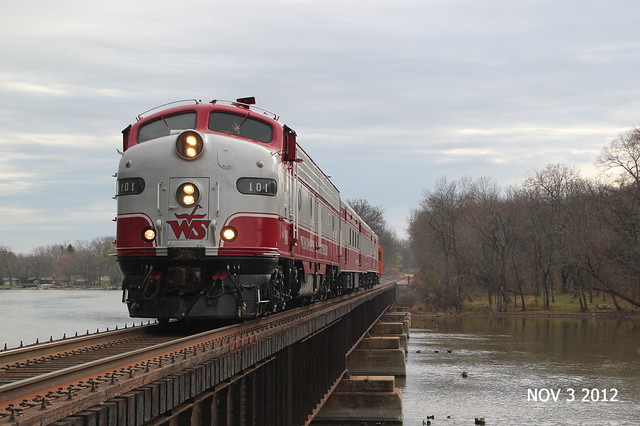
Wisconsin Southern E9A #101 seen hauling the Toys for Tots train cross the Rock River east of Edgerton, WI on November 3rd, 2012. photo- Brian Allen
WISCONSIN- Just a quick update out of the Badger State. I had earlier reported that Soo Line 2-8-2 Mikado #1003 was scheduled to haul a Toys for Tots holiday train over the Wisconsin & Southern last month.

However, shortly before the scheduled November 3rd departure, the #1003 was sidelined with an unspecified mechanical problem. Wisconsin & Southern E9A #101 handled the Toys for Tots train between Milton and Middletown, WI.

The #1003 was pulled from service two years ago in order to under to undergo her FRA-mandated 15 year boiler inspection. Due to rising costs, there were some concerns from the preservation community that the #1003 would never return to service again.

OHIO- Two Ohio-based preservation groups have announced plans to begin restoration of a 100 year old ALCo steam engine to service.

Colombus-based American Steam Railroad Preservation Association has reached an agreement with the Cleveland-based Midwest Railway Preservation Society to house the restoration of former St Louis-San Francisco 2-8-2 Mikado #1352 at the MRPS' former Baltimore & Ohio roundhouse in Cleveland.

The #1352 was built by ALCo in 1912 and operated on the Frisco for nearly 45 years before her 1956 retirement. The Frisco donated the #1352 to Kansas City where she was on display at Swoop Park, but soon fell victim to neglect and vandalism. A group of concerned preservationists eventually purchased the 1352 and moved her into storage in rural Illinois.

The MRPS is also home to another, slightly newer ALCo 2-8-2 Mikado- former Grand Trunk Western #4070. The #4070 was built in 1918 and most recently operated in 1990 on the nearby Cuyahoga Valley Scenic Railroad.

Sunday, October 21, 2012

Quickie, Steamy Iron Horse Roundup for October 21, 2012


Milwaukee Road 4-8-4 #261 seen passing a farm in Plato, MN with an excursion in May 2008. Robert Butler photo

MINNESOTA- After a lengthy custody battle between preservation groups, a movie cameo with Johnny Depp and an FRA-mandated boiler inspection, Milwaukee Road 4-8-4 Northern #261 appears ready to go back into service for the Friends of the 261 non-profit.

The 1944-built ALCo was successfully test-fired at the end of September and a number of shakedown runs are scheduled for the next several weeks. The locomotive last ran on a BNSF employee special between the Twin Cities and Winona, MN in September 2008. Within a year, the Friends of the 261 and the 261's owner- the National Railroad Museum in Green Bay, WI- were at odds with each other over the lease agreement. After advertising the locomotive for sale in the middle of it's 15-year FRA inspection, the Friends of the 261 and the National Railroad Museum eventually came to an agreement after a rumored sale to a 3rd party in California fell through. In May 2010, the National Railroad Museum announced that it had sold the 261 to the Twin Cities based non-profit for $225,000. While this gave Friends of the 261 sole ownership of the locomotive, funds allocated for the completion of her boiler inspection were used to complete the purchase.

The Friends of the 261 were able to raise funds by operating charter luxury railcar excursions using restored Milwaukee Road Hiawatha varnish behind Amtrak or Canadian Pacific. Prior to its 'final' run [before the FRA mandated boiler inspection, at least- NANESB!] the 261 made its way to Chicago for the filming of the Depression-era Dillinger biopic Public Enemies starring Johnny Depp and Christian Bale. Curiously, the 261 wasn't built until a decade after Dillinger was gunned down, although similar locomotives were used extensively at the time.

The 261 also holds the distinction of operating every year between 1993 and 2008. Besides holding down at least one excursion out of the Twin Cities every year up until 2008, the big Northern has even ventured as far afield as Scranton, PA and the New River in West Virginia in the 1990s.

Soo Line 1003 getting ready for a photo freight at Fairwater, WI in October 2008. Daniel Simon photo.

WISCONSIN- Speaking of steam locomotives in the upper Midwest, Soo Line 2-8-2 Mikado #1003 will reportedly be going back into service less than two years before she was withdrawn for her mandatory 15 year boiler inspection.

Stored at the Wisconsin Automotive Museum and successfully test-fired earlier this year, the Steam Locomotive Heritage Association announced that the #1003 was ready for service and would be hauling the 2012 Toys for Tots train over Wisconsin Southern rails between Milton and Middleton, WI on Saturday, November 3rd.

The 1913-built Mikado last ran on November 13, 2010 and some expressed doubts whether or not there would be enough funding to return the 1003 to steam.

Wednesday, October 3, 2012

Today's Train Of Thought- You Wind Some, You Lose Some, October 3rd, 2012

Today's train of thought takes us to the Northstar state and gives us a slight peek at the rail industry's dalliance with 'green energy'.

Railroads of all shapes and sizes throughout the USA and Canada have been scrambling in recent years to take advantage of fossil fuel exploration and drilling in places like Texas, Alberta, the Appalachians or the upper Midwest. In addition to the crude oil or LNG that gets shipped by rail, these drill sites also require a massive amount of sand and pipe be brought in- a demand that often can only be met by dedicated 60-car unit trains.

Since diesel still rules the rails here in North America, running trains on wind or solar power is something of a pipe dream. While some manufacturers have been experimenting with biodiesel or ethanol, it will be awhile before we see that kind of technology in regular usage- if at all.

Yet with the proliferation of windmill farms throughout the country in recent years, the bulky, unwieldy components that make up the massive turbines don't lend themselves particularly well to being shipped via highways- and a little like oil, coal or natural gas, this is where rail freight once again proves its worth as its often the only feasible way of shipping these parts long-distance [FYI- a large part of the reason the parts typically need to move long distance is because they often arrive in the USA via ship from Asia or Europe- NANESB!].

Even the smaller parts for many windmills require at least one 85 ft flatcar to be transported- the blades and tower assemblies often require multiple specially-fitted flatcars in order to be moved by rail.

Here, rrpicturearchives.net contributor Christopher Muller caught Soo Line SD60 #6001 heading north (railroad west), cresting a gently undulating grade at Mahnomen, MN on June 25, 2005. This portion of the former Soo Line heads north from the Twin Cities to the Canadian border and onto Winnipeg from there.


Mr Muller also snapped this photo of the red and white SD60 and a trailing Canadian Pacific SD40-2 making their way past the grain elevators in the center of Mahnomen with their cargo. He also managed to compile a helpful photo album on rrpicturearchives.net, highlighting the different windmill components as the rolled by that's worth checking out.

Apparently this train is simply passing through, with its final destination being somewhere in Canada.

Friday, July 27, 2012

Steamy Iron Horse Roundup For July 2011


Iowa Interstate's Chinese manufactured 'QJ' 2-10-2 #6988 is seen passing the former Rock Island Iowa City, IA depot on the return leg of its round trip excursion between Cedar Rapids, IA and Rock Island, IL on June 19th, 2012. Erik Rasmussen photo
IOWA- For the second year in a row, the Hawkeye state and regional Iowa Interstate played host to a large gathering of rail enthusiasts and historians with their 2012 convention in Cedar Rapids, IA.

Like last year's Trainfest in Rock Island, IL, this year's NRHS convention featured steam and diesel powered rare mileage excursions on former Chicago, Rock Island & Pacific and Milwaukee Road lines that only see freight traffic these days.

In addition to a day out at the Midwest Old Threshers Reunion at Mt Pleasant, IA where attendees got to see restored trolleys, interurbans and steam as well as vintage steam powered tractors and farm machinery, the convention featured a steam powered excursion between Cedar Rapids and Rock Island, IL with IAIS Chinese QJ #6988 doing the honors.

Cedar Rapids and Iowa City MP15DC #122 seen powering an excursinon on the original interurban line between Cedar Rapids and Iowa City at Cou Lake, IA on June 22nd. FJ Grizel photo.

Attendees also got to ride behind rare mileage excursions over Dan Sabin's Iowa Interstate and former interurban Cedar Rapids and Iowa City- also known as the CRANDIC and owned by Alliant Energy [NYSE- LNT]. In addition to Iowa Interstate's Chinese made QJ, excursions were also powered by F40PH's from Iowa Northern's Hawkeye Express passenger trains that shuttle football fans to and from University of Iowa home football games and some of CRANDIC's yellow and grey EMD endcab switchers.

Interestingly, a few days before the NRHS excursions, the Iowa Interstate operated a series of trips between West Liberty, IA and Durant, IA to benefit those towns' respective fire departments.

The 2013 NRHS convention is scheduled to take place in September 2013 in Anchorage, AK.

Alaska Railroad's former Army 2-8-0 steam locomotive seen returning home from the lower 48 in January at Anchorage, AK. Michael Dinneen- Alaska Business Journal
ALASKA- Speaking of Alaska, the restoration of the Alaska railroad's last steam locomotive got a huge assist thanks to a $350,000 grant.

The Rasmuson Foundation announced the grant to the newly-formed non profit Engine 557 Restoration Company in early July. This is the first substantial donation that went towards the full restoration of Alaska Railroad #557. The unit last saw service in the early 1960s running shuttle trains to the Alaska state Fair before being sold to a scrap dealer in Washington State. However, instead of cutting up the former Army steamer, the scrap dealer took a shine to the Baldwin and displayed it in front of his business. As it turned out, the cool and relatively dry climate of east-central Washington State was almost ideal for preserving a steam locomotive.
Restoration is currently estimated to cost between $600,000 and $700,000. Major costs include initial tooling, asbestos removal and abatement, replacing galvanized steel cladding, new insulation, boiler and tubing replacement and repair, gear inspection and repair, painting and positive train control electronics.

In order to establish a funding mechanism, project supporters recently turned to The Alaska Community Foundation (ACF), which oversees and has helped establish nearly 300 funds and endowments that support philanthropic endeavors that benefit Alaskans. ACF agreed to establish and administer a new fund to accept donations, while the Restoration Company will coordinate the project, including fund-raising, hiring subcontractors, recruiting volunteers and overseeing the restoration work.
While the narrow gauge White Pass & Yukon continues to operate a pair of steam locomotives out of Skagway, Alaska #557 would be the first operating standard gauge steam engine in the Last Frontier on nearly 50 years. While one time roster-mate #556 remains on static display in an Anchorage park, the Tennessee Valley Railroad Museum has a sister locomotive to Alaska #557 & #556- former US Army #610, which was one of the last American steam locomotives made for an American customer.


Soo Line 2-8-2 #1003 seen crossing the Rock River in Edgerton, WI in August 2000 on the Wisconsin Southern. Barry Moore photo.

WISCONSIN- Reports of Soo Line 1003's demise are apparently premature, as the 1913-built Baldwin underwent a series of test-firings in May. The locomotive last operated pulling a Santa Train in November 2010 before her mandatory 15 year FRA boiler inspection.

After being taken out of service, the venerable ALCo steamer was kept on the grounds of the Wisconsin Auto Museum in Hartford, WI. Returning #1003 back to service carried an estimated pricetag of around $400,000, although some of these costs were reportedly picked up by Wisconsin Southern President and CEO Bill Gardner. When in operation, the Soo Line #1003 had operated almost exclusively on the Wisconsin and Southern.

Friday, January 20, 2012

Today's Train of Though- The Many Faces of Soo, January 20, 2012


Today's Train of Thought takes us to the Frozen Tundra of Dairyland on a chilly winter day.

Here, railpictures.net contributor and Heartland Rails webmaster Ray Peacock found something of a rare catch making its way north through Astico, WI in January 2008.

Soo Line SD60 #6021 leads an eclectic lashup of power (SD60/MP15AC/SD60/GP38-2/SD60M/SD60) on a Twin Cities-bound mixed freight as every paint scheme from the last 25 years on the Soo Line is represented. The lead unit (as well as two others) are painted in their as-delivered white with red trim and black lettering, while the trailing unit- an MP15 switcher- is still in its Milwaukee Road orange and black paint scheme (Soo Line acquired the Milwaukee Road outright in 1986). The two trailing units are SD60s, sporting their as-delivered candy-apple red paint scheme. The only thing really missing from this scene to establish that it was taken under Canadian Pacific is the presence of a CP Rail unit powering the train shown above.

A diminishing number of Soo Line locomotives still in Milwaukee Road orange and black continue operating into early 2012, more than a quarter century after the railroad itself ceased to exist.

While Canadian Pacific is likely to keep the SD60s around for the foreseeable, a number of them are slated to be rebuilt and overhauled in Quebec and will receive CP Rail paint once finished.

Friday, August 5, 2011

Today's Train of Thought- Bandits of Wall Street; August 5, 2011


Following a lengthy downward spiral, the Chicago, Milwaukee St Paul & Pacific- the nation's last transcontinental railroad- ceased to exist in 1986 as the beleaguered railroad's assets were purchased and absorbed into the Soo Line's. By that point the CMStP&P- better known as the Milwaukee Road- was a rump of its former self, having abandoned the entire railroad west of Miles City, MT in 1980.

Remnants of the Milwaukee Road west of Miles City still exist in some places such as the Chehalis-Cenralia railroad in southwestern Washington state, the rather self-explanatory Tacoma Rail in Tacoma, WA, the Pend Oreille Valley Railroad north of Spokanne, the St. Marie's River in Idaho's panhandle and the Central Montana Railroad (home of the Charlie Russell Chew Choo).

Between 1980 and 1985, the Milwaukee Road struggled to make ends meet as a much smaller regional railroad, continuing to abandon or sell off underutilized trackage in the Midwest before purchase from the Soo Line. Besides the right-of-way, Soo inherited a number of the Milwaukee Road's locomotives painted in the road's distinctive orange and black. While some of these were sold off or returned to lessor, a number of them stayed in service with the Soo Line. However, the Soo shop forces weren't able to re-paint the entire former Milwaukee Road fleet and a number of the locomotives retained their distinctive orange and black paint scheme with 'SOO LINE' lettering hastily applied- locomotives with the impromptu markings were referred to as 'bandits'.

The Milwaukee's former Twin Cities to Kansas City line (by way of the Quad Cities) remained something of a backwater on the Soo system, even after Canadian Pacific gained full control of the Soo. The line- along with the Sabula, IA to Chicago line- was sold off to the Washington group in 1997 (owners of the Montana Rail Link) and operated as the I&M Rail Link until Cedar American Holdings purchased the line from the I&M in 2002. Cedar American holdings was the parent company of regional railroad Dakota, Minnesota & Eastern- the former I&M/Milwaukee Road segment was operated as the Iowa, Chicago & Eastern up until Canadian Pacific purchased both the DM&E and IC&E from Cedar American in September 2008.

This rather convoluted chain of events coming full circle is summed up rather nicely in this image snapped by railpictures.net contributor JoshD. Here, former Milwaukee Road GP40 #2066 in all its faded orange and black glory is seen with a Soo line GP38-2 trailing as it makes its way down an branchline in the middle of Wall Street in Winona, MN with local freight G77. Besides the middle-of-the-street-running trackage, G77 is something of a throwback as it also regularly features spartan cab four-axle diesels and a caboose to facilitate backing down the street- a Brach's candy factory and brewery are among the customers on this particular branch. Once finished, the train will tie down at the yard leading to the former Milwaukee Twin Cities/Kansas City line.

The date? Try July 2011- there's a reason that paint looks so faded. Hard to imagine, but some 25 years after the Milwaukee Road ceased to exist, Soo Line #2066 is still representing the fallen flag in its orange and black.

Sunday, February 6, 2011

Today's Train of Though- A Boy Named Soo; Feb 6, 2011

Although at first blush it appears to be something from the upper Midwest, Today's Train of thought brings us back to the western shores of Lake Champlain under more harsh and unforgiving circumstances.

Railpictures.net contributor Kevin Burkholder has managed to capture a good amalgamation of Canadian Pacific's latter day acquisitions on a wintry day in Upstate New York, with Soo Line and Dakota, Minnesota and Eastern motive power handling a Canadian Pacific ethanol train on Delaware & Hudson rails.

Here, Soo Line SD60 #6034 is seen leading a trio of DM&E SD40-2s southbound along the frozen shore of Lake Champlain at Port Henry, NY with unit ethanol train 666-801 on January 16, 2011. The train is bound for Whitehall, NY where it will be interchanged with the Vermont Rail System's Clarendon & Pittsford. From there, it will be routed over the Green Mountain Railroad (another VRS subsidiary) between Rutland and Bellows Falls, VT. From there, it will be interchanged with Rail America's New England Southern and the Providence & Worcester en route to its final destination of Providence, RI.

Soo Line power appearing on the D&H isn't that unusual- six axle Soo motors have been appearing on coal and grain trains traversing the original 'Bridge Line' since the early 1990s shortly after the Canadian Pacific takeover. However, the appearance of DM&E's blue and yellow SD40-2s (some of them purchased secondhand from Canadian Pacific) is relatively new while still looking right at home in such frigid conditions.

Tuesday, May 25, 2010

Today's Train of Thought: Planes Trains & Automobiles- No, REALLY! May 25th, 2010


Today's rather multi-modal train of thought comes to us from the land of Obama Lincoln and gives us a pretty good cross section of the American railroads that Canadian Pacific acquired to bolster its presence in the US Mid-West. [Despite the title and Chicagoland nature of this photo, John Candy and Steve Martin are nowhere to be seen- NANESB!]

Railpictures.net contributor Frank Stachowiak caught this meet between two Canadian Pacific trains at Bensenville, IL on May 16, 2010. The train on the right is a unit ethanol train that originated on CP's newest acquisition- Dakota, Minnesota & Eastern. While the bloom is off that particular rose, ethanol has been something of a blessing for the railroad industry since it's almost impossible to transport ethanol via pipeline. This necessitates lengthy trains of inbound grain and outbound finished product.

Don't let red and white SD40-2 #6089 fool you- that actually is (or was) one approximately two dozen SD40-2s the DM&E purchased secondhand from CP Rail. Yet, before it could even be repainted in Cedar America Holding's distincitve blue and yellow scheme (you can see a hint of it on the unit trailing the 6089 or here) Canadian Pacific acquired the DM&E and sister railroad Iowa, Chicago & Eastern, making repainting a pointless exercise.

While waiting to proceed through Bensenville, another freight train is given clearance to proceed past the 6089 and idling ethanol train. This one consist led by Soo Line SD60 #6024, still in it's 'vintage' white and red scheme (like what's seen here). Many of the former Soo Line SD60s had been put into storage or sold to reigonals like the Indiana Railraod, but with an expected increase in traffic CP has begun pulling units out of storage.

As one of the crewmen on the #6089 inspects the passing train, an American Airlines 737 flies overhead on it's approach to O'Hare airport. The passing traffic on the adjacent highway pays this scene little mind, as this is pretty common on the lines into and out of Chicago.

Saturday, February 13, 2010

Today's Train of Thought- High Plains Snow Drifter, Febuary 13 2010


If you stop and think about it, the folks in most parts of the Midwest have to be shaking their heads in bewilderment at the near-hysteria the most recent bout of snowfall was met with in the Mid-Atlantic region. Storms moving in and dumping 3+ feet of snow and causing whiteout conditions are nothing new, and they usually take it in stride.

That's not to say things always go smoothly. In February 2009, Canadian Pacific was having problems with persistent snowdrifts on the North Dakota stretch of its Twin Cities-Portal, ND mainline so much so that it had to reroute some of their snowfighting equipment off of their own line and use lengthy detour over the Dakota, Missouri Valley and Western via the former SOO Line Max branch and DMVW's line to Bismark, ND. Here, railpictures.net contributor Craig Williams caught a Jordan Spreader and snowplow bracketing a quartet of SOO Line, Canadian Pacific and Dakota Missouri Valley & Western locomotives. The Jordan Spreader and grey & orange GP40-2LW belong to the DMVW, while the trailing three GP38-2s (two in the old SOO line red and white and one in Canadian Pacific's 'dual flags' paint scheme) and snowplow are destined for the Canadian Pacific interchange. The colorful consist stands in stark contrast to the white landscape as the consist approaches Max, ND on February 5th, 2009.

Friday, January 8, 2010

Today's Train of Thought- Neither Rain Nor Sleet Nor Snow Nor Dead of Night.... Jan 8, 2010


Railpictures.net contributor Travis DeWitz points out that railways seldom take time off due to inclement weather (unless, of course, it gets to the point where it affects the equipment or right-of-way). And this time of year, inclement weather is a way of life in Minnesota. Less than a day after a blizzard dumped a foot of snow on the area, a pair of SOO line GP38-2s power a Canadian Pacific local past the Red Wing, MN depot on their way back to the Twin Cities after waiting for a delayed Amtrak Empire Builder to make its station stop on the evening of December 9, 2009.