Showing posts with label Pennsylvania. Show all posts

Friday, October 31, 2014

Today's Train of Thought- Throroughbreds and Pumpkins, Oct 31st, 2014


Today's Train of Thought takes us to a pumpkin patch rural central Pennsylvania that just happens to abut the former Pennsy mainline between Pittsburgh and Harrisburg, PA. Here, rrpicturearchives.net contributor Rick Erben caught Norfolk Southern C40-9W #9978 leading a motley lashup- including an SD60I, an SD40-2, a GP38-2 still in Conrail blue and a C39-8- as it leads an eastbound manifest through the quiet Juniata County village of Mexico on Oct 21st, 2010. The pumpkins in the foreground still have a few days to be scooped and made into jack-o-lanterns or pies in time for Halloween that year.

Thursday, September 11, 2014

September 11th Memorial Bookends Attacks with Exhibit Featuring Part of Navy SEAL's Uniform From Bin Laden Raid

The uniform shirt a US Navy SEAL wore during the 2011 raid on the compound in Abbotabad, Pakistan where Osama Bin Laden was hiding went on display this week at New York's September 11th museum earlier this week.

The shirt joins a specially made coin awarded to a CIA operative after the mission and a brick from Bin Laden's compound that go on display at the National September 11th Memorial and Museum this week. The coin was struck after the successful completion of the Abbotabad raid and was reportedly issued to the participating SEALs and an agent known as Maya, who was the basis of the main character portrayed in the 2012 movie Zero Dark Thirty.

"The death of Osama bin Laden is a huge part of the history, and we have an absolute obligation to tell it," National Sept. 11 Memorial Museum President Joe Daniels said Saturday. The display, he said, "allows millions of visitors the chance to recognize the extraordinary bravery of the men and women who sacrifice so much for this country at home and abroad."

The uniform shirt, tan with camouflage sleeves and an American flag patch on the right shoulder — stars forward to invoke the historical role of a flag-bearer leading a charge into battle — belonged to a now-retired member of SEAL Team Six, which put an end to the long manhunt for the world's most wanted terrorist. The garment "connects us in a powerful and immediate way to that operation," Museum Director Alice Greenwald said.

The red, white and blue coin was made to commemorate its conclusion. The coin bears the date — May 1, 2011, in U.S. time — on one side and a red "X'' on the other.

Opened to the public in May, this would mark the first time that the September 11th Museum is open on the anniversary of the September 11, 2001 attacks. A memorial for the people killed in the September 11th attacks was opened in 2012.

Even before the museum opened, the Council on American-Islamic Relations (CAIR) petitioned the museum to edit a video presentation on Al Qaeda, urging them to remove phrases like 'jihad' and 'radical islam' from the presentation. The museum's board reportedly declined any such edit.

Tuesday, September 2, 2014

Today's Train of Thought- Look for the Union Label, September 2nd, 2014


Today's Train of Thought takes us to the Steel City and features a railway that's been operating relatively unchanged since the time of industrial barons such as Andrew Carnegie. In fact, industrialists like Carnegie sought the protect their interests in steelmaking by outright owning the rail lines or barge companies that fed his steel mills in and around Pittsburgh. Not only was it important to ship out the final product by rail, coal that powered the blast furnaces as well as the raw ore had to be brought in by rail or barge- in some cases, Carnegie would outright buy already-existing railroads or rail lines under construction for the right of way for his new steel-hauling railroads, serving the newly-formed US Steel.

Since 1907, the affiliated Bessemer & Lake Erie handled shipments of incoming iron ore on Lake Erie while the Union Railroad operated as a sprawling switching outfit throughout Allegheny County, carrying some of the heaviest loads in the world at the time. When dieselization came, parent company US Steel opted for end-cab EMD switchers- something the Union Railroad has stuck with since then [even though the last end-cab switcher made by EMD was in 1987- NANESB].

Although the Union has occasionally borrowed bigger 6-axle power from (then) sister roads such as the Bessemer & Lake Erie or Duluth, Missabe & Iron Range and evaluated Gensets from Progress Rail or Brookville Locomotive Works in recent years, the 1970s-built MP15DC roadswitchers are the norm for most Union Railroad jobs. Interestingly, the URR didn't order any of these MP15s new from EMD. Instead, the majority of them were purchased secondhand from Class 1 lines or transferred to the Union from other US Steel lines such as the Elgin, Joliet & Eastern, B&LE, Birmingham Southern or DM&IR which traditionally relied on bigger power. By 1988, however, all US Steel [NYSE- X] railways were reorganized under the umbrella of Transtar, Inc- as well as some of the barge and navigation companies. In 2001, the Canadian National ended up purchasing the DM&IR from Transtar and Great Lakes Transportation to fill in a pivotal missing gap on its Duluth, Winnipeg & Pacific line between the twin ports of Duluth, MN and Superior, WI and the CN mainline across the Canadian prairie. Also included in the deal was the Bessemer & Lake Erie as well as Great Lakes shipping companies Pittsburgh and Conneaut Dock and Great Lakes Fleet, Inc. Interestingly, the CN continues to operate the B&LE with minimal changes apparent from the US Steel days since the Bessemer has no rail link with the Canadian National.

In 2009, the CN once again purchased a strategically important Transtar property when they acquired the Elgin, Joliet & Eastern, giving the Class 1 a much-coveted bypass around congestion in Chicago. At the end of 2011, the Birmingham Southern was sold to Kansas-based shortline operator WATCo which left the Union RR as the last original US Steel railway under the Transtar umbrella.

Interestingly, the railway runs pretty much as intended when it was established in the 1890s- serving the US Steel Mon Valley Works, the continuous slab casting at the US Steel Edgar Thompson Works, the rolling mills and finishing lines at the US Steel Irvin Works and the US Steel Clariton works which produces coke for the blast furnace ironmaking process. Traffic includes coke, ore, steel coils, coal, slag and ore.

Here, railpictures.net contributor Robert Pisani caught Union Railroad MP15DC #21 and four other MP15s storming through the Bull Run section of Duquesne, PA- said to contain the only street crossing on the whole Union Railroad- with a general freight on a sweltering August 2nd, 2010 with a mixed freight bound for the Clariton facility. The front door is open to provide some relief for the crew as the five 1500 HP switchers fight the grade. As hot as it may be that day, the crew is probably grateful they aren't running the 'Hot slab train' which shuttles trainloads of hot steel between mills on specially modified flatcars. The slabs reportedly leave the mill at temperatures near 1300 degrees farenheit.

Most of the locomotives in the Union fleet are blue with white lettering, although the #21 and the third unit have the edges painted a bright yellow, presumably for better in-plant visibility. Some URR locomotives are also painted green or a bright yellow.

Thursday, May 1, 2014

At Least 34 Killed As Tornadoes and Storms Rake Through Southeastern USA

After a fairly quiet start to the tornado season, a major storm system moving over Texas and Oklahoma spawned at least 60 tornadoes in the southeast over the last couple of days, as well as some flooding along the Gulf Coast and mid-Atlantic.


The tornado that struck Faulkner County, Arkansas on Sunday was reportedly the deadliest tornado to strike the state in nearly 17 years as it killed 15 people, most of them around the town of Mayflower, AR.

Deadly twisters also tore through Oklahoma, Tennessee, Mississippi, Kansas, Missouri, Alabama and Georgia over the next two days while the storm also saturated rivers and caused flooding along Alabama's Gulf Coast and Florida's panhandle before moving to the northeast.

More than 60 million people from southeastern Michigan to the central Gulf Coast to the Carolinas and southern Virginia were at risk of severe storms and tornadoes, AccuWeather meteorologist Alex Sosnowski said Tuesday.

Mississippi and Alabama remained the states with the highest risk of severe weather, with cities such as Meridian, Miss., and Birmingham, Ala., in the cross hairs for tornadoes, the weather service said.

Mississippi was hit the hardest Monday. The tornado that struck the Louisville, Miss., area was given a preliminary rating of at least EF4 by the National Weather Service. EF4 tornadoes have winds of 166-200 mph, making the Louisville twister the most powerful one to hit the USA this year.

Twelve deaths were reported in the state, nine of them in and around Louisville, a town of about 6,600 people. State Sen. Giles Ward said he was huddled in a bathroom with his wife, four other family members and their dog Monday night as a tornado destroyed his two-story brick house and turned his son-in-law's SUV upside down onto the patio in Louisville.

In Tupelo, Miss., dozens of buildings were damaged and 30 people sought treatment at Northeast Mississippi Medical Center. Four people were admitted.

Two deaths were reported in Tennessee. In Lincoln County, the National Weather Service lifted an initial tornado warning shortly after 7 p.m. Monday, but at 8:24 p.m. it warned a tornado was coming. "Catastrophic damage likely with storm in Lincoln County," the message read. "170 (knots) of rotation with debris extending above 20,000 feet."

Within minutes, the warnings grew more dire with winds exceeding 190 mph, The Tennessean reported. Two people were killed in Lincoln County and several homes were destroyed, The Tennessean reports.

The warning seemingly came out of nowhere, said Chris Murdock, who lives 4 miles from a damaged elementary school. Although he and his family didn't see the tornado, the gusts and hail they saw as they went to a friend's basement were enough for him to know this wasn't an average spring storm.

"Just by the looks of it, you could tell something terrible was happening," he said.

In Alabama, University of Alabama student John Servati, a member of the Crimson Tide swim team, was killed when he took shelter in the basement of a Tuscaloosa home and a retaining wall collapsed on him. In Athens, Ala., the Limestone County Sheriff's Department reported two deaths from a twister that hit a mobile home park west of the town.

In Baltimore, the storm dumped 7 inches of rain onto the area and triggered landslides and sinkholes in some parts of Maryland. Further north, local officials in Philadelphia estimated that the flooding was worse than 2012 superstorm Sandy and at least 60 people had to be rescued from their vehicles as they tried traversing flooded streets and roadways.

Wednesday, February 26, 2014

Today's Train of Thought- Orange and Ore, February 26th, 2014


Today's Train of Thought takes us to a western Pennsylvania carrier that is sort of the odd man out in the Canadian National system that started out life as an outlet for Andrew Carnegie's US Steel to reach the Great Lakes and the rest of the American Railroad network.

Almost an afterthought in Canadian National's 2004 acquisition of Great Lakes Transportation, the Bessemer & Lake Erie has operated largely unchanged since the CN takeover and still primarily operates as a conveyor belt for ore arriving from the docks at Lake Erie in Conneaut, OH to the steel mills around Pittsburgh, PA. Odds are pretty good that the ore originates along other former US Steel railroads- primarily the Duluth, Missabe and Iron Range The line also brings in coal and coke from surrounding areas to fire up the furnaces and occasionally handles aggregates, frac sand and scrap metal. Although some B&LE power has found its way to other parts of the CN system, motive power from other CN line seems to only occasionally make its way to the Bessemer Line.

Here, railpictures.net contributor J Alex Lang caught snow-encrusted B&LE SD40T-2 #902 leading a southbound train of stockpiled ore under Pennsylvania Route 8 in Meharg, PA on the last day of January 2009 with symbol freight 902 S.

Friday, February 21, 2014

Officials From Philly Ironworkers Union Local Arrested on Racketeering Charges


FBI agents arrested ten officials with Ironworkers Local 401 in Philadelphia on charges of racketeering amd arson that targeted contractors in the Philadelphia area who used non-union labor. Prosecutors claim that longtime Local 401 head Joseph 'Doc' Dougherty orchestrated a campaign of assaults and intimidation against business owners, contractors and laborers and projects using nonunion labor and sabotaging those projects.

According to the 49-page indictment, Dougherty, 72, coordinated the campaign of sabotage and extortion, urging members to picket, threaten, and destroy the property of contractors who ignored threats against hiring nonunion employees.

At the meetinghouse work site, prosecutors said, three union members cut steel beams and set fire to a crane in December 2012, setting the project back weeks and costing the contracting firm, E. Allen Reeves Inc. of Abington, more than $500,000.

At the time, Local 401 business agent Edward Sweeney told reporters that he knew nothing about the fire, saying only that he had asked the company to hire union workers.

Authorities said Tuesday that Sweeney ordered the attack.

Dougherty and others in the Ironworkers 401 were also politically active and enjoyed connections with state and local officials [all of whom likely knew of Local 401's violent tactics- NANESB!] to further their goals. While publicly disavowing violence as a negotiating tactic, members of the Local 401 reportedly referred to themselves as The Helpful Union Guys (i.e. THUGs) and promotion within the ranks was said to rely upon participation of attacks on nonunion workers at jobsites. The Ironworkers Local 401 also reportedly earned the ire of other area unions for 'poaching' lucrative contracts away from them.

Like in many labor strongholds, the tactics used by unions like the Ironworkers 401 were viewed as part of the status quo and the price of doing business in the city. In recent years, however, labor's influence in the Philly are has been on the wane. Beginning in 2012, a pair of Philadelphia-area developers began posting surveillance videos of union workers attacking contractors and nonunion workers from their jobsites online.

Instead of cowering or capitulating, the Pestronks used batteries of video cameras to record the activities of picketing union members, which they posted online at YouTube and a website they dubbed “phillybully.com.” And the effect was galvanic.

For many years, Building Trades has been criticized—usually in fearful whispers—for stifling development and economic growth, shutting out new investors, and undermining this city’s entire political process. But the videos shot and posted by the Pestronks provided something to go with all those allegations: evidence. Footage of leering, chuckling union men spitting profanities—so afraid of losing what they have, they can’t see what they’ve become.

Since the first videos went up in spring, the tide of public sentiment has turned, and the Pestronks won a court order restricting the picketers’ behavior

Investigators say that the 2012 Quaker meeting house jobsite sabotage involved intruders using torches cut through steel beams and torched a crane causing $500,000 in damages. Members of the Local 401 are also accused of smashing windows and slashing tires on the cars of contractors and nonunion workers, forming picket lines to block deliveries of equipment, throwing caltrops in front of vehicles, gluing locks shut and pouring oil in front of construction site entrances.

[Hat tip- Support Your Local Gunfighter; Friends of Ours]

Saturday, November 23, 2013

Today's Train of Thought- Reading (and Northern) Rainbow, November 23rd 2013


Today's Train of Thought takes us to Anthracite Country in eastern Pennsylvania and features the regional Reading & Northern. Since its modest beginnings in 1983 as a 13 mile former Conrail branchline outside of Reading, PA, the railroad has been able to weather the ups-and-downs of railroading in the northeastern USA better than most, growing to its current size of more than 300 miles.

Besides anthracite coal, customers for the Reading & Northern include the Yuengling Brewery and Kimberly Clark Paper. Up until recently, the Canadian Pacific utilized trackage rights over R&N's former Lehigh Valley line between Scranton and Leighton, PA to reach Philadelphia under an agreement with the Delaware & Hudson as part of the 1976 formation with Conrail. The line through the Lehigh River Gorge is also home to the Jim Thorpe, PA based Lehigh Gorge Scenic Railway which operate popular excursions out of the former Central Railroad of New Jersey depot in Jim Thorpe. Power for these excursions can be anything from a 1980s built SD50 to the R&N's striking blue 1928-built 4-6-2 Baldwin.

However, the Reading & Northern remains primarily a freight-hauling outfit that traverses the same scenic terrain as the Lehigh Gorge Scenic railway as well as other, less frequently traveled lines.

Here, railpictures.net photographer Chris Starnes caught Reading & Northern SD40-2 #3058 in charge of freight MCQA [Mount Carmel to TamaQuA, PA- NANESB!] heading eastbound through fall foliage at Barnesville, PA in October 2012. Today's train is waiting for a track crew just up the line to finish up before continuing east to Tamaqua- the pair of SD40s started out life on the Union Pacific and are painted in colors reminiscent of the original Reading Railroad.

Friday, October 11, 2013

EPA Announces "Listening Tour" For New Coal Regulations That Bypasses Most Coal Producing States

Coal loadout in Clymer, PA. Roy Blanchard photo

Following through on President Obama's June 2013 speech where he essentially promised to finish off the coal industry, the Environmental Protection Agency has announced a ten city 'listening tour' where they will hear public input on proposed new regulations for coal-fired power plants.

While the EPA's 'listening tour' includes New York, Boston, Washington DC and San Francisco, coal-producing states and states that rely primarily on energy from coal-fired power plants are mostly absent from the listening tour. While the listening tour includes Denver- the metropolitan area closest to Wyoming's Powder River Basin- cities such as Pittsburgh or Cleveland are conspicuously absent from the current schedule.

This has led to accusations by some lawmakers on Capitol Hill that the EPA's public input period amounts to a 'selective listening tour' where the agency would only hear input from audiences receptive to bankrupting the coal industry such as the Sierra Club's Beyond Coal campaign.

Representative Shelly Moore-Capito [R- WV2] and 17 other lawmakers have urged the EPA to include more states that would be heavily impacted by the proposed regulations while Kentucky GOP senator Mitch McConnell has contacted EPA Administrator Gina McCarthy to urge that the 'listening tour' includes a stop in Kentucky as well.

McConnell is running for re-election in 2014 and while the new EPA regulations may go over well with environmentalists and celebrities in New York, Los Angeles and San Francisco, they will likely be a contentious issue in coal producing states like Kentucky, Pennsylvania, Montana and West Virginia for House, US Senate and gubernatorial candidates.

Tuesday, July 30, 2013

Saudi Prince- US Shale Oil Could Undermine Kingdom, OPEC Nations


A Saudi prince and business investor has warned that the kingdom and other OPEC members that their economies were under a growing threat from the 'fracking revolution' in the USA that has shaken up the energy landscape in recent years.
Prince Alwaleed bin Talal, the country’s best-known global investor, said the business model of Middle East oil exporters risks unravelling rich industrial states find ways of cutting demand. “Our country is facing a threat with the continuation of its near-complete reliance on oil: 92% of the budget for this year depends on oil,” he said in a letter to Saudi oil minister Ali Al-Naimi.

Opec admits that new output from hydraulic “fracking” could chip away its dominant position in the market but the group is more worried about recession in Europe and a hard landing in China.

Prince Alwaleed said oil demand from OECD rich states is in “continuous decline”, and the Saudis will not be able to ratchet up their output from 12.5m to 15m barrels per day (bpd) to cover growing budget costs. “It is necessary to diversify sources of revenue, establish a clear vision, and start implementing it immediately,” he said.

A report last month by Leonardo Maugeri at Harvard University said US shale oil output could triple to 5m bpd by 2017, turning America into the world’s top producer once again.

If shale does deliver on its promise and keeps prices low for decades, it will be a mortal threat to OPEC states that rely on oil revenue to cover social spending and placate fast-growing populations.
Prince Alwaleed was ranked by Forbes magazine as the world's 6th richest man at one point and is most infamous for his comments urging that the United States "should re-examine its policies in the Middle East and adopt a more balanced stance toward the Palestinian cause" just weeks after the September 11th, 2001 terrorist attacks. Then-mayor Rudy Giuliani and other New York officials rejected a $10 million donation from Alwaleed after his remarks.

A trio of Dakota, Missouri Valley & Western units approach the Canadian Pacific interchange in Flaxton, ND as a recently-constructed oil pump works in the foreground in November 2012. Steven M Welch photo.
Hydraulic fracture drilling- also known as hydrofracking or fracking- uses a mix of water and chemically treated sand or 'mud' that's injected into the ground to get to otherwise inaccessible deposits of oil or natural gas. The 'Shale revolution'- as some have called it- has led to the formation of oil boomtowns in North Dakota and breathed new life into Rust Belt towns in Pennsylvania and Ohio. This in turn has led to increased manufacturing for components, mining for 'frac sand' and rail activity moving the supplies into the oilfields and the oil out and to refineries.

Drilling for natural gas in Pennsylvania's Marcellus Shale has become particularly contentious recently, with environmentalists and movie stars weighing in on the purported dangers of fracking to groundwater supplies [although some wells were contaminated decades before fracking began in the area- NANESB!]. A 2012 movie titled Promised Land starring Matt Damon as an energy company representative who has a change of heart after being sent to a struggling Pennsylvania town to secure leases for wells was financed in part by the United Arab Emirates- another OPEC member.

The shale revolution isn't just limited to the United States or Canada, either. Earlier this year, there was a massive oil discovery in Australia's outback while fracking for both natural gas and oil began in Argentina in April. Energy companies believe that Poland may contain central Europe's largest reserves of natural gas, and development of that could reduce Europe's dependence on the Russian energy giant Gazprom. Meanwhile, data from the British Geological Survey indicates that the UK's own shale gas reserves are nearly twice the size of original estimates.

Thursday, July 4, 2013

Today's Train of Thought: Pitt-riotic Display, July 4th, 2013

Image and video hosting by TinyPic
Today's Train of thought takes us to one of the busiest portions of rail line in the Keystone state- and the Norfolk Southern system for that matter.

I make sure there's zero ambiguity regarding my love for the main streets of small towns (and/or curvaceous bikini clad women) decked out in bunting for 4th of July Parades, but from rickety branchlines that see maybe one train a month to well polished mainlines that get 70 trains a day, nothing says "America- fuck yeah!" to me more than the rail network. Do you want to know why we don't have high speed intercity passenger trains outside of the northeast? It's not because of an ignorant and intransigent public like some HSR advocates claim- it's because of the sheer volume of goods and commodities that move to market by rail. High Speed Rail would either take one of these vital arteries offline by using it for dedicated passenger service or future HSR lines would have to be built from scratch- both of which are cost prohibitive. Freight- for lack of a better term- pays the freight.

During the 1999 breakup of Conrail, Norfolk Southern obtained the former Pennsy Pittsburgh line between the Enola and Conway yards [just outside of Harrisburg and Pittsburg, respectively- NANESB!]. Dubbed the Pitt Line, this 248 mile mainline traverses some of the most difficult terrain east of the Mississippi. Between Harrisburg and Altoona, the line avoids the difficult terrain by hugging the western bank of the Susquehanna River before turning west and paralleling the Juniata River for much of the way into Altoona. West of Altoona, the Pitt Line's assault on the Alleghenies begins in earnest, climbing grades as steep as 1.86% before traversing the famed Horseshoe Curve and cresting the Alleghenies at the town of Gallitzin- a mountain town named after an 18th century Russian aristocrat who became one of the first ordained Catholic priests in the newly-formed USA. Along the route, the Pitt line cuts through an interesting and often overlooked cross section of American history that dates from before the French established Fort Duquesne to the current natural gas drilling boom along the Marcellus Shale.

Heading west, the line coasts downgrade about 25 miles towards Johnstown, PA. From Johnstown, the Pitt Line follows the Conemaugh and Kiskiminetas Rivers into Pittsburgh and onto the massive yard at Conway, PA from there.

The line provides a sampler of early US History along its route- Harrisburg was a key supply and logistics center for the Union and the ultimate objective for Robert E Lee's Army of Northern Virginia during the Battle of Gettysburg. Further west, despite being rendered obsolete nearly a decade before the Civil War, the Allegheny Portage railroad (which hauled passengers, cargo and barges between canal termini in Hollidaysburg and Johnstown) feature America's first railroad tunnel in Conemaugh township and is now part of a National Historic Park. Horseshoe Curve itself is considered an engineering marvel and was important enough for the US Army to assign troops to guard it against sabotage during the Civil War and World War II.

West of the Alleghenies are the six counties who were among the first locales to rebel against the United States government during the 1791 Whiskey Rebellion after the government attempted to levy a tax on the production of distilled spirits. Johnstown itself is infamous for a catastrophic 1889 flood that killed more than 2000 people. A Pennsylvania Railroad employee became part of Johnstown flood lore that day when Engineer John Hess saw a massive wall of water and debris heading towards his locomotive in East Conemaugh, PA. Acting quickly, Hess reportedly tied down the steam whistle and threw the engine into reverse, the shriek of the steam whistle serving as a warning to the townspeople of Conemaugh of the deadly wall of water and debris hearing their way. Hess was said to have barely escaped his locomotive by the time the deadly onslaught caught up with him.

More recently Johnstown was put back on the map thanks to the eccentric goons of the fictitious Charlestown Chiefs in the 1977 cult hockey comedy Slap Shot. The 'Charlestown Chiefs' are widely believed to be a stand-in for the real life Johnstown Jets of the early 1970s and much of the movie was filmed in and around the Johnstown, PA area with the closure of a steel mill being one of the movie's backstories. Less than a decade later, the East Coast Hockey League established a team in the city and a contest was held to name the new ECHL. Sure enough, the fictional Chiefs were the hands down winner and the team remained in Johnstown for 22 seasons before moving to South Carolina in 2010 in what was clearly a case of life imitating art.

Here, eastbound Norfolk Southern Conway-Enola freight 10A is seen beginning its attack on the Alleghenies at Vandergrift, PA on June 21st, 2008. This mixed freight set to traverse this historic line and the communities alongside it with former Conrail C40-8W #8415 (still in blue) leading and a Helm leasing former Union Pacific SD60 still in armour yellow. Railpictures.net contributor Tom Granville framed this shot beautifully with Old Glory in the foreground.

Saturday, June 8, 2013

Because One Wasn't Enough- Second Iron Horse Roundup for May 2012


East Erie Commercial GE 85-tonner bringing brand-new VLI (Valor Logistica Integrada) BB40-9Ws from General Electric's Erie plant to the CSX interchange in April 2012. The units are destined for one of VALE mining's railroads in Brazil.
BurghMan photo

GENERAL ELECTRIC- General Electric announced plans to cut as many as 950 jobs at their Erie, PA plant in April. Production will be shifted to GE's new facility in Ft Worth, TX.
The reductions are slated to start in six months pending a 60-day period of talks with union leaders, said Lorenzo Simonelli, head of GE's transportation unit. The new plant in Fort Worth, also the headquarters for Warren Buffett's Burlington Northern Santa Fe railroad, is about 20 percent more efficient than the Erie plant, which is more than 100 years old.

The Fairfield, Conn.-based company is the world's largest builder of locomotives.

Simonelli said production of Evolution-series locomotives will be increased in Fort Worth, along with wheels for mining equipment, as output in Erie is reduced. About 10 percent of the work now handled at the Pennsylvania site will be moved to Mexico and third-party manufacturers, he said.

About 200 of the Erie job cuts, more than 20 percent, are linked to declining coal demand, Simonelli said. GE's railroad customers have parked about 3,000 locomotives as utilities that once relied on coal carried by trains to produce electricity began switching to cheaper natural gas from shale formations.
Although the move would put GE closer to major customers such as Union Pacific, BNSF and Kansas City Southern, critics point out that GE is moving from a union facility in Pennsylvania to a right-to-work state where labor costs are lower. In 2011, the National Labor Relations Board issued an injunction that blocked Boeing from shifting production of their 787 Dreamliner from Washington state to South Carolina- a move similar to what General electric CEO Jeffery Immelt is doing by shifting GE production from Pennsylvania to Texas. However, its worth pointing out that Immelt was appointed to President Obama's short-lived 'Jobs Council' in early 2011.


Freshly repainted Massachusetts Central GP38-2 #1750 is seen at Mid America Car in Kansas City, MO on May 25th. The #1750 and #1751 are awaiting relettering before heading east to Massachusetts. Matt Mauner Photo.
MASSACHUSETTS CENTRAL- The Mass Central is expected to take delivery of a pair of  repainted GP38-2s. The units were repainted into a McGuinness style 1960s-era Boston & Maine inspired paint scheme.

Currently the Mass Central operates freight service on 26 miles of a former Boston & Albany branch between Palmer, MA and South Barre, MA. The railway began operations in the mid 1970s after purchasing the current line from Penn Central and motive power includes a GP9, a former Milwaukee Road GP20 and an extremely rare 1947-built ex-Southern NW5 that's been with the Mass Central from the beginning.

Interestingly, while the Boston & Maine did roster GP38s at one point, they were painted a more basic blue and white paint scheme with the notable exception of B&M #200, which was painted red, white and blue colors in 1975 for America's bicentennial.


Former McCloud River ALCo 2-6-2 is seen with a photo freight on the Oregon Coast Scenic railroad on May 4th. The line was severed from the rest of the country by a December 2007 storm. Thomas R Schultz photo
OREGON- The Oregon Coast Scenic railroad reached an agreement in 2012 with the Port of Tillamook Bay to operate excursions between Tillamook, OR and the Salmonberry River Canyon- some 46 miles.

After performing repairs and maintenance on a section of the line that has been out of service for more than five years, the Oregon Coast Scenic ran a test train from Garibaldi, OR to the mouth of the Salmonberry River and current end of the line in April.
The excursion also measured how long the trip would take, Thompson explained, and was an opportunity to shoot photos and video of a train on the track for future promotional footage.

“The last time a steam engine passed through Salmonberry was 1953 – 60 years ago,” Thompson said.

A total of 55 people made the trip, most of them OCSR volunteers and their families and friends. A family with young children that had been ogling the train when it stopped at Wheeler were invited to join the tour. Thompson conducted trip, riding the caboose at the end of the train and manually checking road crossings for traffic.
The 95-mile Port of Tillamook Bay Railroad between Hillsboro and Tillamook, OR was knocked out of service by numerous washouts and landslides during a December 2007 storm, causing an estimated $50 million in damage. Using a fleet of former Southern Pacific and Burlington Northern SD9s, the POTB hauled lumber and forestry products between the Hillsboro and Tillamook. Since then, the POTB and Oregon Coast Scenic have been isolated from the rest of the nation's rail network.

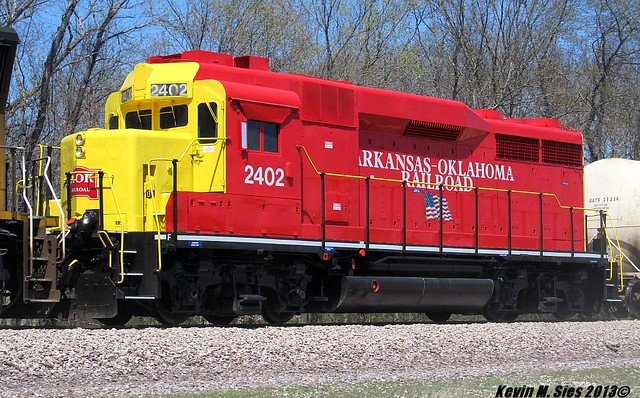
Freshly repainted GP30M #2402 seen in transit on the Union Pacific on the Union Pacific outside of Livingston, IL on April 19th. Kevin Sies photo
ARKANSAS-OKLAHOMA RAILROAD- The Arkansas-Oklahoma railroad has acquired a quartet of former BNSF GP30M's from Larry's Truck and Electric of MacDonald, OH. In addition to the four GP30M's, the A-OK has also acquired a former Idaho Northern & Pacific (ex Wheeling & Lake Erie, nee Southern) ALCo-trucked GP35. The EMD's are expected to replace five former Conrail B23-7s that have been on the railroad since 2005.

The A-OK runs between McAlester and Howe, OK and leases a 36 mile former Union Pacific branch between Shawnee and Oklahoma City. Commodities handled include coal, frac sand, wheat, plastic, corn, acid, aggregates, lumber and feed. The 118 mile former Rock Island line between Shawnee and McAlester had been dormant for several years due to an unstable bridge over the North Canadian River. The AOK has been working to restore service between McAlester and Shawnee, and progress was made at the end of 2012 when the AOK successfully reopened the bridge over the North Canadian River.

Florida East Coast SD40-2 #714 is seen with Jacksonville-bound intermodal freight #226 as it crosses the San Sebastian River in St Augustine, FL on March 10th.
Bob Pickering photo
FLORIDA EAST COAST- The Florida East Coast has begun repainting units in a red and yellow scheme reminiscent of the line's early diesels. This would not be the first time the FEC has painted a unit in what has been referred to as Flagler or Champion colors- more than a decade ago, GP40 #2000 was painted in similar colors as a one off.

FEC's motive power fleet consists of GP40s in a dark blue and white scheme, SD70M-2s painted in colors closely copying the Alaska Railroad (blue and gold) or Rail America (red white and blue) and former Union Pacific SD40-2s that have been operating in UP's Armour Yellow for years. So far, the colors have been applied to the former UP SD40-2s.

The move is likely an effort to boost the railroad's corporate image ahead of an anticipated increase of intermodal traffic that is expected to coincide with the widening of the Panama Canal. The massive project is expected to be completed in 2014 or 2015 and the FEC has been working with the Port of Miami and Port Everglades to include on dock rail facilities as part of their expansion plans.

The Florida East Coast was acquired by Fortress Investment Group [NYSE: FIG] in 2007- they also owned a stake in Rail America until their 2012 sale to Genesee & Wyoming. Although the FEC was largely operated independently of other Rail America properties, some of the new SD70M-2s were delivered in Rail America colors (while still lettered for FEC) and Rail America subsidiary New England Central received GP40s and SD40-2s from Florida East Coast beginning in 2009 before they were relettered for the NECR in 2011.

Painted in Delaware & Hudson-inspired colors, Saratoga & North Creek B39-8 #8524 is seen trundling through the golf course at Stony Creek, NY with the railroad's first revenue freight train on February 11th. John Sesonske photo
SARATOGA & NORTH CREEK- It was a short, one car train- reminiscent of a bygone era for shortlines in the Northeast- but Iowa Pacific is hoping this could be just the beginning.

A lone boxcar carrying garnet bracketed by a Saratoga & North Creek B39-8 and Delaware & Hudson painted bay window caboose left North River, NY on Feb 11th in what was the first freight movement over the former Delaware & Hudson branch in more than 25 years.

“We’re open for business,” Iowa Pacific President Ed Ellis said Wednesday. “We’ve broken the ice here. We’re thrilled that Barton is working with us. We’re hopeful this means we’ll be moving a lot more different things moving forward.”

Lumber, logs and rock tailings from an old mine in Tahawus are other possibilities.

In Corinth, officials are optimistic that freight service will lure new industry to the former International Paper Co. site.

“This is what we’ve been waiting for, not just passenger service,” Supervisor Richard Lucia said.

A rail spur goes to the former International Paper property, whose large old buildings have been razed. In addition to rail service, however, the location has ample water, a waste treatment plant, landfill and a new million-dollar electric substation.

“I still feel this is the best heavy industrial site in eastern New York,” said Jack Kelley, director of economic development for Prime Companies, an Albany-based realty firm. “Freight service makes it even more desirable for someone to move in.”

Most recently, an Italian solar panel manufacturer expressed interest, but plans never moved forward.

Kelley said he believes anything from wood products to natural gas power generation make sense for the site, or perhaps an intermodal facility similar to one in Mechanicville where products could be unloaded for transport by truck to their final destination.

“There aren’t an awful lot of places in this area where trains can sit while they’re loaded and unloaded,” Kelley said.

Barton’s facility in North River is at the south end of a recently reopened 30-mile stretch of track from North Creek north to Tahawus. Barton’s garnet abrasives are used around the world for waterjet cutting, coatings removal and other special uses such as surface preparation.

At the north end of that line, in Tahawus, NL Industries owns a former ilmenite mine that was used to make titanium during World War II. The line sat idle for many years until Iowa Pacific readied it for re-use last year, despite objections from environmental groups.

A portion of track runs through Adirondack Forest Preserve.

Ellis said a large market exists for waste rock to be used in road building and similar large-scale construction jobs. NL Industries has hired a firm to find potential buyers, he said.

“I believe there will be stone moved in 2014,” he said, adding that freight revenue should account for about half the railway’s revenue within two years.
The dormant line was purchased by Warren County in the 1990s and the Upper Hudson Railroad operated excursions over a portion of the line until 2010. In 2011, Iowa Pacific was awarded the contract to operate the entire 57 mile line and began operating passenger excursions between North Creek and the Canadian Pacific interchange in Saratoga, NY in July 2011. The line also directly interchanges with Amtrak's Ethan Allen and Adirondack passenger service as well.

Friday, May 31, 2013

Pennsylvania Democrat Caught Using Multiple Aliases Online to Harass Constituents Who Support Natural Gas Drilling

A state representative from southwestern Pennsylvania has apologized for harassing constituents who had expressed support for natural gas drilling using online comments under a number of fake names on various websites.

The apology came hours after state representative Jesse White (D-Washington) denied using such tactics when he was questioned by a reporter from Pittsburgh TV station KDKA. In fact, White initially called the accusations a personal attack against him by "the propaganda wing of the natural gas industry" when a KDKA camera crew caught up with him.


Janice Gibbs- a Washington County grandmother who supported natural gas drilling- began posting her pro-drilling views online under the moniker Proud American. Almost immediately after posting her comments, White apparently revealed her identity and accused her of being a paid operative of natural gas companies [despite the fact that Gibbs has no lease on her land- NANESB!] . Other commenters called Gibbs "dumber than a box of rocks", an "uneducated yinzer" and "an embarrassment to the community"- she suspected that Rep White was behind a number of those comments himself, but didn't have any proof until somebody began posting anti-fracking comments under her name on the natural gas industry's Energy In Depth website.

The organization traced the comments from "Janice Gibbs" and "Janet Gibson" to a computer using Rep White's IP address. The domain name for an anti-fracking website called 'GasRoots PA' that routinely lauds White and refers to fracking supporters as 'whores' was also registered under White's name. White refused to comment when he was confronted with both facts by a KDKA reporter.

But while White stonewalled, Gibbs freely spoke.

“I kind of feel violated,” Gibbs said. “Yep, I feel violated that an elected official would go this far.”

White told Sheehan he has no connection to an anti-drilling website called GasRootsPA.com, which chastises drilling supporters as “whores” and regularly praises White.

However, when Sheehan searched the domain name he found that it also was registered in White’s name.

Within an hour after the interview, GasRootsPA was re-registered under another name — Tony Stewart — another fictitious person.

But, the intrigue goes even deeper.

In the past two years, Internet sites have been littered with postings from people named Victoria Adams, Frank Reynolds, Cindy McPherson and others attacking pro-drilling advocates.

Sheehan couldn’t find any evidence that these people actually exist, but their language is strikingly similar to White’s own Facebook postings where he is fond of calling opponents “trolls.”

Cindy McPherson calls pro-gas supporters: “nameless trolls.” Victoria Adams calls another a “gas industry troll” and Frank Reynolds calls yet another an “energy industry troll.”

Farmer Don Roessler gets royalties from Marcellus Shale drilling. He suspects White — using the handle “Prouder American” — has told people to boycott his crops and has called him names too.

“He’s gone on insulting me, insulting my intelligence,” Roessler said.
Roessler and Gibbs aren't the only constituents who were reportedly harassed online by White. A pro-dilling township supervisor in Cecil, PA named Elizabeth Cowden said that somebody has been posting comments online using a similar name to make it appear as though she was calling herself a liar. Far from being a political opponent of White, Cowden said that she had donated regularly to White in the past but had stopped in the two years.

Two years ago, a Washington County jury also ruled that White's online comments- which were made under his own name- libeled and defamed Robinson Township Committee member named Raymond Bish- a fellow Democrat. White is also an attorney and fellow lawyer Charles Kurowski said the attacks on Bish were despicable and unprovoked.

The Marcellus Shale formation stretches form upstate New York to southwestern Virginia and contains massive reserves of natural gas that remain largely untapped. A process known as hydraulic fracture drilling- or hydrofracking- has been used to drill for gas in Pennsylvania and West Virginia. However, the natural gas industry faces well-financed and well-publicized opposition from environmentalists and New York City-based entertainers opposed to the fracking process, claiming it will irreversibly foul local groundwater- despite hydrofracking having been used elsewhere without such dire effects.

Most of the drilling in the Marcellus Shale is taking place in Pennsylvania so far, while New York State has placed an ongoing moratorium on hydrofracking.

Sunday, March 31, 2013

Iron Horse Update for March 2013


In a scene that won't be repeated anytime soon, Delaware & Hudson painted GP38-2 #7304 is seen rolling along the former Pennsy RR High Line through Philadelphia, PA with a mixed bag of CP and leased SD40s in charge of Train 158-04 in August 2011. Lee King photo


CANADIAN PACIFIC/DELAWARE & HUDSON- The Canadian Pacific railroad announced their pullout from the Philadelphia area effective March 4th. The move comes as something of a surprise as the CP Rail [NYSE- CP] had been seeing increased traffic in the form of dedicated unit crude oil trains between the Bakken formation in North Dakota and refineries in the Northeast- including in the Philadelphia area. In fact, the Carlyle group plans on investing more than $200 Million in a Sunoco [NYSE- SXL] refinery along the Schuykill River.

The Canadian Pacific actually owns no right-of-way around Philadelphia. Instead, the CPR reached the city of Brotherly Love thanks to trackage rights date back to the 1976 formation of Conrail after the bankruptcies of the Penn Central, Lehigh Valley, Reading, Central New Jersey and Erie Lackawana. The Delaware & Hudson was allowed trackage rights into Philadelphia (as well as Newark, NJ Buffalo, NY and Chessie System/CSX's Potomac Yard in Alexandria, VA) to prevent Conrail from monopolizing freight rail service. The trackage rights were included in CP Rail's 1991 purchase of the Delaware & Hudson, but since Conrail's 1996 sale of the former Lehigh Valley mainline between Scranton and Packerton, PA and the 1999 breakup of Conrail itself, the Canadian Pacific has had to negotiate trackage rights over multiple railroads just to reach Philadelphia proper. While CPR still utilizes trackage rights over Norfolk Southern's Southern Tier line to reach Buffalo, the D&H's Potomac Yard service was cut back to Harrisburg, PA in 1989 [while the New York, Susquehanna & Western was the designated operator- NANESB] and the Newark service was cut back to Allentown, PA in 2012.

Canadian Pacific's ceding Philadelphia to CSX and Norfolk Southern reflects a broader trend of cutting back on trackage deemed unprofitable or redundant since the 2011 takeover of the Calgary-based Class 1 carrier by private equity firm Pershing Square Capital. In December 2012, the CPR announced they were seeking buyers for more than 600 miles of former Dakota, Minnesota & Eastern trackage in South Dakota, Wyoming, Minnesota and Nebraska.

CANADIAN PACIFIC/SOO LINE- Fourteen cars of a 94-car southbound Canadian Pacific freight train derailed in Western Minnesota on March 28th. The derailment took place near Parkers Prairie, MN and three of the cars had spilled oil onto the ground. Initial estimates claimed that as much as 30,000 gallons had leaked from one of the ruptured cars, but that figure was later revised downward to less than 15,000 gallons.

No injuries were reported in the derailment, although the cold weather hampered cleanup by giving the oil a thicker, tar-like consistency. The line was reopened within a matter of hours.


SWEDEN- A woman in the Swedish capital was hospitalized and is facing charges of suspicion of reckless endangerment after allegedly stealing an empty commuter train from a depot in Stockholm and crashing it into a house back in January.
Tomas Hedenius, a spokesman for train operator Arriva, said the woman, born in 1990, stole the four-car train at a depot outside Stockholm.

She then drove it about 1.6 kilometres to the end station on the railway line, where it jumped off the tracks, careered for about 25 metres and crashed into a three-story building.

“There were three families inside the apartment building, but no one was injured. At least not physically,” Hedenius said.

The motives of the woman, who worked for a company contracted to carry out cleaning for the train operator, were not immediately clear.

“We have only heard good things about her. We’re investigating how this could happen, and why she did what she did,” Hedenius said.
It is unclear how the woman got the keys to the train, but the Arriva spokesman said that operating the commuter trainsets is pretty straightforward once in the cab.

HOUSATONIC RAILROAD- The Housatonic Railroad suffered its second derailment since November earlier this month. Shortly after midnight on March 15 four cars jumped the rails and tipped over near the entrance of a paper mill in Lee, MA with two high-sided gondola cars spilling construction debris along the banks of the Housatonic River.

Crews spent the weekend cleaning up the derailment and re-opening the line, although a Housatonic spokesman said that the two gondola cars would likely be scrapped on site.

Texas-New Mexico SD9043MAC #113 seen leading a short mixed freight at Hobbs, NM. The 104-mile Iowa Pacific subsidiary is enjoying a revival of oil drilling in the Permian Basin, which straddles the Texas and New Mexico border. JR Leal photo

TEXAS-NEW MEXICO- After spending approximately $25 million dollars on improvements to the right-of-way, Iowa Pacific's Texas-New Mexico Railroad began handling their first unit train of crude oil at the end of January. Ultimately bound for refineries along the Texas Gulf coast, the crude is loaded along the TNMR in Winkler County, TX. Some of the improvements also include a joint Union Pacific/Texas-New Mexico unloading facility for frac sand at the interchange in Monohans, TX that Iowa Pacific chipped in more than $1.5 million towards.

When Iowa Pacific Holdings first acquired the Texas-New Mexico and disconnected sister line West Texas & Lubbock in 2002, there were reportedly only 12 oil rigs operating throughout the Permian Basin. More recent estimates now put the number at 450.

The Texas-New Mexico operates with a motley hodgepodge of motive power, including new SD9043MACs as well as B39-8s from sister railroad San Luis & Rio Grande as well as former Arizona & Eastern GP20s and GP35s.

Before the reinvigoration of drilling the Permian Basin, the TNMR was pretty busy handling fertilizers, LNG, clay, chemicals, aggregates, scrap metal and unit trains loaded with contaminated silt dredged up from the Hudson River in upstate New York and destined for Waste Control Specialists in Andrews County, TX. In addition to those commodities and the new unit oil trains, the TNMR also recieves trainloads of fracking sand and proppants from the upper Midwest at the UP interchange in Monohans.

[Hat tip to Ruckus Rails for the background information on the TNMR- NANESB!]

Saturday, February 23, 2013

Quickie Sports Chowdah Update for February 23rd, 2013

AP Photo/Mike Carlson
NHL- Something rather curious happened during the Bruins fairly lengthy hiatus this week. While they've played exactly one game since Sunday, Montreal has won three out of their last four contests and the Ottawa Sentaors have won four straight during the same timeframe. The lengthy interval between games for Boston combined with the good week that both Ottawa and Montreal have had mean that the Bruins have slipped into 3rd place in the Northeast Division - despite winning two consecutive contests.

The most recent win for the Bruins came on Thursday night against a team they were supposed to face off against during winter storm Nemo earlier this month- the Tampa Bay Lightning. That contest was supposed to take place on April 25th, but because of the blizzard-related state of emergency in Boston, it was postponed until April 25th, 2012.

However, the first Bruins-Lightning game of the 2013 season took place in Tampa, FL instead. Boston jumped out to a 2-0 lead vs Tampa Bay thanks to goals from Nathan Horton and Patrice Bergeron before the Lightning's Steven Stamkos put Tampa Bay on the board. The Lightning would tie the contest up at 2-2 on a Cory Conacher goal in the second. However a few minutes later, the Bruins would take the lead for good on a Brad Marchand goal. Nathan Horton would give Boston some additional insurance with a goal in the 3rd to give Boston the 4-2 win.

Tukka Rask stopped 24 of 26 shots faced on Thursday night while Anders Lindback stopped 22 shots on a similar number faced by by Rask.

The Bruins swing through the Sunshine State continues on Sunday afternoon at 3:00 ET with a matchup against the Flordida Panthers. This game will be televised on both NESN and the NHL network in select markets.

NASCAR- At least 28 people were injured at Daytona International Speedway on Saturday during a massive collision on the final lap of NASCAR's junior cirucit Nationwide Series.

Saturday's wreck happened after driver Regan Smith, who was leading the race, attempted to block another driver as they were nearing the checkered flag and hit the other car, a report on NASCAR.com said.

The crash sent driver Kyle Larson's car airborne and ripped out its engine, although he climbed out of the wreckage afterward unhurt.

"I was getting pushed from behind, it felt like," Larson told ESPN after the crash.

"By the time my spotter said, 'Lift,' or to go low, I believe, it was too late and I was in the wreck. Then I felt like it was slowing down, and it looked like I could see the ground, and had some flames in the cockpit. Luckily, I was all right and could get out of the car quick," he added.

The injured were carried away on stretchers from the chaotic scene in the stands. They were taken to Halifax Health Medical Center and Florida Hospital Memorial Medical Center in Daytona Beach.
The crash involved 10 vehicles and some of the spectators undergoing medical tratment at Daytona include a 14 year old.

WINTER OLYMPICS- Less than a week after the US Luge team's practice sleds went missing from the back of a truck, a Pennsylvania man who discovered the sleds by the side of the road contacted State Police about his discovery.

A representative from the USA Luge team had reportedly lost the sleds after failing to secure them to the truck properly during a recruiting trip to eastern Pennsylvania. The man, identified as Mike Miller from Moore Township, PA, had heard about the missing sleds in media reports and turned them over to the Pennsylvania State Police on Friday.

Monday, January 7, 2013

New York State Report Deems Hydrofracking Safe, Matt Damon Hardest Hit

Natural gas well in Wilcox, PA

An unreleased document from New York State's Department of Enviromental Conservation leaked to the press indicates that the state has reached the conclusion that hydrofracking can be done safely.
The document, first reported by the New York Times and Gannett News Service and published online Thursday by New York State public radio, references sections of DEC's draft environmental review that deal with health impacts from shale gas drilling and high-volume hydraulic fracturing, or fracking. The report concludes that adverse health impacts will be prevented if DEC's guidelines are followed.

The eight-page document references sections of DEC's 1,500-page environmental impact study of shale gas development. A final version of that study, which is expected to be released in February, will include revisions based on public comment and a health impact review now under way by the state Health Department and three outside experts, DEC has said.

Cuomo has said he'll lift the state's ban on fracking if it's shown to be safe. The state has had a moratorium in effect since July 2008, when DEC began its review of the impacts of fracking.

The document appears to have been written for inclusion in the larger environmental impact study. It describes potential health risks associated with fracking and shale gas development such as exposure to chemicals, contamination of drinking water sources, air pollution, and contact with radioactive elements brought up from deep underground.

DEC Commissioner Joe Martens in September rejected calls for a separate health study by outside experts. Instead, he said the Health Department and a panel of outside experts would review what DEC had already done.
The Marcellus shale formation extends from the southern tier region of New York State to southwestern Virginia and contains trillions of cubic feet in natural gas. Using a method known as hydraulic fracturing or simply fracking, drilling began five years ago in Pennsylvania and West Virginia. Hydrofracking uses pressurized water, sand and a number of chemicals injected to the ground to drill through the shale and reach the natural gas trapped underground.

Some activists have expressed concern that fracking will contaminate drinking water or even cause earthquakes around the drilling areas. The Department of Environmental Conservation's report reportedly hasn't discouraged activists from protesting fracking from gathering in Albany this week.

Meanwhile, Matt Damon's United Arab Emirates-backed anti-fracking movie Promised Land fared poorly at the box office in its opening weekend nationwide.
The film, which Matt Damon co-wrote and stars in, took just 10th place at the weekend box office, with $4.3 million in ticket sales, according to The Los Angeles Times.

The top weekend spot, with $23 million, went to the slasher flick “Texas Chainsaw 3D.”

“Promised Land,” which cost $15 million to make and was directed by indie pioneer Gus Van Sant, delves into fears about water pollution from fracking
Damon denied the film had an anti-fracking message and that the writers and cast simply wanted to 'start a discussion' on the subject of fracking [which in liberal-speak usually means you're supposed to sit and not question anything they say- NANESB]

Saturday, January 5, 2013

Former Minnesota Policewoman Awarded More Than $1 Million in Breach of Privacy Lawsuit

Officer Anne Marie Rasmusson of the St Paul, MN Police department seen very much out of uniform.
A former Twin Cities policewoman has been awarded more that $1 Million in damages after learning that more than 100 of her former colleagues illegally accessed her personal information, looking up her driver's license in a state database. The case marks the largest data breach by law enforcement in the state's history.

Anne Marie Rasmusson, 37, was forced into early retirement from the St Paul, MN police department due to an injury in 2003 but continued working out and entered bodybuilding competitions as her husband continued working as a policeman in Minneapolis, MN.


Officer Anne Marie Rasmusson, this time in uniform
Rasmusson became suspicious after she was contacted out of the blue by former colleagues asking for dates or complimenting her on her driver's license photo.
When she was 24 and new to the St Paul police force, one of her co-workers suggested a bet – who could lose the most body fat in three months.

The once overweight officer dropped 15 pounds in three months, and continued her regimen of exercise and healthy eating until she dropped an additional 70lbs.

Rasmusson, who was known by colleagues as Bubbles because of her cheerful personality, first became aware that other officers were looking up her photo when a former police academy colleague mentioned to her in 2009 that she looked great and that he and his partner had used their squad car computer to view her driver’s license image.

In August 2011, she contacted the state’s Department of Public Safety asking if it was possible to restrict access to her driver’s license file. Following an investigation, a DPS worker revealed that her record had been accessed by officers numerous times as far back as 2007.

[Independent tabloid] City Pages found that 104 officers in 18 different state agencies accessed her driver’s licence record 425 times.
At least 104 officers, including police chiefs, stand accused of illegally accessing Rasmusson's personal data and could face disciplinary action.

The city of Minneapolis agreed to pay Rasmusson a $392,000 settlement in addition to a separate $280,000 settlement with other cities whose officers illegally accessed her personal data. Rasmusson will also be awarded a $385,000 suit from her former employer, the city of St Paul. That figure could increase depending on the outcome of a pending suit against the state of Minnesota.

Keep in mind this sort of conduct isn't necessarily limited to the Twin Cities. In Philadelphia, Deputy Commissioner William Blackburn is accused of flipping through the department's personnel files looking for attractive female officers to try and pick up. According to a lawsuit filed by Philadelphia P.D. officer Debra Frazier, Blackburn would then have his subordinated arrange for a meeting with officers he picked from the files.

A separate lawsuit accuses Philadelphia P.D. Staff Inspector Jarrod Bates of coercing a female subordinate into having sex with him in order to keep her job. Bates was a former supervisor of Internal Affairs and was the Equal Employment Opportunity officer in charge of investigating abuse and harassment complaints.

Sunday, November 25, 2012

Today's Train of Thought- Fall Classics, Nov 25th, 2012


Today's Train of Thought takes us to Pennsylvania's northern tier and gives us a glimpse of some old war horses doing what they were built for some 40 years after their manufacturer shut down.

The Western New York & Pennsylvania got its start in 2001 on a dormant former Conrail (nee- Erie) line between Meadville, Pa and Hornell, NY. Even before the 1999 takeover of Conrail by Norfolk Southern and CSX, the line had been taken out of service by Conrail.

After some legal wrangling, the line was re-opened by the Western New York & Pennsylvania railroad in 2003. In addition to attempting to generate traffic along the 190-mile Meadville line, the WNY&P also reached an agreement with the Norfolk Southern to use the line as a shortcut between the coal fields of Southwestern Pennsylvania and a number of power plants in the Northeast, bypassing the Buffalo area altogether.

By early 2007, the WNY&P had expanded further with the lease of a portion of the former Conrail Buffalo line from Norfolk Southern between Machias and Driftwood, PA. The former Pennsylvania railroad line used to run all the way between Buffalo and Harrisburgh, PA- the WNY&P leases about 90 miles which includes 5 miles of 2.6% grade at Keating Summit, PA.

Besides hauling water, pipe and frac sand for increased drilling in the Marcellus Shale along Pennsylvania's northern tier, the WNY&P got an unexpected revenue boost in 2009 when their portion of the Buffalo line was used for the filming of a number of scenes from Tony Scott's Unstoppable.

Here, railpictures.net photographer Aaron J Border caught burly 6-axle ALCO C630M #630 heading southbound with train DFT [the Driftwood Turn- NANESB!] at Sinnemahoning, PA on October 20th, 2009, framed by some trees changing color at WNY&P's southern end of the Buffalo line.

The WNY&P locomotive fleet is exclusively ALCO or Montreal Locomotive Works- an anomaly in these days. The steep grades around Keating Summit, PA justify the presence of the vintage 3000 HP beasts- management of the Arkansas and Missouri in northwestern Arkansas has also cited the steep grades on their former Frisco line through the Ozarks as the reason why they maintain an all-ALCO fleet. In fact, the #630 is still painted in Arkansas & Missouri colors- the locomotive started out life as Canadian Pacific #4500. The trailing unit is still wearing the colors of Quebec-Cartier mining.

While the WNY&P has experienced a number of setbacks since then- Norfolk Southern's overhead traffic has virtually dried up and a steep decline in the price of natural gas has cut back in drilling activities along the Marcellus Shale- the line still handles commodities like steel, aggregates, wax and cheese on both the Buffalo and Meadville lines.

Thursday, November 1, 2012

Hundreds of Thousands Without Power As Death Toll From Hurricane Sandy Expected to Rise


Storm surge from Hurricane Sandy inundating the Inlet section of Atlantic City, NY as seen from above Dan Cuellar photo

From Labrador to South Carolina, much of the eastern seaboard is digging out from the havoc wrought by Hurricane Sandy's impact and local officials are starting to assess the damage as the death toll from the storm is expected to climb.

Hurricane Sandy- dubbed Frankenstorm after some meteorological projections put it on a collision course with another winter storm system moving in from the Midwest- made landfall just south of Atlantic City, NJ on October 30 before moving inland into Pennsylvania. Although it lost strength after moving inland, all five boroughs of New York City were hit particularly hard by the outer bands of Sandy.

Sandy's impact on the Big Apple was a double whammy of storm surges coming around the same time as high tide. From lower Manhattan to Queens, streets, tunnels and subway lines were flooded, stranding residents and forcing the NYPD and FDNY to respond to a number of calls by boat. In the Breezy Point section of Queens, as many as 110 homes were lost during a 5-alarm fire since the FDNY's trucks could not navigate the flooded streets to reach the homes until the tide receded.

State Island was the hardest hit out of all the boroughs in New York City. Portions of the island were under an evacuation order, but a number of residents chose to ride it out after Staten Island was left relatively unscathed by Sandy last year. According to officials 15 of the 39 confirmed fatalities in New York City from Sandy were on Staten Island.


Even amid the storm, several New York City hospitals took the unprecedented step of evacuating hundreds of patients as backup generators failed. Bellvue Hospital, which had received patients from elsewhere during the storm, began evacuating about 400 patients to Mt. Sinai. A New York City Health and Hospital Corporation official said that National Guardsmen activated due to Sandy instrumental in bringing in much needed fuel for the generator and assisting staff with transporting patients into waiting ambulances. Some of the patients had to be moved down 17 flights of stairs.

With some subway lines still inundated with saltwater, New York's MTA announced that it will resume limited subway service in Manhattan beginning Friday.

While power had been restored to some 4 million households throughout the region, at least 2.5 million are still without electricity in the New York metropolitan area. Across the Hudson in New Jersey, people have been lining up by the hundreds at gas stations to fill their cars or keep their generators running. Many gas stations are without power and remain closed while the ones that are open sell out quickly and it could be days before they're resupplied. This means that many in the slow-moving gas lines- some nearly two miles in length- will have waited in vain.

Amtrak announced that limited intercity service to Boston, Philadelphia, Baltimore and Washington DC will resume out of New York's Penn station beginning Friday.

Downtown Elkins, WV under a blanket of snow from the western portion of Hurricane Sandy. Higher elevations in the Appalachians received anywhere from 2 to 3 feet of snowfall. AP Photo/Vicki Smith

To the west, Sandy dumped several feet of snow in West Virginia and central Pennsylvania. At least 6 people were confirmed killed in West Virginia and an estimated 109,000 customers throughout the state were still without power on Thursday, prompting Gov. Tomblin to seek a federal disaster declaration. At least 36 state highways remained shut down on Thursday due to rising floodwaters, fallen tree limbs and heavy snowfall. The melting snow is also expected to saturate the Potomac watershed in the coming weeks.

Tuesday, October 2, 2012

Anti-Fracking Movie Starring Matt Damon Bankrolled in Part by OPEC-Member United Arab Emirates


A new drama starring Matt Damon as a smooth-talking natural gas company official who attempts to purchase drilling rights from local residents in a rural Pennsylvania town is already generating buzz, but it has nothing to do with what takes place on-screen.

The movie Promised Land supposedly dramatizes the dangers involved in the drilling process known as hydrofracking- a local environmentalist seeks to thwart Damon and his company's attempts to drill in the area. To hardly any one's surprise, the local schoolteacher and environmentalist who raises the alarm regarding hydrofracking is portrayed in a positive manner while I suspect Damon's gas company official will be portrayed as manipulative and unethical- at least until his change of heart where he falls in love with a local woman.

Pretty standard Hollywood 'We-Liberals-and-Environmentalists-know-whats-best-for-you-rubes-in-flyover-country' boilerplate so far, right? With its December release, there's even Oscar talk for Promised Land all while bringing the ongoing debate over fracking front and center.

Only it was recently discovered that the film has received considerable financial backing from the United Arab Emirates- a member of OPEC and among the top 10 oil producing nations in the world.
The film was produced “in association with” Image Media Abu Dhabi, a subsidiary of Abu Dhabi Media, as first reported by the Heritage Foundation. Abu Dhabi Media is wholly owned by the government of the United Arab Emirates, a small but extremely wealthy federation of absolute monarchies along the southern coast of the Persian Gulf.

Very obviously, the UAE has an interest in slowing down the expansion of hydraulic fracking that has created an energy boom in the United States.
This would not be the first American film that would've received financial backing from Image Media Abu Dubai- other titles include The Help, Contagion and The Crazies among others.

Locations for filming Promised Land include the city of Pittsburgh as well as Westmoreland and Armstrong counties in Western Pennsylvania. A group of Armstrong county residents, upset at what they claim were the filmmakers using false pretenses to film in the area, started up a Facebook page called Armstrong County Promised Land Pride. Visitors to the page are greeted with the following succinct message: "They filmed this movie in our backyard. They said it would be fair to drilling. It's not. We're pissed."

Fracking opponents claim that the process injects massive quantities of hazardous chemicals into the groundwater and that hydrofracking can cause tap water to burst into flame and caused last year's magnitude 5.8 earthquake in Mineral, VA that was felt up and down the East Coast- even though the nearest natural gas well was hundreds of miles away.

The movie is loosely based on events in Dimock, PA where a handful of local residents had claimed drilling from nearby wells had contaminated their groundwater. However, after analysis by Pennsylvania's environmental agency and the EPA, the water was deemed safe to drink by the EPA this summer.

The real-life events in Dimock have reportedly prompted a hasty re-write of the Promised Land script. Of course this is where Hollywood decided to double down on the stupid in typical Hollywood fashion.
according to sources close to the movie, they’ve come up with a solution — suggest that anti-fracking fraudsters are really secret agents employed by the fossil-fuel industry to discredit the environmental movement.

In the revised script, Damon exposes Krasinski as a fraud — only to realize that Krasinski’s character is working deep undercover for the oil industry to smear fracking opponents.

Hollywood is worried about declining theater audiences; it’s blaming the Internet and the recession. But the real problem might be closer to home.

Damon and Krasinski said they were making a movie that “defines us as a country” but then shoehorned ideology into a script — and when real-world events became a problem, they shoehorned in more ideology.
You see, instead of the noble well-intentioned environmentalist perhaps having some kind of a 'Mea Culpa' moment and the dire environmental consequences Kasinski's charachter warned about not taking place, in west coast liberal screenwriter-land, the anti-fracking advocates being wrong are purely the fault of the oil company who are disseminating misinformation to discredit opponents.

Instead of some ancillary plot where the cash-strapped townsfolk can now afford to save up for their kids' college education or put an elderly relative in a decent rest home- all while drinking and bathing with tapwater that doesn't burst into flames- the alarmist and false narrative spun by the environmentalists and celebrity anti-frackers has to be placed at the feet of the energy companies. I believe that is called 'chutzpah' in some parts of the world.