Today's Train of Thought takes us to the Buckeye State and features the regional Wheeling & Lake Erie, one of the few remaining independent regionals in the USA.
The current incarnation of the W&LE takes its name from the original Wheeling and Lake Erie which was completed in 1877 as a link between the coal fields around Wheeling, WV and the ports and steel mills along the shores of Lake Erie. After WWII, the (original) W&LE merged with the Nickel Plate, which in turn became part of the Norfolk and Western in 1964. In the early 1980s, the Norfolk & Western and Southern merged to form the Norfolk Southern.
In 1990, the Norfolk Southern divested themselves of a portions of the original W&LE line between Brewster, OH and Pittsburgh- this new iteration of the W&LE was also able to secure trackage rights over CSX's ex-Baltimore & Ohio Sand Patch line through the Alleghenies between the Pittsburgh area and Cumberland, MD- an agreement the B&O had with the original W&LE that pre-dated the formation of CSX.
By most accounts, the early 1990s were pretty lean years for the W&LE but by 1994 the company restructured its debt and acquired the Akron and Barberton Belt Railway. While some of the traffic- such as iron ore, coal, aggregates and chemicals- has been in the same since the 1990 incarnation of the W&LE, traffic has picked up thanks to increased drilling in the Marcellus and Utica Shale.
Here, Richard W Thompson caught Wheeling and Lake Erie SD40-2 #6348 with a stone train backing past a bright crimson shed in Bellevue, OH in August 2010. Besides being home to a number of limestone quarries, Bellevue is also home to the Mad River and Nickel Plate Railroad Museum and where rail and real-estate tycoon Henry Flagler first ventured into starting his own business in the 1850s before going on to start the Florida East Coast railroad.
Besides being used for aggregates, limestone is also used for drilling pads throughout the Utica and Marcellus Shale.
In an interview with Syracuse PBS affiliate on Friday, Cuomo stated that conservatives have "no place in the state of New York, because that's not who New Yorkers are".
The Republican Party candidates are running against the SAFE Act — it was voted for by moderate Republicans who run the Senate! Their problem is not me and the Democrats; their problem is themselves. Who are they? Are they these extreme conservatives who are right-to-life, pro-assault-weapon, anti-gay? Is that who they are? Because if that’s who they are and they’re the extreme conservatives, they have no place in the state of New York, because that’s not who New Yorkers are.
If they’re moderate Republicans like in the Senate right now, who control the Senate — moderate Republicans have a place in their state.
Shortly after the remarks were made public, Cuomo backtracked and his supporters claimed that his remarks were merely 'taken out of context', instead. Some supporters highlighted Cuomo's qualifier of 'extreme' and pointed out the Governor's praise of 'Moderate' Republicans who have more or less rubber-stamped some or all of Cuomo's agenda. Cuomo attempted to walk back his statements by saying that New Yorkers prefer moderate politicians of either party running for office only a few weeks after avowed socialist and Sandinista supporter Bill DeBlasio was sworn in as mayor of New York City.
By 'anti-gay', Cuomo is apparently referring to anybody who held similar views on same-sex marriage as Pope Francis or President Obama prior to his 2012 re-election campaign. Meanwhile, the NY SAFE Act, a hastily written and almost confiscatory gun law rushed through a closed-door session of the New York state assembly in the immediate aftermath of the December 2012 Newtown, CT school shootings has proven extremely unpopular upstate. Opponents point out the law does nothing to deter crime and makes criminals out of law-abiding citizens who own previously legal firearms while prompting manufacturers and businesses to move out of state because of the increased restrictions.
Another issue that has residents upstate irate at the son of Democratic former governor Mario Cuomo is fracking. New York's Southern Tier sits atop the Marcellus Shale natural gas formation- in fact, the formation is named after the village of Marcellus outside of Syracuse. However, while there has been drilling activity in Pennsylvania, Ohio and West Virginia, Cuomo has dragged his feet on the issue since his 2010 election. Although drilling for natural gas could give the Empire State's economy a shot in the arm- particularly the economically hard-hit Southern Tier- hardline environmentalists and celebrity activists such as Yoko Ono or actor Mark Ruffalo seem to have the ear of Gov Cuomo's office, regaling his staff with liberally embellished horror stories of artificial earthquakes and tap water bursting into flames due to fracking. As the celebrities, environmentalists and wealthy Manhattan progressives do there utmost to ensure that no drilling takes place in New York, upstate counties atop the Marcellus Shale have unemployment rates of around 8%. To his credit, Cuomo floated a compromise where drilling would be confined mostly to the Southern Tier counties of Broome, Chemung, Tioga, Steuben and Chenango but that was quickly overruled by environmentalists. While the Governor and state officials have made no official decision on fracking, observers believe Cuomo and other Democrats are waiting for a more politically opportune time after the 2014 election to make an unpopular decision.
Meanwhile, as landowners in the Southern Tier have been hit with a double whammy of an economy that's been in decline since the 1970s and some of the highest property taxes in the USA, Governor Cuomo has been fundraising in Hollywood- for his re-election bid as governor of New York.
Between the push for same-sex marriage, gun control and abortion while obstructing a surefire means of reviving the Southern Tier's long suffering economy for political expediency, Cuomo's actions as governor have made it abundantly clear that he believes conservatives (or even moderates who disagree with him) have no place in New York. his statements in Friday's PBS interview simply made it official.
Prince Alwaleed bin Talal, the country’s best-known global investor, said the business model of Middle East oil exporters risks unravelling rich industrial states find ways of cutting demand. “Our country is facing a threat with the continuation of its near-complete reliance on oil: 92% of the budget for this year depends on oil,” he said in a letter to Saudi oil minister Ali Al-Naimi.
Opec admits that new output from hydraulic “fracking” could chip away its dominant position in the market but the group is more worried about recession in Europe and a hard landing in China.
Prince Alwaleed said oil demand from OECD rich states is in “continuous decline”, and the Saudis will not be able to ratchet up their output from 12.5m to 15m barrels per day (bpd) to cover growing budget costs. “It is necessary to diversify sources of revenue, establish a clear vision, and start implementing it immediately,” he said.
A report last month by Leonardo Maugeri at Harvard University said US shale oil output could triple to 5m bpd by 2017, turning America into the world’s top producer once again.
If shale does deliver on its promise and keeps prices low for decades, it will be a mortal threat to OPEC states that rely on oil revenue to cover social spending and placate fast-growing populations.
Prince Alwaleed was ranked by Forbes magazine as the world's 6th richest man at one point and is most infamous for his comments urging that the United States "should re-examine its policies in the Middle East and adopt a more balanced stance toward the Palestinian cause" just weeks after the September 11th, 2001 terrorist attacks. Then-mayor Rudy Giuliani and other New York officials rejected a $10 million donation from Alwaleed after his remarks.
A trio of Dakota, Missouri Valley & Western units approach the Canadian Pacific interchange in Flaxton, ND as a recently-constructed oil pump works in the foreground in November 2012. Steven M Welch photo.
Hydraulic fracture drilling- also known as hydrofracking or fracking- uses a mix of water and chemically treated sand or 'mud' that's injected into the ground to get to otherwise inaccessible deposits of oil or natural gas. The 'Shale revolution'- as some have called it- has led to the formation of oil boomtowns in North Dakota and breathed new life into Rust Belt towns in Pennsylvania and Ohio. This in turn has led to increased manufacturing for components, mining for 'frac sand' and rail activity moving the supplies into the oilfields and the oil out and to refineries.
Drilling for natural gas in Pennsylvania's Marcellus Shale has become particularly contentious recently, with environmentalists and movie stars weighing in on the purported dangers of fracking to groundwater supplies [although some wells were contaminated decades before fracking began in the area- NANESB!]. A 2012 movie titled Promised Land starring Matt Damon as an energy company representative who has a change of heart after being sent to a struggling Pennsylvania town to secure leases for wells was financed in part by the United Arab Emirates- another OPEC member.
Similar proposals- such as a cap and trade system- couldn't make it through a House and Senate controlled by the Democrats in Obama's first term, which was why the President announced his intention to bypass congress with these new regulations.
In recent years, the coal industry has been besieged by competition from oil and natural gas while simultaneously being targeted from the left by well funded and politically connected environmental groups. Although coal is also used in the steelmaking and cement making processes, roughly 40% of the electricity generated in the USA comes from coal-fired power plants. Metallurgic coal is also exported to China, South Korea and Europe for steelmaking there, proposed coal export terminals have been facing increased political opposition in the Pacific Northwest. In the traditionally coal-centered economies of western Pennsylvania, West Virginia and eastern Ohio, natural gas drilling in the Marcellus and Utica shales [along with the EPA's previous regulatory burden- NANESB!] has brought more pressure on the coal industry there.
While the Administration's focus on crippling the coal industry may have seemed to benefit the oil and natural gas industries at first blush, Obama also weighed in on the Keystone XL pipeline during his Georgetown speech, saying that the project wouldn't be approved if he determined that it increased carbon emissions. Backers of the pipeline cite a State Department finding from earlier this year transporting the oil sands from Canada by pipeline would emit less greenhouse gases than shipping it by rail.
Unlike President Obama's vaunted 'green jobs', hiring has been brisk around the oilfields in North Dakota and western Texas in recent years and parts of western and central Pennsylvania have seen economic growth due to exploration and drilling activities around the Marcellus shale.
The apology came hours after state representative Jesse White (D-Washington) denied using such tactics when he was questioned by a reporter from Pittsburgh TV station KDKA. In fact, White initially called the accusations a personal attack against him by "the propaganda wing of the natural gas industry" when a KDKA camera crew caught up with him.
Janice Gibbs- a Washington County grandmother who supported natural gas drilling- began posting her pro-drilling views online under the moniker Proud American. Almost immediately after posting her comments, White apparently revealed her identity and accused her of being a paid operative of natural gas companies [despite the fact that Gibbs has no lease on her land- NANESB!] . Other commenters called Gibbs "dumber than a box of rocks", an "uneducated yinzer" and "an embarrassment to the community"- she suspected that Rep White was behind a number of those comments himself, but didn't have any proof until somebody began posting anti-fracking comments under her name on the natural gas industry's Energy In Depth website.
The organization traced the comments from "Janice Gibbs" and "Janet Gibson" to a computer using Rep White's IP address. The domain name for an anti-fracking website called 'GasRoots PA' that routinely lauds White and refers to fracking supporters as 'whores' was also registered under White's name. White refused to comment when he was confronted with both facts by a KDKA reporter.
But while White stonewalled, Gibbs freely spoke.
“I kind of feel violated,” Gibbs said. “Yep, I feel violated that an elected official would go this far.”
White told Sheehan he has no connection to an anti-drilling website called GasRootsPA.com, which chastises drilling supporters as “whores” and regularly praises White.
However, when Sheehan searched the domain name he found that it also was registered in White’s name.
Within an hour after the interview, GasRootsPA was re-registered under another name — Tony Stewart — another fictitious person.
But, the intrigue goes even deeper.
In the past two years, Internet sites have been littered with postings from people named Victoria Adams, Frank Reynolds, Cindy McPherson and others attacking pro-drilling advocates.
Sheehan couldn’t find any evidence that these people actually exist, but their language is strikingly similar to White’s own Facebook postings where he is fond of calling opponents “trolls.”
Cindy McPherson calls pro-gas supporters: “nameless trolls.” Victoria Adams calls another a “gas industry troll” and Frank Reynolds calls yet another an “energy industry troll.”
Farmer Don Roessler gets royalties from Marcellus Shale drilling. He suspects White — using the handle “Prouder American” — has told people to boycott his crops and has called him names too.
“He’s gone on insulting me, insulting my intelligence,” Roessler said.
Roessler and Gibbs aren't the only constituents who were reportedly harassed online by White. A pro-dilling township supervisor in Cecil, PA named Elizabeth Cowden said that somebody has been posting comments online using a similar name to make it appear as though she was calling herself a liar. Far from being a political opponent of White, Cowden said that she had donated regularly to White in the past but had stopped in the two years.
Two years ago, a Washington County jury also ruled that White's online comments- which were made under his own name- libeled and defamed Robinson Township Committee member named Raymond Bish- a fellow Democrat. White is also an attorney and fellow lawyer Charles Kurowski said the attacks on Bish were despicable and unprovoked.
The Marcellus Shale formation stretches form upstate New York to southwestern Virginia and contains massive reserves of natural gas that remain largely untapped. A process known as hydraulic fracture drilling- or hydrofracking- has been used to drill for gas in Pennsylvania and West Virginia. However, the natural gas industry faces well-financed and well-publicized opposition from environmentalists and New York City-based entertainers opposed to the fracking process, claiming it will irreversibly foul local groundwater- despite hydrofracking having been used elsewhere without such dire effects.
Most of the drilling in the Marcellus Shale is taking place in Pennsylvania so far, while New York State has placed an ongoing moratorium on hydrofracking.
The document, first reported by the New York Times and Gannett News Service and published online Thursday by New York State public radio, references sections of DEC's draft environmental review that deal with health impacts from shale gas drilling and high-volume hydraulic fracturing, or fracking. The report concludes that adverse health impacts will be prevented if DEC's guidelines are followed.
The eight-page document references sections of DEC's 1,500-page environmental impact study of shale gas development. A final version of that study, which is expected to be released in February, will include revisions based on public comment and a health impact review now under way by the state Health Department and three outside experts, DEC has said.
Cuomo has said he'll lift the state's ban on fracking if it's shown to be safe. The state has had a moratorium in effect since July 2008, when DEC began its review of the impacts of fracking.
The document appears to have been written for inclusion in the larger environmental impact study. It describes potential health risks associated with fracking and shale gas development such as exposure to chemicals, contamination of drinking water sources, air pollution, and contact with radioactive elements brought up from deep underground.
DEC Commissioner Joe Martens in September rejected calls for a separate health study by outside experts. Instead, he said the Health Department and a panel of outside experts would review what DEC had already done.
The Marcellus shale formation extends from the southern tier region of New York State to southwestern Virginia and contains trillions of cubic feet in natural gas. Using a method known as hydraulic fracturing or simply fracking, drilling began five years ago in Pennsylvania and West Virginia. Hydrofracking uses pressurized water, sand and a number of chemicals injected to the ground to drill through the shale and reach the natural gas trapped underground.
Meanwhile, Matt Damon's United Arab Emirates-backed anti-fracking movie Promised Landfared poorly at the box office in its opening weekend nationwide.
The film, which Matt Damon co-wrote and stars in, took just 10th place at the weekend box office, with $4.3 million in ticket sales, according to The Los Angeles Times.
The top weekend spot, with $23 million, went to the slasher flick “Texas Chainsaw 3D.”
“Promised Land,” which cost $15 million to make and was directed by indie pioneer Gus Van Sant, delves into fears about water pollution from fracking
Damon denied the film had an anti-fracking message and that the writers and cast simply wanted to 'start a discussion' on the subject of fracking [which in liberal-speak usually means you're supposed to sit and not question anything they say- NANESB]
Today's Train of Thought takes us to Pennsylvania's northern tier and gives us a glimpse of some old war horses doing what they were built for some 40 years after their manufacturer shut down.
The Western New York & Pennsylvania got its start in 2001 on a dormant former Conrail (nee- Erie) line between Meadville, Pa and Hornell, NY. Even before the 1999 takeover of Conrail by Norfolk Southern and CSX, the line had been taken out of service by Conrail.
After some legal wrangling, the line was re-opened by the Western New York & Pennsylvania railroad in 2003. In addition to attempting to generate traffic along the 190-mile Meadville line, the WNY&P also reached an agreement with the Norfolk Southern to use the line as a shortcut between the coal fields of Southwestern Pennsylvania and a number of power plants in the Northeast, bypassing the Buffalo area altogether.
By early 2007, the WNY&P had expanded further with the lease of a portion of the former Conrail Buffalo line from Norfolk Southern between Machias and Driftwood, PA. The former Pennsylvania railroad line used to run all the way between Buffalo and Harrisburgh, PA- the WNY&P leases about 90 miles which includes 5 miles of 2.6% grade at Keating Summit, PA.
Besides hauling water, pipe and frac sand for increased drilling in the Marcellus Shale along Pennsylvania's northern tier, the WNY&P got an unexpected revenue boost in 2009 when their portion of the Buffalo line was used for the filming of a number of scenes from Tony Scott's Unstoppable.
Here, railpictures.net photographer Aaron J Border caught burly 6-axle ALCO C630M #630 heading southbound with train DFT [the Driftwood Turn- NANESB!] at Sinnemahoning, PA on October 20th, 2009, framed by some trees changing color at WNY&P's southern end of the Buffalo line.
The WNY&P locomotive fleet is exclusively ALCO or Montreal Locomotive Works- an anomaly in these days. The steep grades around Keating Summit, PA justify the presence of the vintage 3000 HP beasts- management of the Arkansas and Missouri in northwestern Arkansas has also cited the steep grades on their former Frisco line through the Ozarks as the reason why they maintain an all-ALCO fleet. In fact, the #630 is still painted in Arkansas & Missouri colors- the locomotive started out life as Canadian Pacific #4500. The trailing unit is still wearing the colors of Quebec-Cartier mining.
While the WNY&P has experienced a number of setbacks since then- Norfolk Southern's overhead traffic has virtually dried up and a steep decline in the price of natural gas has cut back in drilling activities along the Marcellus Shale- the line still handles commodities like steel, aggregates, wax and cheese on both the Buffalo and Meadville lines.
A new drama starring Matt Damon as a smooth-talking natural gas company official who attempts to purchase drilling rights from local residents in a rural Pennsylvania town is already generating buzz, but it has nothing to do with what takes place on-screen.
The movie Promised Land supposedly dramatizes the dangers involved in the drilling process known as hydrofracking- a local environmentalist seeks to thwart Damon and his company's attempts to drill in the area. To hardly any one's surprise, the local schoolteacher and environmentalist who raises the alarm regarding hydrofracking is portrayed in a positive manner while I suspect Damon's gas company official will be portrayed as manipulative and unethical- at least until his change of heart where he falls in love with a local woman.
Pretty standard Hollywood 'We-Liberals-and-Environmentalists-know-whats-best-for-you-rubes-in-flyover-country' boilerplate so far, right? With its December release, there's even Oscar talk for Promised Land all while bringing the ongoing debate over fracking front and center.
The film was produced “in association with” Image Media Abu Dhabi, a subsidiary of Abu Dhabi Media, as first reported by the Heritage Foundation. Abu Dhabi Media is wholly owned by the government of the United Arab Emirates, a small but extremely wealthy federation of absolute monarchies along the southern coast of the Persian Gulf.
Very obviously, the UAE has an interest in slowing down the expansion of hydraulic fracking that has created an energy boom in the United States.
This would not be the first American film that would've received financial backing from Image Media Abu Dubai- other titles include The Help, Contagion and The Crazies among others.
Locations for filming Promised Land include the city of Pittsburgh as well as Westmoreland and Armstrong counties in Western Pennsylvania. A group of Armstrong county residents, upset at what they claim were the filmmakers using false pretenses to film in the area, started up a Facebook page called Armstrong County Promised Land Pride. Visitors to the page are greeted with the following succinct message: "They filmed this movie in our backyard. They said it would be fair to drilling. It's not. We're pissed."
Fracking opponents claim that the process injects massive quantities of hazardous chemicals into the groundwater and that hydrofracking can cause tap water to burst into flame and caused last year's magnitude 5.8 earthquake in Mineral, VA that was felt up and down the East Coast- even though the nearest natural gas well was hundreds of miles away.
The movie is loosely based on events in Dimock, PA where a handful of local residents had claimed drilling from nearby wells had contaminated their groundwater. However, after analysis by Pennsylvania's environmental agency and the EPA, the water was deemed safe to drink by the EPA this summer.
The real-life events in Dimock have reportedly prompted a hasty re-write of the Promised Land script. Of course this is where Hollywood decided to double down on the stupid in typical Hollywood fashion.
according to sources close to the movie, they’ve come up with a solution — suggest that anti-fracking fraudsters are really secret agents employed by the fossil-fuel industry to discredit the environmental movement.
In the revised script, Damon exposes Krasinski as a fraud — only to realize that Krasinski’s character is working deep undercover for the oil industry to smear fracking opponents.
Hollywood is worried about declining theater audiences; it’s blaming the Internet and the recession. But the real problem might be closer to home.
Damon and Krasinski said they were making a movie that “defines us as a country” but then shoehorned ideology into a script — and when real-world events became a problem, they shoehorned in more ideology.
You see, instead of the noble well-intentioned environmentalist perhaps having some kind of a 'Mea Culpa' moment and the dire environmental consequences Kasinski's charachter warned about not taking place, in west coast liberal screenwriter-land, the anti-fracking advocates being wrong are purely the fault of the oil company who are disseminating misinformation to discredit opponents.
Instead of some ancillary plot where the cash-strapped townsfolk can now afford to save up for their kids' college education or put an elderly relative in a decent rest home- all while drinking and bathing with tapwater that doesn't burst into flames- the alarmist and false narrative spun by the environmentalists and celebrity anti-frackers has to be placed at the feet of the energy companies. I believe that is called 'chutzpah' in some parts of the world.
NORFOLK SOUTHERN- There was more to the 30th anniversary celebration of Norfolk Southern than the 21st Century Steam program, as it turned out.
Although it had initially planned a total of 18 'heritage' units- new locomotives painted in the colors of various Norfolk Southern predecesors- the total was bumped up to 20 earlier this summer with the belated additon of the Penn Central and Monongehela as part of the heritage fleet.
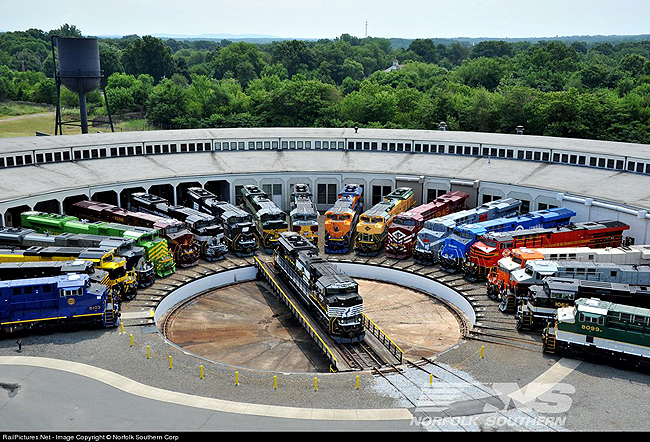
While just about all of the heritage units were placed in revenue service after arriving from GE's Erie, PA plant of Progress Rail's EMD facility in Muncie, IN, in late June, all 20 units were sent to the North Carolina Transportation Museum at Spencer, NC for a one-of-a-kind 'family portrait' at the Museum's massive roundhouse.
In the above official Norfolk Southern image, the heritage units on display include Norfolk & Western ES44AC #8103, Nickel Plate ES44AC #8100, Virginian SD70ACe #1069, Wabash SD70ACe #1070, Illinois Terminal SD70ACe #1072, Pennsylvania #8102, New York Central #1066, Penn Central SD70ACe #1073, Erie SD70ACe #1068, Delaware Lackawana & Western SD70ACe #1074, Central Railroad of New Jersey SD70ACe #1071, Reading SD70ACe #1067, Lehigh Valley ES44AC #8104, Monongehela ES44AC #8025, Conrail ES44AC #8098, Norfolk Southern ES44AC #8114, Interstate ES44AC #8105, Wabash SD70ACe #1070, Savannah & Atlanta SD70ACe #1065 and Southern ES44AC #8098.
Norfolk Southern had also made it a point to have some of the heritage units accompany the steam-powered employee specials earlier in the summer with 'Nickel Plate' GE #8100 accompanying Nickel Plate #765 in Pennsylvania and 'Savannah & Atlanta' EMD #1065 accompanying the Southern #630 on trips through Tennessee and Virginia. Reportedly the Wabash #1070 will accompany the Fort Wayne Historical Society's big Nickel Plate Berkshire to St Louis this month for additional employee specials.
Although Union Pacific and Pan Am have both paid tribute to predecessor roads with specially painted locomotives, the size and scope of Norfolk Southern's heritage program is unprecedented. About half the roads honored in the NS Heritage program are due to the carrier's 1999 joint takeover of Consolidated Rail Corp- better known as Conrail- with CSX. Conrail was hastily formed from the remnants of the Penn Central, Erie Lackawana, Central Railroad of New Jersey, Reading and Lehigh Valley in 1976. Conrail also acquired a controlling interest in southwestern Pennsylvania coal hauler Monongahela in 1993.
A pair of Wheeling & Lake Erie SD40-2s dropping ballast in the yard adjacent to the MarkWest Liberty Mid-stream processing plant in Westland, PA on Aug 2nd, 2012. To access the facilities, the Wheeling & Lake Erie had to re-lay track over a 4½ stretch of former Montour Railroad track that was abandoned nearly 30 years ago and converted into a hiking trail. Jason Capra photo
WHEELING & LAKE ERIE- A portion of a rural branchline in the southwestern corner of Pennsylvania that was abandoned and torn up in 1984 is once again seeing trains thanks to the ongoing natural gas bonanza from the Marcellus Shale.
A subsidiary of the Pittsburgh & Lake Erie, the Montour Railroad was down to 23 miles in the early 1980s when their last major shipper- the Westland Coal Mine- announced they were closing down in 1984. In the early 1990s, the Montour Trail Council was formed to convert much of the remaining Mountour Railroad right-of-way into a hiking trail in the Pittsburgh area.
In 2005, a natural gas well was drilled in rural Washington County, PA using a relatively new technology called hydrofracking where sand, water and certain chemicals are used to drill through layers of shale for natural gas. Although geologists had long believed there were abundant natural gas reserves in the Marcellus Shale outcropping- which stretches from Upstate New York to eastern Tennessee- accessing it in an economic manner was problematic until the hydrofracking process had been proven successful.
Although Denver-based MarkWest energy [NYSE: MWE] had completed a massive cryogenic processing plant in Westland, the natural gas byproducts were loaded up in tractor trailers that had to negotiate at least 8 miles of relatively narrow, 2-lane roads before reaching interstate 79 in nearby Cannonsburg, PA. But in 2011, MarkWest Liberty announced their plans to re-open a portion of the former Montour Railroad which would give the cryogenic facility access to the Wheeling and Lake Erie railroad's line between Mingo Jct, OH and the former Norfolk & Western Rook Yard in Pittsburgh as well as interchange with CSX, Norfolk Southern and multiple Genesee & Wyoming properties.
The first train to operate over the newly-opened line was a short ballast train in June powered by two W&LE SD40-2s. In August, MarkWest Liberty began shipping byproducts by rail out of the Westland yard for the first time.
Currently, the rail loading facility has the capability of loading 12 tankers, but plans are to expand the number of loading racks so that up to 24 tankers can be loaded per trip.
The gas is piped to the rail loading facility from the processing plant in pure product lines, mostly propane or butane. The butane will be transported to petrochemical refineries while most of the propane is shipped to the East Coast for home heating use. There also will be shipments of isobutane and natural gasoline, McHale said. The natural gasoline is expected to be shipped to Canada for processing. All of the byproducts markets are subject to negotiated contracts with the producers and, in Washington County, MarkWest processes natural gas exclusively for Range Resources.
While the train is currently making one trip a day with 50 tankers, eventually that will become four trips a day for a total of 200 tankers. Each rail tanker takes four trucks off the road.
As for the rails-to-trails portion, there is still a trail involved. Contractors for MarkWest Liberty also completed a parallel portion of the Montour Trail along the line, with the fence separating the hiking trail from the railroad line.
A pair of Columbus & Chatahoochee SD40-2s lead two more Genesee & Wyoming units southbound with a mixed freight along Brickyard Rd in Girard, AL on July 1st during the innagural run of the C&C.
Frank Orona photoGENESEE & WYOMING- Shortly before the Genesee & Wyoming's [NYSE- GWR] purchase of competing shortline holding company Rail America [NYSE- RA] was announced, GWR started up operations on yet another Southeastern shortline.
Operations for the 26 mile Columbus and Chatahoochee began on July 1, 2012 on a former Norfolk Southern branch between Girard and Mahart, AL. The deal also includes trackage rights on Norfolk Southern between Girard, AL and Columbus, GA to reach the Norfolk Southern Yard and sister GWR road Georgia Southeastern.
Power for the line is a pair of SD40-2s in GWR's trademanrk orange and black. At its startup, the line is also borrowing power from sister railroads Chattooga and Chickamagua and The Bay Line in the form of 3 GP38s. The Columbus & Chatahoochee is the ninth GWR railroad to start up operations in the region- a number of the other lines include formerly independent shortlines and regionals such as the Georgia Central, Altanta & St Andrews Bay, Georgia Southwestern, Chatahoochee Industrial or Meridian & Bigbee.
A pair of former Quebec, North Shore & Labrador SD40-2s are seen on the Wellsboro & Corning at Tioga Jct, PA hauling a cut of empty sand hoppers north to the Norfolk Southern interchange in Corning, NY in June 2010 Dave Seitzer photo
The deal is worth an estimated $18 million and gives Jacksonville, FL-based Rail America a 70% stake in the northern Pennsylvania railroad. Previous owner Tom Myles and his family retain a 30% share of the railroad, which has benefited considerably from increased drilling and exploration for natural gas along the Marcellus shale- a formation that stretches from southern Tennessee to the Adirondack foothills in Upstate New York.
Formed in 1992 from an abandoned Conrail (nee New York Central) line, the Wellsboro & Corning operated with a single SW8 for the lines sparse traffic. The end-cab switcher was eventually sold to another Pennsylvania railroad and the WCOR would end up leasing power from the Norfolk Southern. While the first natural gas wells were being drilled in Northern Pennsylvania, Myles had just purchased the line and reportedly pinned the Wellsboro & Corning's future on shipping outbound wood chips and lumber from Tigoa County, PA. However, increased natural gas drilling in the area led to 60+ unit sand trains meant the Wellsboro, PA based shortline would need additional horsepower. In early 2010, that horsepower arrived in the form of four 3000HP SD40-2s that last saw service with Quebec ore hauler Quebec, North Shore & Labrador.
Pan Am GP9 #52 was released from the Waterville, ME shops as the second unit in Pan Am's 'Heritage' program towards the end of 2011. Painted in vintage Maine Central colors, the #52 is seen leading local SAPPI-3 freight back into the Waterville, ME yard in December 2011. Justin Franz photo
PAN AM RAILWAYS- Following up GP9 #77 being repainted in the Boston & Maine's maroon and gold 'Minuteman' paint scheme over the summer, Pan Am released a second 'heritage' unit from their former Maine Central Waterville, ME shops in December.
Pan-Am GP9 #52 was painted in a green and yellow paint scheme and lettered for Pan-Am/Guilford predecessor Maine Central. The unit was immediately put into service on Waterville-based local SAPPI-3.
There are unconfirmed reports that Pan Am may release an additional 'heritage' painted unit in Boston & Maine's McGinness-era paint scheme known as 'bluebirds'.
Marquette Rail SD40-2 #3001 is seen with two lease units idling at White Cloud, MI with a northbound freight from Grand Rapids to Baldwin awaiting a re-crew in August 2011. Michael Biehn photo
The employee-owned Marquette Rail operates between Grand Rapids and Manistee, MI with a branch to Ludington, MI. Traffic include chemicals, paper and pulp. The company purchased the lines from CSX in late 2005.
Marquette Rail will become the 5th shortline or regional railroad in the Wolverine State to fall under the Rail America umbrella, joining Mid Michigan Railroad, Grand Rapids & Eastern, Michigan Shore and Huron & Eastern.
Norfolk Southern's Southern Railway-painted 'Heritage' GE ES44AC is seen leading Chattanooga, TN to Harrisburg, PA mixed freight 38Q north/east through Telford, TN on March 23rd. Tony King photo.
NORFOLK SOUTHERN- Not to be outdone by Pan Am or Union Pacific in the 'retro' department, Norfolk Southern recently announced an amibitous 'Heritage' program of their own.
The first three locomotives from the Norfolk Southern heritage program- painted for Conrail, Southern and the Nickel Plate- were unveiled earlier this month and put into revenue service.
The Class 1 carrier plans a total of 18 units being painted into 'Heritage' colors, including Erie, Norfolk & Western, Central New Jersey, Wabash, Lehigh Valley, Illinois Terminal, New York Central, Virginian, Savannah & Atlanta, Delaware, Lackawana & Western, the original Norfolk Southern, Interstate Railroad, Central of Georgia, Reading Railroad and`the Pennsylvania Railroad. The first three NS Heritage units were GE ES44AC GEVOs, but Norolk Southern anticipates applying the Heritage colors to nine brand new GE locomotives and nine new EMD SD70ACE locomotives.
Interestingly, both Norfolk Southern and CSX still have a number of locomotives in service that are still in Conrail blue that were never repainted from their 1999 takeover of Conrail. Consolidated Rail Corp- better known as Conrail- was formed in 1976 by cobbling together struggling northeast and rust belt carriers Penn Central, Erie Lackawana, Lehigh Valley, Reading, Central New Jersey and the Lehigh and Hudson River.
New England Central GP38 #3857, Providence & Worcester GP38-2 #2008 and E9B #668 lead a joint NECR/P&W/CN office car special south across the White River in W. Hartford, VT on February 7th 2012. The train is approaching White River Jct and will continue south to Worcester, MA. Shaun McGinniss photo
NEW ENGLAND CENTRAL/PROVIDENCE & WORCESTER- The Providence & Worcester and Rail America's New England Central and operated an Office Car special between St Albans, VT and Worcester, MA in February. The special was to highlight the potential for officials from the Canadian National to utilize the two New England regional railroads to access shippers in the Boston area and operated on the NECR line south of Palmer, MA to P&W's Willamantic Branch before returning north to Worcester on P&W Rails. Officials from the three railroads are hoping the route can help them compete with CSX's former Boston & Albany mainline between Selkirk, NY and Beacon Hill yard in Boston, MA and Norfolk Southern and Pan Am Railway's joint Patriot Corridor between Mechanicville, NY and Ayer, MA.
Ironically, the St Albans, VT to New London, CT NECR mainline used to be operated by Central Vermont- a subsidiary of Canadian National- before the line was spun off to RailTex (later Rail America) in the mid 1990s. However, the Central Vermont didn't enjoy the close degree of cooperation with the Providence & Worcester that the NECR does today.
This would be the second Office Car Special with officials from a Canadian class 1 carrier to operate over the NECR and P&W in the last few months. An OCS between Whitehall, NY and Worcester, MA via Rutland VT and the Vermont Railway was supposed to take place over the 2011 Labor Day weekend, but serious damage to the Vermont Railway and NECR lines in the wake of Hurricane Irene meant that the OCS was postponed until October. That OCS also had officials from the Vermont Railway and Canadian Pacific to highlight the VTRR's Green Mountain Gateway between Whitehall, NY and Bellows Falls, VT. Canadian Pacific already sends unit ethanol trains from North Dakota to Providence, RI via the Green Mountain Gateway to the NECR and Providence & Worcester. Additional traffic could be sent through the Green Mountain Gateway as Pan Am is starting a project to improve clearence for double-stack containers at the 4.75 mile Hoosac Tunnel.
OTHER NEW ENGLAND CENTRAL NEWS- By late December 2011, all Florida East Coast GP40-2s and SD40-2s on NECR property had their FEC markings removed. The FEC 'Hurricane' nose logo was replaced by a New England Central herald and lettering on the sides of the units.
Soo Line 2-8-2 #1003 seen passing through Fairwater, WI with vintage freight cars in October 2010, about a month before being pulled from service for her FRA-mandated 15 year boiler inspection. Tom Binger photo
WISCONSIN- After being taken out of service for her 15 year boiler inspection in late 2010, the owners of Soo Line 2-8-2 #1003 have announced that the 1913-built Mikado will return to steam.
The announcement was made on the 1003's website and credits Wisconsin & Southern president William Gardner with a significant donation towards the #1003's eventual return to service- the #1003 would often haul excursions over rails operated by the WSOR while she was in service. The total cost of the neccesary boiler work is estimated to be in the neighborhood of $400,000.
Things are looking quite promising for steam in the upper Midwest. In addition to the Soo Line #1003's scheduled return to service, the nearby Mid Continent Railway Museum has announced plans to restore Chicago & Northwestern 4-6-0 #1385 to service and has already recieved a $250,000 challenge grant towards the full restoration of the 1907-built ten wheeler. Over in the Twin Cities, the Milwaukee Road #261 could return to service as soon as this fall and the Minnesota Transportation Museum is currently restoring Northern Pacific 4-6-2 #2156.
CEFX SD9043MAC is seen leading sister #130 and two dead-in-transit Vermont Railway EMDs past the entrance of Okemo ski resort outside of Ludlow, VT with Rutland-Bellows Falls train #263. Kevin Burkholder photo.
VERMONT RAILWAY- The Vermont Railway System is currently testing a pair of SD9043MACs on their Green Mountain route to evaluate their ability in hauling heavy freight trains over the Rutland-Bellows Falls Green Mountain line.
The Vermont Railway, New England Central and Providence & Worcester have been promoting the Green Mountain Gateway in recent years with some success, resulting in heavier unit coal and ethanol trains moving through the Green Mountains to and from the Canadian Pacific/Vermont Railway interchange in Whitehall, NY. However, the advent of unit ethanol trains from Canadian Pacific destined for Providence, RI in March 2010 highlighted the VTRR's need for bigger locomotives and additional power when the initial 80-car train required most of the Vermont Railway roster to clear the Green Mountains. Currently, the 80-car trains are split in two at Rutland and moved to the NECR interchange at Bellows Falls, VT in 40-car sets while the empties return to Canadian Pacific with 80 cars.
The SD9043MACs are rated at 4300 HP each and features AC Traction motors and radial steering trucks. CEFX #125 was previously in service with Four Rivers Transportation's Appalachian & Ohio and wears an A&O hearald on its long hood.
Interestingly, this is not the first time VTRR has tested CEFX SD9043MACs on the Green Mountain route. In 2000 CEFX #138 and #139 also underwent evaluation on the Green Mountain line, although it was 10 years before heavy unit trains would regularly appear on the VTRR.
Should the Vermont Railway purchase the new EMDs, they would join the Indiana Railroad and Montana Rail Link as shortlines or regionals who have purchased late model EMDs new from the manufacturer in recent years.
The debate over drilling for Natural Gas in the Marcellus Shale took a nasty and downright odd turn this week when replying to am e-mail query about the impact of exploration and drilling on local communities from Capitolwire.com, Pennsylvania House Democrat Policy Committee Chairman Mike Sturla (D-Lancaster) offered the following reply:
“Also, aside from building roads so their trucks can get to drill sites and doing a little stream work to mitigate damage from their road building, exactly what are all those things the drillers are doing for the local communities? Patronizing the bars at night? Driving up the cost of rental housing? Spreading sexually transmitted disease amongst the womenfolk? Causing school districts to ask local governments to ban truck traffic on local roads during school bus pick-up and drop-off times so kids don't get killed? Upgrading emergency preparedness equipment to handle a well blow out? Running compressor stations that have decibel levels equal to a jet engine?...Really community-oriented stuff...”
Not surprisingly, the state Representative's archaic comments about the STD riddled workers and promiscuous 'womenfolk' has drawn the ire of Rep Sturla's GOP counterparts in the Pennsylvania state house- many of them representing districts where natural gas drilling and exploration are taking place.
“Talk about wrong-headed, misinformed, archaic, and just shocking,” said Rep. Sandra Major (R-Susquehanna/Wayne/Wyoming), the House Republican Caucus Chair. “The House Democrat leadership attitude, after studying the impacts of the Marcellus Shale industry in Pennsylvania, is insulting.”
“Drunks and promiscuous ‘womenfolk’ – that is what the House Democrat leaders are calling the hard-working men and women living within the Marcellus Shale region,” Rep. Sheryl Delozier (R-Cumberland County) said. “Who can really support such notions from leaders who think so little of those working in a growing industry?”
Keep in mind that Sturla is from a political party that claims to have the monopoly on concern for the American blue-collar worker, yet his comments about the drunken and diseased Marcellus Shale workers and promiscuous womenfolk exhibit a contempt towards blue collar, rural Americans more typical of Manhattan or inside the Beltway. By and large it seems to be reserved for those doing the hard work in the energy sector, but not necessarily limited to those along the Marcellus Shale.
Exit question- If I were an environmentalist or leftist who held Americans that worked in the coal, oil or natural gas sectors in the utmost contempt, what would I do differently to express my disdain than what any number of Democrats from President Obama all the way down to state Representative Sturla have already done in terms of policy?
HOUMA, La. — Ravi Sangisetty, candidate for U.S. Congress in the Louisiana Third District, said the federal government has issued a death sentence to South Louisiana’s economy.
“Last night the President went on TV and said, ‘If something isn’t working, we want to hear about it,’” Sangisetty said. “Well, because of the federal government and BP, the list of things that aren’t working is pretty long. The federal government’s moratorium means the oil rigs aren’t working; failure to regulate BP means now the Gulf is full of oil; the oil means the fishermen aren’t working; that means our restaurants and tourism industries aren’t working. Mr. President, the federal government stopped South Louisiana from working.”
Sangisetty said that safety must be ensured on the deepwater rigs in a matter of days, not months. He also said that domestic oil is key to our national economy and security.
“The President chastised America for sending a billion dollars a day to foreign countries for their oil,” Sangisetty said. “Domestic oil is a perfect way to counter that, however our ability to drill our own oil has been crippled because Washington is broken. We have a serious problem down here. We need a solution for coastal economy that puts South Louisiana back to work now.”
Did I mention that Sangisetty is a Democrat? And that I agree with him? For some reason, Sangisetty is not running on the 'Obama-is-responding-to-the-BP-oil-spill-just-fine-you-stupid-coonasses' platform in 2010 like I suspect the DNC would like him to.
Meanwhile, in West Virginia's long-serving and ethically challenged congressman Alan Mollohan lost a challenge in West Virginia's 1st congressional district primary race to Mike Oliverio back in May. Oliverio- like anybody with some functioning synapses- claims he is against Obamacare, Cap & Trade and the increase of government spending and is none too fond of Nancy Pelosi either.
Oh yes- did I mention he's a democrat, too?
Besides Republican challenger David McKinley, Oliverio faces opposition from 94 year old Ken Hechler, an influential Mountaineer state Democrat who vowed to establish a Political Action Committee with the sole purpose of defeating Oliverio[because nothing says 'bold and refreshing and ready for change' like another 90-something West Virginia democrat!- NANESB!].
West Virginia's 1st district includes Wheeling and the Northern panhandle along with Morgantown and the university of West Virginia- which is coal country and also sits atop the Marcellus Shale natural gas deposits.
Somehow I get the feeling that neither Sangisetty or Oliverio (or their respective districts) would fully embrace a campaign appearance by Obama or Pelosi.